Sunday, April 24, 2011

Cutting For Stone


Cutting For Stone
By Abraham Verghese

I have a Doogie Howser reading complex as of late. According to the books I read, teenage surgeons are far more common than I have been lead to believe. First there was Homer Wells in The Cider House Rules and now Marion and Shiva Praise in Abraham Verghese's opus Cutting For Stone. Who would have thought that performing life and death procedures could be so flippantly possible for those suffering from low self-esteem and acne.

But I digress.

Cutting For Stone is an epic story of two generations of expatriate doctors living and working at a mission hospital in Addis Ababa in Ethiopia. The novel is actually quite sweeping and provides a wonderful insight into life during the last years of Selassie's reign and the tumultuous years of Mengistu's dictatorship (not to mention the uncertainty of the Eritrean and Tigre independence movements occuring in the background). Verghese is an adept novelist who knows exactly where, when and how much information to divulge to the reader throughout but is also careful to remind readers along the way about key ingredients that cannot be forgotten along the way. I enjoyed the way he constructed such flawed, fragile characters and his ability to describe specific forms of surgery is borderline grotesque. Verghese reminded so much of Salman Rushdie at times that I had to check the cover to make sure I hadn't picked up The Moor's Last Sigh by mistake.

Cutting For Stone, like so many novels I have read this year, really concerns itself with time and love, our lack of time and the way we as humans fritter it away on things we assume are meaningful, much to the detriment of love. This notion is best represented in the relationships between the narrator, Marion Stone, his (formerly conjoined) twin brother Shiva and their childhood friend Genet. One uses time, another abuses it the third lives as if it doesn't exist at all. This, as one can imagine, complicates their relationships immensely as they grow up and enter the world for adults. This was the central precept of the entire novel for me. As a complete piece of work, Cutting For Stone is quite a rewarding read...

That is, if you can get that far.

Aha!

Considering the plaudits this book has received since its publication in 2009, I might be sticking my neck out by saying this. The problem with this novel, for me, lies in it's first third. It's a minor problem in the grander scheme of the entire book, but it was something that bothered me the entire length of the read. I spent a week reading this book and almost half that time trying to slog my way through the first 150 pages. I hardly ever put a book down, but Cutting For Stone really tested my mettle. I can't recall a novel that eased into the story more slowly.

Verghese sets a pastoral, provincial tone for life in Haile Selassie-era Ethiopia and much of the first third is comprised of plot structures in need of construct for their inevitable culmination. I understand setting up your pins, but things need to keep moving. Furthermore, Verghese spends this portion of the novel delivering a Ondaatje-esque, dream-like narrative of life before the birth of the main character, Marion. All of this together makes for some pretty foggy reading.

There is a (non-spoiler) scene around the 150 page mark that speaks volumes about the pace of this book. Ghosh, one of the resident doctors at the mission (called Missing) hospital is asked to perform voluvus (a blockage in the bowel) surgery on a controvertial army colonel. The surgery is ultimately successful, Ghosh saves the colonel's life and the colonel is able to pass stool once again. I found this bit to be an interesting piece of art-imitates-my-reading.

Perhaps it was my own state of mind during the first few days of reading but it seemed to me that the novel itself had been suffering from a blocked narrative and this little piece of fictionalized surgery removed the blockage and allowed for the story to finally progress unobstructed without asides, tangents or fuzzy pre-birth assumptions. It was only after this scene that I was able to settle into the book and truly enjoy it.

Minor thing, I know and certainly not the sort of thing that should dissuade you from reading this novel, especially if you are interested in Africa, medicine or complicated familial relationships. Ultimately, this book is well worth the effort. Abraham Verghese is a stunningly adept writer of prose and a vibrant new face in the literary world. I'll be on the lookout for his other work in the near future.

Wednesday, April 13, 2011

Clara Callan


Clara Callan
By Richard B. Wright

Note: This post will include some possible spoilers, so if you plan to read Clara Callan, perhaps you may want to bookmark this page and return here upon completion of the novel.

The following is a transcript of an actual conversation I had with a Kiwi buddy. We often ask about the books we are currently reading and when he sawRichard B. Wright's Clara Callan sitting on my desk he asked:

Kiwi: "Is this any good?"

Canadian: "Yes, but you won't like it."

Kiwi: "Why not?"

Canadian: "It's Canlit."

Kiwi: "Canlit? You guys have a word for novels written by Canadian writers?"

Canadian: "Yeah. Don't New Zealanders have a term for novels written by New Zealand writers?"

Kiwi: "Yeah. We call them books."

Touche

It's no secret that Canadians are fiercely nationalist. We are not nationalist in the American-jingoist sense of the word but rather in a more self-concious way. Canadians make a sport of fretting over identity and Canadian-ness to the point of fault. It's a by product of sleeping in bed with an elephant. The tired myth of Canadian patches on backpacks round the world has warmed the hearts of millions in the Great White North as a way in which we identify ourselves as "not-American." This obssession with what it means to be Canadian (aka not American) spills over into literature. Canadian readers obssesively read Canadian novels as if it will somehow make them more Canadian. I've not encountered any other readers from any other English-speaking nation that go out of their way to read so many books by writers from their home countries. It's a small part of a larger phenomenon that I have noticed over the past eight years as a Canadian living abroad: Canadians are incorrigibly Canadian.

I prefer to remain pithy on that last statement for now. I, being Canadian, will most assuredly read another Canadian novel before too long. I believe my citizenship would be revoked it I didn't.When I do read another, I promise expound on this theory or incorrigibility further.

Anyway, back to Clara Callan.

If I (or any other Canadian) were to write the stereotypical Canadian novel it would read something similar to Clara Callan. This is not to say that it is a bad book. Far from it. I enjoyed the holy hell out of this book. It's a real page-turner and such and such but it had virtually every element that Canadian writers use in crafting their unique stories of life in the bleak wastelands of the provinces. Everything is stereotypical in this novel: the setting, the characters, the themes. Everything!

But don't take my word for it, Let's put Clara Callan to the test. Here is an informal list of elemets found in a good many Canadian novels. In brackets next to the elements in whether or not Clara Callan contains said elements. It's startling!:

1. Novel set between 1900~1945. (check!)
2. Novel is set in/on a small town/island/northern settlement. (check!)
3. Novel involves a strong/complicated/deranged female protagonist on a journey of self-identification. (check)
4. Novel involves one or more conservative/despicable/sexually deviant men. (check x2)
5. Story involves one or more hard-boiled sidekicks. (check x2)
6. Story involves an unwanted pregnancy/abortion/infant mortality. (check!)
7. Story mentions the Dionne quintuplets/Edward's abdication/Vimy Ridge. (check!)
8. Story involves a major snowstorm (check!)
10. Story contains mild to overt anti-Americanism (check!)
11. Story explores multiculturalism. (big miss on this one...)
12. Story contains mild to overt anti-Religion themes. (check!)

Twelve out of thirteen for Clara Callan! If there was any doubt, this book won the Governor General's Award AND the Giller Prize in 2001.

And how could it not?

Friday, April 8, 2011

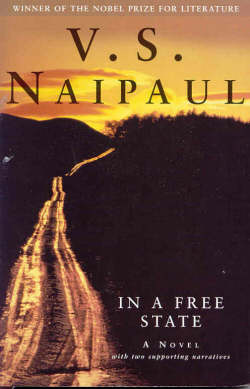
In a Free State


In a Free State
By V.S. Naipaul

(This blog post concerned the third (of three) and longest story in V.S. Naipaul's novel In a Free State. The first two stories concern third world immigrants to America and England respectively and are not discussed below.... just so you know)

I suppose you just had to be there.

That's how I felt about On The Road by Jack Kerouac. I suppose if I was young and savage and living on society's fringes in the 1950s On The Road would have been a virtual bible in my hands. But by the time I read it in my late twenties in 2004 it read like so much self-indulgent hippie drivel. So irresponsibly self-absorbed and frivolous. A precursor to the Woodstock generation. I suspect that a good portion of people under the age of 40 who claim to like Kerouac do so simply because they have been instructed to like it because, at one particular point in history, Kerouac was the epitome of cool.

As was Hunter S. Thompson. and although I actually enjoyed Fear and Loathing in Las Vegas, it didn't hit me the way it must have hit readers when it first appeared 30 years ago. The drug and alcohol fuelled mayhem of Thompson's novel has been repeated ad nausem by lesser writers for so long that going back to the original doesn't really cut it. I've also heard some people say the same for Catcher in the Rye, but I'm not having that. Salinger's novel is as relevant today as it ever was. And as long as there are kids falling through the cracks of the education system, it will continue to speak to generations.

1984 is another dated "classic." A scathing and terrifyingly inaccurate notion of a distopian future circa 1930. While I love old ideas of what the future holds (Metropolis, The Jetsons etc...), they don't hold up well in the common consciousness. I have no idea why 1984 is considered a classic novel. Animal Farm, sure. 1984? Never.

I suppose Orwell had all the reason in the world to believe that the world would turn out that way given the direction things were heading at the time of his writing 1984, but the book has not dated well. Turns out that Orwell's vision of the future has not come to pass and when I read 1984 in high school (in 1993, by the way) I was astute enough to tell my then English teacher, Mr. Switzer, that the book had long since passed its expiration date. Aldous Huxley was far closer to the mark with his idea of a world brimming with pleasurable distractions (Brave New World).

I guess you just had to be there?

The entire genre of colonial literature is another example of books I suspect would have been more poignant if I had grown up in that particular social environment. Since very few people of European and North American descent under the age of 65 still hold to the tenants of the "white man's burden," it is extremely hard for younger readers to connect with novels such as Joseph Conrad's Heart of Darkness or George Orwell's (Again! What gives, George?) Burmese Days. Most people simply don't see Africa and Asia in that same light.

This goes for V.S. Naipaul's Booker Prize Winning (1971) novel In a Free State which deals primarily with two acquaintances driving across a nameless African state (most likely Uganda or Rwanda) on the verge of a military coup against the Western-supported king. The vast majority of the story consists of conversations between these two characters, an aging colonel and an African named Peter, all of which deals with the the dying days of imperialism.

While certainly the problems that came with colonialism have not simply disappeared in Africa, the Middle East or Asia and certainly western country's have not simple "butted out" of their respective business, many of the attitudes of average Western people (especially among ex-pats living in said countries) has radically changed. Cultural relativism has replaced old colonial values among many Europeans and North American's living abroad. It seemed a little absurd to read a novel that was personifying the struggle between these two viewpoints.

But I'm no social or cultural anthropologist, so I'm not really interested in waxing intellectual on colonialism vs. cultural relativism. I am, however, a North American living (permenantly) in an Asian country I feel as though I have a valid opinion. Naipaul's novel seems as though it would have been a bombastic novel of vital importance when it was published in 1971 amid the burgeonining independence of dozens of states around the world but reading it today it seems to have lost it's cultural imortance, unless of course you are reading it as a piece of historical curiosity.

If so, it's worth a look, otherwise, In A Free State is, like so many other novels of their particular place and time, out of place in 2011.

Monday, April 4, 2011

Black Ajax


Black Ajax
By George MacDonald Fraser

I have a theory about sports movies. It goes like this: Sport, as a subject for a non-comedic film, rarely works. Sure there are all sorts of comedies about sports that entertain (Caddyshack, Happy Gilmore, Slapshot etc...) but when it comes to making a serious, poignant film about a sport, the pickings become fairly slim.

There are two exceptions to this rule, however: The first exception is boxing. For whatever reason, film has always been about to portray boxing with delicacy and humnity than, say.... bobsledding. Does boxing possess more pathos than bobsled competitors? Well, ok... bad example, but there is no shortage of great films about boxing: Raging Bull, Ali, The Hurricane, Rocky among dozens of others. I guess there is something about pummelling other humans within an inch of their life that makes for human tragedy as well as filmatic consumption.

(The other exception to the sport movie theory is baseball movies starring Kevin Costner. I have no idea why but baseball movies roundly stink and Kevin Costner is an unforgivably awful actor but when baseball and Costner are brought together, it's magic. But I digress).

I am beginning to wonder whether this theory may apply to fiction as well. Surely, there is no shortage of excellent non-fiction about sport. Some recent reads include Our Game by Ken Dryden (Hockey), Invictus by John Carlin (Rugby) and The Luckiest Man by Jonathan Eig (Baseball) all of which reduced me to tears, but the list of good sport non-fiction is longer than I care to type and I'm trying to get somewhere with this post, so lets just agree that sports are well covered in the non-fiction category, shall we?

Finding good fiction about sport is more difficult and usually relegated to the world of Young Adult Fiction. Here's why: The fun-loving loser (or team of losers) winning the championship works only if it's a true story. It comes across as a tired cliche if it is fictionalized. If there is an animal or alien or magician or magical alien animals involved in the winning of said championship all the more reason to not read it. With all due respect to the genre of young adult fiction, I'm not young. I want something a little more nuanced.

Black Ajax is that book.

I must admit, Black Ajax by George MacDonald Fraser is a bit like cheating to get an example of good sport fiction. First, it's historical fiction which immediately makes the story more believable since, you know, it actually happened, more or less. Second, it's about boxing which, as I mentioned above, makes for good human tragedy. Third it is about a particularly misunderstood era of the sport (bare knuckle boxing) and finally it is about Tom Molineaux, a former American slave and the first black man to challenge for the title of Champion of England. You simply can't make up a story that interesting.

George MacDonald Fraser is a scholar of Victorian England, its culture as well as its language and does a stunning job of chronicling the events of Molineaux's life leading up to his title fights with Tom Cribb through the voices of witnesses (trainers, former boxers, fellow slaves, sportswriters, his opponents and even the Prince of Wales) all written in painstakingly realisitic Victorian and pugilistic vernacular. A glossary is provided to translate the vast repitoire of slang used by the witnesses.

Black Ajax gives a stark and often grotesque account of the world of bare-knuckle boxing during the years of the Napoleonic Wars and the hold Tom Molineaux had over the sport for the year of two in which he was the talk of the Fancy (world of English Boxing). Fraser harsh narrative is in accordance with the views and prejudices of the time and the leading characters of the brutal sport. Reality is what a reader should look for in a work of historical fiction. In Black Ajax, the reader is provided with a wonderful example of how it should be written.

Highly recommended.

Friday, April 1, 2011

The Cider House Rules

The Cider House Rules
by John Irving

An open letter to John Irving:

Dear John,

Please excuse my sudden interuption of your highly successful career. I realize that an author of your caliber has very little time to answer open letters addressed to himself on random blogs scattered about the internet but if I could just ask you to put down that enormous bucket of money for a second and hear me out, I think it would do you and your readers a little good.

It's odd that I feel a little like your character Wilbur Larch who, in his ever-so-gradual descent into an ether-fuelled senility begins writing to President Roosevelt (and later Truman and Eisenhower) to plead his case for the legalization of abortion. Perhaps I should have begun this letter: Dear Mamie.

Ha ha. Just a joke, John. Just a joke. I'm not senile.

Not yet.

First, I must confess that I have not read a lot of your books. This is not entirely my fault, as you might not know. I don't often come across your novels in Taiwan (you should talk to your agent and publishers about that, by the way). But I did read A Prayer For Owen Meany way back in high school and recall enjoying it quite a bit.... High school, John. That was over 20 years ago. Jeez, we're getting old, huh?

I remember that Owen Meany freaked me out. Not the book, but the character. Can't remember why, though. I have forgotten most of that book.

Anyway, I just now got through your 600 page opus, The Cider House Rules. I want you to know, John, that I didn't enjoy this book and I want to tell you why: I can see by the clothes on your back and the bushel-full of currency you have at your feet that you must be doing something right. You don't spend your days unloading stacks of Benjamins if you're doing it wrong and who am I to sit here hunched over my keyboard in the early hours of an Asian morning to tell you otherwise?

(Benjamin is apparently a slang term for an American one hundred dollar bill, John. I just looked it up, Kids, these days, huh?)

Well, since you are still reading, I can only expect you want to know. It occured to me while reading The Cider House Rules that you have trouble commencing a book. It's lucky for you that I'm not the sort of person that puts a book down, John. It took me over 250 pages of random nonesense to get even a feel of where you were going. The story meandered around with no apparent sense of direction or purpose. It got so bad that I expected you to wax intellectual about a crowd of golden daffodils at one point.

Oh, it's not like I demand predictability from a novel. If you continue down this blog, you will see that I quite enjoyed the entirely unpredictable work of Kazuo Ishiguro and who doesn't like a good Kurt Vonnegut novel, hey John? Anyway, I certainly don't want to know the plot before it happens but I do want a book to catch my imagination before I am a full third into the reading. And since you're such a verbose and pleonastic fellow who often write books in excess of 500 pages, a third of a book is a hell of an investment to make just to get interested. It makde me wonder: Did you know where this book was going when you started it? Hell, there wasn't even a damned cider house until 300 pages in!

Wait, wait! I know you are checking your watch. I know you are thinking: I've sold millions of books, many of which have been made into movies that star Michael Caine and John Lithgow, why should I listen to the critique of one guy, living in the outskirts of nowhere, writing a blog read by the bare minimum of his friends and suffering from attention deficeit disorder.

Well, you shouldn't.

But, if it's all the same to you, I still felt it necessary to let you know, personally, why I didn't enjoy your novel (or, more precisely, why it took me 250 pages to develop even the slightest interest in the development of your characters, setting and plot). That's the sort of thing that makes me not want to read your other work, which will very marginally affect your vast and more-than-adequate income which, in turn, should be infintisimally disconcerting to you.

Sincerely,

Your Almost Fan
Ryan

Tuesday, March 22, 2011

Never Let Me Go


Never Let Me Go
By Kazuo Ishiguro

It's odd which books leave a permanent impression. I read great books that usually fade off into obscurity again soon after reading (Water for Elephants). Others I remember in bits and pieces. I can tell you the basic plot, maybe even remember a character's name or two and perhaps a few specific points in the narrative that I felt were particularly memorable (Shalimar the Clown). Still others are so terribly bad that I recall them simply because it offended my sensibilities so much (Twilight). Then there are the rarest books of all. The ones that leave an indelible mark. The ones that refuse to go away, even long after reading. These books simmer just under the surface and are always the first books I recall when people ask me about my favorite books.

This is not to say that these ARE my favorite books, but for whatever reason they have imprinted themselves onto my brain. Plot, tone, mood, characters, setting, pacing.... everything is right there for immediate recall as if I read them yesterday. But it's not fair to say they are necessarily among my favorites. Midnight's Children is one of my all-time favorite books but I struggle to remember the details (I should probably re-read that one one of these days) as is Creation by Gore Vidal but I don't remember them as well as say, Late Night on Air by Elizabeth Hay. Some books just won't go away. Here are the ten books that I recall vividly long after finishing them (note that many of these have very specific gimmicks. That probably says a lot about the sort of books I enjoy):

1. Barney's Version by Mordecai Richler
2. Cloud Atlas by David Mitchell
3. Replay by Ken Grimwood
4. Jitterbug Perfume by Tom Robbins
5. Fall On Your Knees by Anne-Marie MacDonald
6. The Time Traveler's Wife by Audrey Niffenegger
7. Catcher in the Rye by J.D. Salinger
8. Johnny Got His Gun by Dalton Trumbo (Chapter 10 especially)
9. The Wind-Up Bird Chronicle by Haruki Murakami
10. Breakfast of Champions by Kurt Vonnegut

Kazuo Ishiguro's Booker Prize nominated novel Never Let Me Go has all the criteria to squeeze onto this personal list. It is a haunting novel lush with details that makes the reader want to flip back to page one and start all over again immediately after finishing the last page. It's one of those books that I will forcibly foist upon friends when it is within my means. The fact that it does have a particular gimmick only adds to it's appeal for me.

Never Let Me Go is a sterling example of what can be done with science fiction in the hands of a talented novelist. I am not suggesting that Isaac Asimov or Ray Bradbury or the likes are bad novelists... far from it... but they were often limited by their genre. Ishiguro, like Margaret Atwood, is not strictly a science fiction writer and therefore brings fresh elements to the table. He applies a softness, compassion and, indeed, quirkiness to the genre that allows it to broaden it's scope without being weighed down by the conventions of science fiction.

Furthermore, Ishiguro is a writer entirely in command of his work. He leads the reader through his finely sculpted world one step at a time, opening the door a little at a time. Da Vinci Code Brown should take some notes. This is the way to write cliffhanger chapters. The revel is slow and methodical but at the same time relentless and tragic. Dan Brown has been wrongly commended on his talent to keep readers turning the pages. When you read Ishiguro you realize how clumsy Brown is as a writer.

I've often read books nominated for the Booker and thought to myself: "Who voted for this?" In the case of Never Let Me Go the question switches to "Who didn't vote for this?" No disrespect intended to the 2005 winner John Banville or his novel The Sea... until I read it, of course.

Sunday, March 20, 2011

Angela's Ashes


Angela's Ashes
by Frank McCourt

Look at me! I'm reading the most talked about book of 1996! Yes, I know my books aren't timely and most real readers have read what I read long ago, but please remember that I live in a place where access to English books is scarce and I am at the mercy of what I get from a variety of sources.

End of rant... on with the blog!

It's not that I didn't like Angela's Ashes. I did! I did! It's a searing yet heartbreaking memoir of childhood poverty in Ireland. Its themes of forgiveness and understanding and fragility are underscored by desperation and anger. It is a stark actualization of a specific period in Irish history and a brutal cross-section of life in the lanes. In short, it's a sublime piece of honesty.

But something troubled me about this book.

It's not that I didn't feel for little Frankie and his mother, Angela and all the kids (both living and dead). Every time Frankie's father didn't come home with the wages and the kids suffered from some class of hunger I would go to my own kitchen and marvel at my refrigerator and all the contents therein. Every time angela had to bury one of her kids i thought about how lucky my wife and I have been to have never experienced anything like that. Every time someone got sick with the consumption or typhoid I was thankful for my health benefits. I certainly wouldn't classify myself as a man living in the lap of luxury, but there is always food in the cabinets, money in the bank and time for the pint. Thank Jaysus!

It's not that I didn't enjoy the way Frank McCourt brought to life the abject poverty of Ireland in the 1930s and 1940s. His cast of characters from county Limerick are worth the price of admission from his hardened grandmother and Aunt Aggie to Uncle Pa, Theresa and his best friend Micky Malloy. I loved the way in which Frankie learns about the world by simply being in it and picking things up along the way. Felt bad about ll that Catholic guilt, though.

It's not that it wasn't well written. I enjoyed the childlike stream of conciousness and the way he wrote the entire memoir in the present tense so that we discovered his world along with him throughout.

I liked everything about this book. I thought it was one of the best books I've read this year and one of the best books (among many) that I have read about growing up poor in Ireland. There was just something off about the entire book. Something that, if left unresolved, was going to ruin any chance I would have of enjoying the book. So I sat down and thought hard until I figured it out: I've read this book before. No, not Angela's Ashes, specifically, but rather the story in general. Only the first time I read it it was called Paddy Clarke Ha Ha Ha and it was written by a guy named Roddy Doyle.

It's a memoir. I'm not questioning McCourt's authenticity. Once I figured it out, I finished the book happily and enjoyed every page. It's a good book. But I found it strange that Roddy Doyle and Frank McCourt's stories could be so similar despite Doyle's being older and a piece of fiction.

I know, I know... books about growing up poor in Ireland are a dime a dozen. James Joyce, Leon Uris and others have done that theme to death, but still... I am currently working on a theory that Roddy Doyle may be in possession of a time machine.

Monday, March 14, 2011

Three Day Road


Three Day Road
By: Joseph Boyden

Novels about World War One. Nothing like a book about a devastating human tragedy while watching another human tragedy play itself out on the news (My heart goes out to the people of Japan during this time of crisis). I know it's odd, but I like books about World War One for a few reasons. First, I studied history in college and World War One was always my favorite topic. Second, I've read so many WWI books that they are now a source of comfort for me (I know, men going "over the top" into a hail of machine gun fire is hardly comfort. I can't explain it). Third, I like novels about war.

Three Day Road is a worthy addition to any reading list. The two main characters, Xavier and Elijah, are James Bay Cree from Northern Ontario who spend their time in the bush hunting game and dreaming of their future. When they decide to march into to war for Canada, and into the world of the Europeans, in 1914, they have no idea what is in store. The novel explores the relationship between these friends as it tries to survive the scourge of war, death, tradition, modernity, history, and betrayal. The subplot involving Xavier's aunt, Niska and the story of the Windigo-killer is equally intriguing. For fans of Can-Lit, this is quite the novel. But then again, like I said... I like novels about war.

I like them so much I have actually taken the time to figure out which books I've read about war, what wars they were about and which one was my favorite. This is not an exhaustive list. I didn't include books about ancient battles (like the Iliad) or early medeival battles. Nor did I include non-fiction. I realize there are large, gaping holes in my reading so there is no need to tell me that I've never read A Farewell to Arms. I know. This is about war novels I've read to date. So without further ado, here are my favorite novels about war in chronological order by war:

The Hundred Year's War: Azincourt by Bernard Cornwell

Well, this one wins by default because, as far as I can tell, it is the only book about the Hundred Year's War that I have ever read so it goes without saying that it must be my favorite as well. But even if I had read more, I would suspect this one would be close to the top. Bernard Cornwell is an excellent writer of historical fiction.

Revolutionary War: Johnny Tremain by Esther Forbes

I was quite surprised to find out that Johnny Tremain remains the only book about the Revolutionary War that I have ever read. I racked my brain, scoured internet lists and looked through my bookshelves but as far as I can ascertain, it stands alone for the time being. It's a good book. So good, in fact, that they should have called it: Johnny Deformed.

American Civil War: Cold Mountain by Charles Frazier

With all due respect to the Red Badge of Courage, Frazier's novel about a Civil War defector walking home with the vague hope of seeing a woan who he had only seen once was infinitely superior. Frazier gave the reader such a poignant cross-section of America at the time, especially along the border states that Inman covers during the novel. The relentless tone of uncertainty and danger is underscored by such desperate hope. Wonderfully written.

Runners-up:

Lincoln: Gore Vidal
The Red Badge of Courage: Stephen Crane

World War One: All Quiet On the Western Front by Erich Maria Remarque

Having disclosed that I love books about World War One, you might assume that choosing just one favorite would be difficult but it is not. All Quiet on the Western Front is still, to this day, the only book I finished and began re-reading immedaitely. I've read this book more times than any other book (other than books I teach in the classroom, of course). It is simply the best account of the war I have ever read. It takes the reader straight into the trenches and holds no punches. The part in which Paul is desperately trying to survive a bombadment. He seeks shelter in an old cemetary and uses a disenterred coffin as a shelter against shrapnel. The image of re-killing the dead struck a nerve with me. Such a brutal, mechanical war that they had to kill individuals multiple times. This book deserves re-reads.

Runners Up:

The Wars: Timothy Findley
Johnny Got His Gun: Dalton Trumbo
Generals Die in Bed: Charles Yale Harrison
Storm of Steel: Ernst Junger
Three Day Road: Joseph Boyden
Old Soldiers Never Die: Frank Richards
Mrs. Dalloway: Virginia Woolf

World War Two: Catch-22 by Joseph Heller

There is no book published before or since that captures the absurdity of war as Catch-22. A bomber pilot named Yossarian needs fifty missions to be grounded but each time he approaches that number, his superiors increase it by five. He is at his wits end and wants out of the war. He learns of a loophole in which a pilot can be permenantly grounded if he is certified crazy by a doctor. But crazy men don't know they are crazy. Any pilot that visits a doctor and claims to be crazy must, logically, be perfectly sane. Since a man can only be deemed crazy via a visit to a doctor, it is categorically inpossible to be grounded. This book went a long way toward changing public opinion on the military-industrial complex and the image of the military. Black comedy gold.

Runners Up:

The English Patient: Michael Ondaatje
The Book Thief: Marcus Zuzak
Slaughterhouse Five: Kurt Vonnegut
Don't You Know There's a War On?: avi
Famous Last Words: Timothy Findley
A Day in the Life of Ivan Denisovich: Aleksandr Solzhenitsyn

Vietnam: The Sorrow of War by Bao Ninh

Talk about hopelessness. This novel written from the perspective of a North Vietnamese soldier fighting against the Americans in the dense rain forests of Central Vietnam is bone-chillingly bleak. I read this book while I was in Vietnam (my second tour... 2004) and it offered a perspective on a war that is overwhelmingly told from the American side. The abject fear that Kien lives with from start to finish humanizes the otherwise voiceless veterans of the Vietnamese army.

Runner Up:

The Quiet American: Graham Greene

Sunday, March 6, 2011

A History of Violence


A History of Violence
By John Wagner

I didn't see this film last year when it came out, which is odd because I love David Cronenberg and violent films. But then again, it isn't so odd when you think about where I live (the east coast of Taiwan) and the selection of films that makes it to my culture-deprived corner of the planet (Hollywood blockbusters and romantic comedies). So when this graphic novel was passed on to me last week I was keen to give it a read.

Living on the east coast of Taiwan provides the bare minimum of western culture. If you don't actively seek it out via the Internet you can easily miss entire years of music, film, television and books. While many of those mediums are well provided for on the internet (I am a big fan of The Big Bang Theory, I loved True Grit and my favorite semi-current band is The Dead Weather) you learn quickly to make amends by reading and absorbing every book that comes your way. Unless you are hip with the Kindle (I'm not), books are the cultural medium most hard to come by round these parts.

But all is not lost. There is a really voracious local reading population that is constantly bringing in new books via online shopping, trips to Taipei or abroad, packages from home or the vast social network of English-speaking people in Taiwan. So over and above the books I accumulate myself, I am always getting something placed in my hands and I'm never want for a book. A History of Violence was leant to me by a friend and co-worker who picked it up at the Taipei Bookshow. I'd have never read it otherwise.

But beggars can't be choosers. I'm always astounded when I'm back in Canada when I walk into a Chapters or Indigo (or any bookshop for that matter) how easy it is to find exactly what you want to read right now. You want to read about 19th century gravediggers? Sure, right over here. The history of the coffee bean? that's over there next to books about the Franco-Prussian War. A biography of Frances Farmer? You bet! After years of reading what I have rather than what I want, I find that sort of choice overwhelming. In my first week back in Canada I invariably find myself whimpering for hours in the literature M-N section at Chapters, a stack of twenty books scattered on the carpet beneath me.

That's not to say the books I read are bad. A History of Violence was damned good! My books are rarely up to date. I doubt I'll read the Booker Prize nominated books for 2011 until well into 2014. But I read a lot of stuff I wouldn't have read back home, which I think, in the long term, is actually good. I would have never, ever read Peter Pan back home. Nor would I have bothered with anything by Margaret Atwood (I've made my peace with Ms. Atwood), Natsuo Kirino, Robert McCammon or Neil Gaiman all of which i have enjoyed. I find my lack of choice in reading material a satisfying lack.

It was this lack of choice that I began hoarding books. Not to keep to myself, but to develop an English library for the 100 or so English speaking foreigners living in my town. Over the past year I have amassed over 700 books for anyone in town to borrow at their leisure. We still don't have much recent stuff, but it is well represented and there is something there for vitually anyone looking for a book to read. It expands on the charity of those in the community who would like to help see the library grow (and from a few overseas donations that have been very, very well recieved.

So here's to the ongoing community of readers on the east coast of Taiwan. We continue to pass books around and ensure each of us has something to read. In a place like this, if you don't work at it, you lose it, and that would be a shame.

The Face of Battle


The Face of Battle
By John Keegan

John Keegan is essentially the alpha and omega of military history between the 14th and 20th century and virtually the god of all writing concerning World War I (well, at least in my eyes) so I was excited to get into this book. I know how pathetic that sounds. I was excited to get into a book about military history. What can I say, I'm a nerd for this stuff.

The Face of Battle is an in depth look at three defining battles in the history of warfare (and more specifically, British warfare): Agincourt, Waterloo and Somme. Rather than sticking to the tried and true historical tradition of recounting the battle, movements and tactics, Keegan attempts to delve into the humanity of the chaos. He spends a lot of time on the battlefield attempting to give the reader a sense of the emotions and psychology of soldiers and officers in the field as well as the aftermath and clearing of the battle field in the days following. A real left turn in terms of traditional military history, especially in 1976 when this book was first published.

The Face of Battle is an up and down affair. Chapter One deals with a lot of historiography which, even for the most avid devotees of history, can be tedious reading. Historiography is a very important study, but one that attracts the bare minimum of fans, even among history nerds so it took me a while to trudge through this morass. But once Keegan settles into the three battles proper it begins to roll forward with a momentum that rarely lets up. This momentum is primarily due to the increased amount of source material available to Keegan as he makes his was from Agincourt (1415), tthrough Waterloo (1815).

Agincourt is particularly worthy of note in that King Henry's withered and starving army could defeat the mammoth (for the time) French juggernaut. I read an exceptional piece of historical fiction called Azincourt by Bernard Cornwell that covers a lot of the salient points of this battle. It was interesting to see how closely the Cornwell's fiction mirrors historical accuracy. And while Keegan's treatment of Waterloo is even more detailed, my distaste for all things Napoleonic had me nodding in and out of interest. But the chapter on the Battle of the Somme (1916) is Keegan at his absolute finest.

I've always been a World War I buff and John Keegan is the best writer on the subject, bar none. So it was no surprise that the chapter devoted to Britain's failed Battle of the Somme was the highlight of the entire book. It is a real treat to listen to Keegan dissect the battle and its implications on the the soldiers, the officers and the psyche of a nation. You can practically smell the trenches, hear the continuous ballast of the week long bombardment, feel the crippling anxiety of the soldiers about to go "over the top" and the abject horror of No Man's Land. Never mind the nightmares experienced by the soldiers that survived and the imagined terrors of those who did not.

In the end, the Somme cost Britain 60,000 souls (21,000 in the first hour of the battle). The mind boggles at the catastrophic (and senseless) loss of life. Keegan handles the subject to deftly. For me the entire book culminated in a passage as sublime (if a little melodramatic) as any that appears in print concerning the butchery of World War I. With apologies to Paul Fussell, this is Great War history at its pinnacle. Allow me to quote it here, word for word. It's worth it:
Accounts of the Somme produce in readers and audiences much the same range of emotions as do descriptions of the running of Auschwitz - guilty fascination, incredulity, horror, disgust, pity and anger - and not only from the pacific and tender-hearted; not only from the military historian, on whom, as he recounts the extinction of this brave effort or that, falls an awful lethary, his typewriter keys tapping leadenly on the paper to drive the lines of print, like the waves of a Kitchener battalion failing to take its objective, more and more slowly towards the foot of the page; but also from professional soldiers. Angeris the response which the story of the Somme most commonly evokes among professionals. Why did the commanders not do something about it? Why did they let the attack go on? Why did they not stop one battalion following in the wake of another to join it in death?
If only I had the ability to write half as well as that about history. I'd be teaching it at a post-secondary institution somewhere rather than blogging my opinions about Keegan's work into the electronic void.

Anyone with a remote interest in military history should read this book, if they have not already. It goes a long way toward understanding the way pitched battles work and what it might be like to be involved in one. Probably the closest I'll ever get to an engaged battle and, judging by Keegan's words, that's close enough.