Sunday, June 12, 2011

People of the Book


People of the Book
By Geraldine Brooks

This isn't a great book. It's good, but not great. It's uneven, sometimes uninspired and its characters are often un-engaging. Some bits have all the drama of a visit to the Pottery Barn on a Sunday afternoon. I'll get to that in a moment, but first I want to defend this novel against a critical travesty. People of the Book, despite what critics would lead you to believe, is not The Da Vinci Code. So I find it unfair to see this novel being compared incessantly to a lesser novel everywhere I look. Even a friend of mine who saw the book sitting on the table when we met earlier in the week noted that it was an academic's Da Vinci Code, a comment that made my head hurt all the more. First, because a friend who espouses critical thinking was echoing back a comparison that has been made ad nauseam throughout the literary world and second, because if this is what passes for academic literature, we are in for a bumpy ride.

As far as I'm concerned, the fact that both People of the Book and The Da Vinci Code are slightly less-than-average historical fiction is the beginning and end of the comparison. If that were enough to merit comparison why not Gore Vidal's Lincoln or the collected works of Bernard Cornwell or Ken Follett? Why? I'll tell you why... because they are all different! That's why!

Whereas the Da Vinci Code is a crap pseudo-history of the Catholic Church, its marginal weirdoes, Gnostics, creepy Freemasons and virtually every other dusty European secret society mentioned in Foucault's Pendulum trying to pass bad fiction off as solid history (or at the very least conspiracy theory on a millennial scale), People of the Book is a pretty honest attempt at a fictionalized history that remains within a manageable time frame and nothing more. While it often fails, it doesn't do so on the scale of the Da Vinci Code.

People of the Book examines the possible history of an illuminated 14th century Jewish manuscript called the Sarajevo Haggadah, a very real and very famous codex. Scholars agree that the book was copied and bound in Spain somewhere around 1350 and has spent the past three quarters of a millennium avoiding destruction at the hand of the Inquisition, Nazis, the Ustache, Tito, the Bosnian War and various other European catastrophes that have made Europe so popular. It is a literary survivor if there ever was, and the people of Sarajevo (rightfully) have a great sense of pride in this particular manuscript. Here. Take a look. It really does have striking illustrations:


Brooks' novel examines the possible history of the book as it travels from Spain to Bosnia (via Italy) over the centuries. The over-arching story unfolds as an infuriating Australian book conservator is called in to do some work on the recently rescued (from the Bosnian War) manuscript. She happens to find several interesting things hidden within the pages (an insect wing, a wine stain, crystalized salt and a white hair). Each of these things is a catalyst for an ever more intriguing history of the book that continues to reach backward in time to its earliest days.

Brooks' fictionalized history of the book is interesting and a wonderful insight into the life of Jews and Muslims in Christian Europe during the late Medieval period, through the Renaissance and into the Modern Era. The contemporary story ties the histories together (that of the grating Australian book conservator and her even more grating mother). It is so painful to read, I found it hard to get to the next bit about the actual book. That's how much I didn't care about Brook' protagonist.

I like the idea of using a modern story to stitch the history together. It has been done well in other books and I suspect will continue to be done well in books in the future. It is, however, very important to make the over-arching story interesting enough to carry the novel. Since the reader will not revisit the characters involved in the history of the book, it's important to make us care about the contemporary characters.

This is where People of the Book ultimately fails. Hannah Heath is as interesting as warm milk and her globe trotting dramas involving her family history, a slightly swarthy Bosnian lover with a dying child, an auto accident and her relationship with her beast of a mother completely miss the mark. It all plays out like a bad weekday soap opera, which only serves to trivialize the rich history Brooks is trying to illuminate. Her modern day characters do nothing to honor Haggadah and its ability to survive the centuries. Perhaps if Brooks had concentrated on one of these elements rather than trying to accomplish too much, too fast, this could have been a great book. It's a shame, too. The history of the codex is wonderfully rendered and left me doing a bunch of research on the manuscript. If only her modern characters could carry that feeling.

I can see where the comparisons to Dan Brown's book come from, but they don't really stand up. People of the Book is a slow-paced account of a possible history of a single book. there are no conspiracies. No Freemasons. The papacy doesn't get involved. People of the Book actually has a few compelling characters and, unlike The Da Vinci Code, Brooks has the capacity to bring history to life, something Dan Brown only wishes he could do. While I won't go out on the limb and recommend People of the Book, I won't condemn it either. It has its moments and sometimes a few moments is all a book needs.

Tuesday, June 7, 2011

Dead Famous


Dead Famous
By Ben Elton

According to Ben Elton, England is going down the tubes and it's all reality television's fault. Once a proud nation that resolutely stood up to the Nazis during the Battle of Britain and stared imminent annihilation in the face with cool determination and a stiff upper lip. British men were made of moxy and steel and their women, well, they were made of moxy and steel, too! Winston Churchill defiantly proclaimed that:
"We shall fight on the beaches, we shall fight on the landing grounds, we shall fight in the fields and in the streets, we shall fight in the hills; we shall never surrender."
Immortal words from one of the great modern statesmen. Britain would stand proud for another thousand years thanks to Churchill's (and Britain's) resolve.

Just a half-century later and we have an entirely different generation with entirely different values and an entirely different vocabulary. It's probably worth lamenting, if it weren't so damned funny. In Dead Famous, Ben Elton's highly improbable, post-post-modern novel about a preposterous reality television program, characters have insanely amped up names such as Woggle or Gazzer or Moon, probably don't know where to buy Winston Churchill brand cigarettes if you asked them and speak like this:
"Woggle, he da man! Da top man. Respect! But the whole show is totally wicked, so fair play to all the posse in the house. Kelly's my girl, Oojah, Oojah!"
There's a lot in that quote I really don't understand. I can't imagine that anyone, anywhere actually talks like this, but if there is, I never want to meet him or her. Call me old-fashioned, but I prefer eloquence.

Now, I should have known I wasn't going to like a book that featured characters with names like Woggle or Gazzer or Moon, especially one that centered on a third-rate reality game show called House Arrest. I despise reality TV with a passion and have never understood people's fascination with such thinly-veiled voyeurism. But, I persevered and, at the end of the day, I actually enjoyed this book for what it was, and that what it's all fookin' about, inn't? Respect!

So what gives?

I suppose the reason enjoyed this book is that it was such an over-the-top parody of reality television and didn't attempt to squeeze some sort of moral or philosophical point out of what is, ultimately, an extremely hollow genre of entertainment. I mean, anyone who stops to consider the social and cultural implications of reality television is simply going to think themselves into a considerable headache and be nowhere closer to a solution than they were an hour previous. It's lowest-common-denominator television and anyone who argues otherwise is delusional or simply dim.

Had this book taken itself even a little seriously, it would have fallen flat on its face. Instead Elton carefully portrays each of the "housemates" as the cardboard cut-outs they are: The boozer, the struggling actor looking for a break, the quiet doctor who is trying to blend into the surroundings. the lesbian, the manipulative and money-grubbing producer, the bitter evictee, and the smelly hippie anarchist that endears himself to the public. Elton's characters have about as much depth as a puddle. There are no subtle personalities and no extended networks of friends or family (only those relevant to the plot). Each character is no more than the sum of their parts as they appear on television. Single-serving characters as Edward Norton might say.

When a murder is introduced to the plot (something that would obviously send a REAL reality show to a screeching, lawsuit-addled halt), the already absurd cast of characters is thrust into improbability hyperdrive that includes attempted suicide, and a kick-boxing Irish lass. I mean, what's not to like? Had they added a fifty-foot giant iguana that terrorized London I wouldn't have batted an eyelash.

Add the impossible circumstances in which the murder takes place (in an enclosed environment littered with cameras that document the happenings in literally every corner of the house) and give each and every "housemate" a motive for killing the victim (some very flimsy motives, I might add) and you've got yourself an enjoyable, if ultimately pointless read. The wonderfully pyrrhic conclusion is worth the price of admission alone. It was so unnecessarily convoluted that I had to read it twice and it still made my head hurt, but who cares? It's reality television literature which means it's like the junk food of fiction. I'll feel bad for a few hours after finishing the book and forget the entire thing by next week (unless of course I descend into a downward spiral of junk food books and choke on my own vomit).

For the one or two people who read this blog on a regular basis, you might ask: "Why give Dead Famous a pass and Henry's Sisters such a colossal fail?"

Well, my dear reader, it was all about delivery. While Cathy Lamb wrote with all the sincerity in her entire body and failed, failed, failed, you get the impression throughout Dead Famous that Ben Elton is simply taking the piss out of our modern culture (or lack of culture). As is mentioned before if at any point in this book had Elton waxed intellectual on the state of modern pop culture and the decline of Western civilization you would be reading a blog post akin to Henry's Sisters. As it stands, he didn't and the book is every bit as vacant as you would expect. It's the difference between Zoolander and It's Pat: The Movie. One is so stupid it becomes smart parody, the other is simply stupid. There is a fine line and one that is not easily explained. I would suspect that the people who cannot tell the difference between parody and stupid are also fans of reality television.

Anyway, I've wasted enough time on this book. Let me give a closing example to prove my point about stupid-turned-funny. At a crucial point in the book when the remaining non-murdered "housemates" are sitting around chatting about God, one of the characters spews this thought-provoking sound bite of wisdom:

"I'm quite interested in Eastern religions. For instance, I reckon that Dalai Lama is a fookin' ace bloke, because with him it's all about peace and serenity, ain't it? And at the end of the day, fair play to him because I really really respect that."

Take away the annoying Britishisms and you have a Hansel quote, right there. That's comedy gold, right there, Jerry!

Wicked!

Friday, June 3, 2011

Just So Stories


Just So Stories
By Rudyard Kipling

People never ask me: "What do you use for a bookmark," but they should. It's an interesting question. One that deserves some thought.

Since moving to Taiwan nine years ago I have tended to use people's name cards. In Taiwan, name cards are serious business and everyone falls all over themselves to give you theirs. So I've always got a handful of ideally sized paper rectangles in the pocket of my pants waiting for something to do. And since I don't often pick my teeth with them, bookmark is a perfect job. While I usually favor my wife's name card (they are most readily available to me) I am currently using a friend's card. She makes women's jewelry. Since I am never going to be her target market and I could never pick my teeth with it, I figured her card acting as my current bookmark is the highest show of support I can give her. Being my bookmark is an honor.

But I have not always used name cards. In my younger days I tended toward folded lined paper, Post-It Notes, photos, bank books and unpaid bills. In my more desperate hours I have been known to use TV remotes, pens, my wallet, foreign currency, keys, photographs, a cell phone, tissue or even other books. In a pinch, virtually anything that within reaching distance will do so long as it is of a certain size, and dry. Someone will be along shortly with a name card and I can return to normalcy.

I have, on occasion, owned actual bookmarks. Some were promotional materials for new releases when I worked in publishing, others were more finely crafted bits of art. I once was in possession of a leather bookmark with my initials engraved on a gold plate near the top. It was a gift from my great aunt... one I wish I hadn't lost. I would never pay for a bookmark as a luxury item. Like pens and CDs, bookmarks exist to be lost. The world is just too full of things to mark your page.

I have never been a fan of turning the book upside down on a table. I believe that flipping a book ages it prematurely and I'm not interested in the systematic destruction of literature, thankyouverymuch. Furthermore, if you leave a book in that state too long, it develops an affinity for that particular page and it's hard to train that out of a book, especially if you crack the spine.

As for dog-earring, I'm of two minds. A dog-eared book looks well-read, but too many and it makes the book look unnecessarily ragged and worn (or ends up looking like a research book for a doctorate candidate). One has to treat a book well on its journey through life lest it end up in a recycling bin long before it should. Dog-ear with caution.

In conclusion, what I use for a bookmark is an interesting topic. Far more interesting than Rudyard Kipling's almost unreadable collection of Just So Stories. If you are desperate for something of this nature, and I can't see why, read Aesop's Fables.

Thursday, June 2, 2011

Every Man Dies Alone


Every Man Dies Alone
By Hans Fallada

"Would you rather live for an unjust cause than die for a just one?"

Every Man Dies Alone is Hans Fallada's extraordinary novel of crippling repression, resistance and the triumph of life in Germany under Nazi rule. It follows the compelling story of Otto and Anna Quangel, an aging couple whose only son has been unceremoniously killed in France early in the war. In response to their grief, they begin to write anti-Nazi postcards and drop them around Berlin. Although this is a work of fiction, this novel is based on the true story of Otto and elise Hampel who committed similar acts of civil disobedience and were executed in Plotzensee Prison. Italian chemist (and holocaust survivor) Primo Levi called Fallada's book: "The greatest book ever written about German resistance to the Nazis."

Concurrently, the novel follows the antics of several characters inside the Gestapo as try, fail, continue to fail and then ultimately succeed in solving the case. While the story of the Quangels and their circle of everyday Germans is interesting, I found the murderous and petty machinations of the Gestapo far more riveting, especially knowing that these monsters agents will eventually get their culprits and the fear that goes with not knowing exactly what they will do once they get them.

In discussing the Third Reich it is so easy to lose site of the fact that there existed a large population within Germany who actively plotted against the Party from distributing anti-Nazi leaflets to harboring their Jewish friends and neighbors.

Before I get to my more philosophical musings on this subject I should review this book a little. If you are looking for some light summer reading, pass this one by. I was glad that the weather remained gloomy and cold while I read this book, otherwise it would have really brought me down. Every Man Dies Alone is one of the bleakest books I have ever read. Along the lines of Cormac McCarthy's The Road, Alexandr Solzhenitsyn's One Day In The Life Of Ivan Denisovich and George Orwell's 1984, Every Man Dies Alone starts off bleak, remains bleak and ends on a sad note. However, along the way there are glimmers of hope and, like I mentioned before, the triumph of the human spirit.

To say that this book deals with some weighty issues is an understatement. To say that this book, first published in German in 1947 (not translated to English until 2009), has little value upon readers in 2011 is categorically false. I found that this book spoke to me in a way that many other books with similar themes have not. Through its bleak, hopeless tone, Hans Fallada speaks a message through the generations and, if anyone is listening, it could very well save us a repeat performance of these historical shenanigans.

When I started this book, I was caught up in a discussion over Facebook about the usefulness of conspiracy theories and whether or not their vocal and ofttimes obfuscating manner was not perhaps a detriment to a large cause of change and social justice. Whether a horde of people yelling often nonsensical theories perhaps clouded issues that might otherwise gain more tread in this world. I wasn't speaking against freedom of speech (I would never, ever do that), just the jumbling of messages that could be something more fluid, more tangible, more cohesive. Millions of voices screaming billions of theories seemed counter-productive against an establishment with one common, conservative and potentially dangerous voice.

After reading Fallada's novel and delving into the tyrannical fear of Nazi Germany, I think I may have changed my tone on this point. Shouting from the rafters is exactly the sort of thing we should all be doing, and often. Silence is equal to support. If you don't speak out when you have a chance, what will you do when you lose that chance? This is the sort of stuff we as citizens of this world are dealing with every hour of every day.

Got a problem with your leader? Do something about it. Dislike the environmental practices of a local industry? Make it known. Think someone in a position of power is lying to you? Call them on it. Sitting idly by and saying things like: "That's somebody else's problem" is exactly the sort of attitude that allowed for the emergence of the Nazi State in Germany and, given that Adolf Hitler is poised to exit from our collective consciousness in the next generation or so, this sort of rampant, oppressive power is very much ripe for a return. Question everything. We owe it to ourselves.

For Otto and Anna they began their revolution far too late but at least they had the guts to do something. Far better people did far less. They realized an inherent truth about their government at a time when doing even the smallest act against the state meant death not only for them but also for anyone associated with them. In a climate of crushing fear it's a wonder that people had the courage to do even as little as the Quangels. Far more simply kept quiet and hoped and waited for it all to end.

There is so much to gain from reading Every Man Dies Alone. This should be required reading for any student of critical thinking.

Silence can be violence.

Tuesday, May 24, 2011

Scar Tissue


Scar Tissue
By Anthony Keidis

I've never been a rabid fan of The Red Hot Chili Peppers. They've always inhabited a peripheral position among my record collection. I own a copy of Mother's Milk, Blood Sugar Sex Magic and One Hot Minute, but none of them have ever gotten heavy rotation on my stereos over the years. The problem being that, in my mind, the Chili Peppers are masters of the single but struggle to compile enough material to produce a competant album. The closest they came was Blood Sugar Sex Magic, but even that is a struggle to get through in one sitting.

So I was a little apprehensive about reading Anthony Keidis' biography, Scar Tissue. Couple that with my reservations about reading rock and roll biographies about known drug addicts and you have a very reluctant reader. But it came highly recommended, so I gave it a whirl. Since I went in with no expectations, I would rate the experience of reading Scar Tissue as good overall, but just barely.

Turns out Anthony Keidis is either one of the most genuine souls in rock and roll or his years of relapses has turned him into one of the best smooth-talkers in the business, able to sell ice to an Eskimo. While I was rooting for the former throughout the book, by the end I was fairly convinced of the latter.

The first third of the book chronicles Keidis' turbulent childhood straddled between Michigan and California. Growing up with his drug-dealing father exposed the young Anthony to a bevvy of sex and drugs at a very young age (and no small amount of jealousy from this reader). As with virtually every rock and roll biography, this is by far the most interesting part of the book. I had no idea that Keidis was essentially living with Sonny Bono through his junoir high school days.

The second third of the book chronicles the formation and emergence of the Red Hot Chili Peppers on the L.A. punk scene in the early 1980s. I liked that they defined convention at the time and played a unique brand of funk in a scene dominated by glam metal and to hell with what the scene dicatated. The rise of the band co-incides with Keidis' descent into the world of heroin and cocaine addiction, which, as I have written before, is such a cliche it's almost boring if it weren't about the very real suffering of a human being. Before he finally kicks his habit (for the first time) prior to recording Mother's Milk the book reads like "Knock Me Down" on perpetual repeat.

The segment devoted to his first clean stint (the time period between the recording of Mother's Milk and the end of the Blood Sugar Sex Magic tour) is also a fun read. Keidis is a bit of a world traveler and I enjoyed is recollections about trekking through Borneo, touring Japan and his irrational and incomprehensible love for New Zealand.

It's when Keidis relapses for the first (of too many to count) times that this book derailed. I hate to complain about the narrative of a biography, but the story went from slightly repetitive to a broken record of scoring drugs, driving to a motel and getting high for a few days then flying somehwere warm, weaning off the drugs, playing a few gigs, attending to a few responsibilities, repeat. I'm not kidding, this formula went on for over 200 pages. In the meantime people were born, people died, he changed girlfriends and guitarists more often then I change my underwear and his band recorded two albums.

This is not to say that the book was without merit. In fact, I found myself revisiting a lot of Chili Pepper albums while reading this book. While I still maintain that they have never recorded a great album, I had forgotten how good many of them were. Also, I found that I had never really given them thir place among the great rock and roll acts of all time, which they most certainly are, if not in the studio, certainly for their brazen live performances. I was especially pleased to not that Keidis wrote specifically about a show in Toronto that I attended in the late nineties (a free show at the corner of Yonge and Dundas). That was kinda cool.

Also, the first half of the book was devoid of that smarmy self-help remorse that so many former addicts have. He's recollections of a childhood and early adulthood consuming drugs and playing rock and roll were entirely without regret or remorse. I liked that he could look back fondly on a time he would not necessarily like to revisit rather than spent that portion apologizing to everyone and their brother about the pain and suffering he put them through. That makes great psych couch conversation but terrible reading.

But the book ultimately falters. It was when the 12-step philosophies began to creep into the narrative that things really took a turn for the worse. While the recollections on band life, touring and his travels remained fun to read, his intellectual musings on the nature of addiction and healing got nauseating (granted, I have never had a heroin problem so who am I to talk). Lots of new-age, self-help mumbo-jumbo and psuedo-religious ramblings that only served to prove that his years of drug intake had done their best on his brain.

As I mentioned to the guy who leant me the book, you can't help rooting for Anthony Keidis throughout the book. He seesms so genuine. Each time he cleans up you are hoping it will be his final detox only to have him disappoint you time and again. But the end when he (supposedly) cleans up for the last time, I could barely manage to feel anything for a guy who had thrown away so many chances.

Anthony Keidis is a really lucky man. Not because he is the frontman of one of the world's most successful rock and roll outfits, although that is certainly pretty cool. He's lucky because he has continuously been surrounded by people that never gave up on him. Despite lying, cheating and abusing them, his family, friends and bandmates never abandoned him. Considering his behavior over time, he should count himself blessed to have a support network as dedicated. If only he was that dedicated to himself.

Scar Tissue. It's the One Hot Minute of rock biographies. Full of promise, an all-star cast, some really, really spectacular moments, but in the end fails to inspire much beyond a curt nod to say, "Yep. I've read that now. What's next?"

Friday, May 20, 2011

6 x H


6 x H
By Robert A. Heinlein

I think I know who Robert A. Heinlein is. I'm onto him. He wasn't who he said he was. Oh, I'm sure he believed he was who he said he was, but I think he was something a little more. Something a little more culturally relevant. Something more literary that he ever acheived during his own life. Something intangible. More on this in a few paragraphs.

Originally published under the name The Unpleasant Profession of Jonathan Hoag, 6 x H is a little book of six short stories by legendary science fiction writer Robert A. Heinlein (a man best known nowadays for having written Starship Troopers but back in the day he was considered to be one of the three best sci-fi writers in the world along with Isaac Asimov and Ray Bradbury although that meant virtually nothing outside the realm of sci-fi, of course). The centerpiece of the book is a novella also named The Unpleasant Profession of Jonathan Hoag which was originally published in Unknown Worlds Magazine in October 1942 under the pen name of John Riverside (don't ever accuse me of not bringing the facts!). The other five stories are considerably shorter and, on the whole, great deal better.

The stories in this collection are an eclectic mix. They run from abysmal (Our Fair City and They) to excellent (-And He Built a Crooked House- and The Man Who Traveled in Elephants) to the absolutely sublime (-All You Zombies-). -All You Zombies- is one of those rare sci-fi stories that has you guessing right until the end and even when the story is revealed you feel the need to go back and read it again to make sure all the pieces are in place (they are). It will find a place among my favorite short stories of all time.

But don't assume I'm an expert on this subject.

It has only been in recent years that I have discovered old science fiction as a genre. It probably started a few years back when I finally discovered Kurt Vonnegut (my introduction was via Breakfast of Champions and I have subsequently read everything he has ever written except God Bless You Mr. Rosewater) I then revisited Ray Bradbury's excellent collection of short stories The Illustrated Man, a book I was forced to read in high school English and enjoyed a lot more as an adult. This lead me to Fahrenheit 451 and then a glut of Asimov, Jeff Noon, Arthur C. Clarke, as well as Ken Grimwood (Replay is still my favorite sci-fi book of all time).

I can't profess that I am a sci-fi aficionado, but I suppose I have read more than your average reader. I read Heinlein's short novel Methuselah's Children last year and while it didn't blow me away, it was good enough to merit a second book. Heinlein is a master of hanging on, in my opinion. while 6 x H wasn't the best thing I will read this year, it was certainly good enough for me to read one more. But something about the stories really rubbed me the wrong way.

The problem I have with old science fiction stems from my first reading of Breakfast of Champions and Vonnegut's recurring character of Kilgore Trout. Trout is a widely published writer of science fiction but he is only published in pornographic magazines. Trout himself doesn't even know how many stories he has written, and yet there are readers who obsess over his writing.

I got a Kilgore Trout vibe while reading Heinlein's stories and it occurred to me that Kurt Vonnegut may have modeled the eponymous Kilgore Trout after Heinlein. Heinlein was nothing if he was not prolific. Certainly, Heinlein's stories have an absurd quality that matches Trout's. And clearly Heinlein's stories were published in some fairly dubious publications. Heinlein was writing at least a full decade before Vonnegut put pen to paper and while I don't dismiss that idea that Kilgore Trout is a composite of all science fiction writers of the era if you follow Heinlein and Trout's career trajectory from Breakfast of Champions through Timequake you find that while never cracking the mainstream literary world, Heinlein, like Trout, gained a modicum of respect at the end of his career.

Which then begs the question: Is Robert A. Heinlein the real Kilgore Trout? If so, how much of Kurt Vonnegut's career is owed to the career of Robert A. Heinlein? It's an idea that niggled its way into my head while reading but hasn't had time enough to ferment. More on this as I continue to read.

Tuesday, May 17, 2011

Flashman


Flashman
By George MacDonald Fraser

I didn't know it when I started this book but if there was going to be one novel to snap me out of my current reading funk (two atrocious books in a row, by God!) it was going to be a book about the legendary reprobate, Harry Paget Flashman.

For those not in the know (and I counted myself among you only one short week ago), Harry Paget Flashman is the bully from Tom Brown's School Days who was expelled from Rugby for public drunkenness. For over a century, this was virtually all anyone knew about Flashman until his papers were supposedly discovered in Ashby, Leicestershire in 1965. Flashman (the novel) is the first in a series of novels that expose the true fate of that famous drunk via his long lost diary.

If Holden Caufield was literature's first true anti-hero then Flashman is anti-heroism personified. A coward, lecher, bully and cheat, Flashman stumbles, bumbles, rapes and fumbles his way from Rugby to the 11th Hussars regiment, through Scotland, then India, Afghanistan and, ultimately home again. In the process he manages to seduce his father's mistress, cheat his way to fame in a dual, dishonor and subsequently marry the daughter of a Scottish industrialist, buy and sell a Hindu slave girl, run afoul of virtually every Pashtu tribesmen in Afghanistan, get tortured, narrowly (and unwittingly) escape death on more than a dozen occasions and finally become an undeserving hero and meet Queen Victoria herself. And he would have sold his grandmother at any point along the way to assure his own success.

What's not to like?

In the tradition of Colonial-ear adventure novels of the 19th and early 20th century, Flashman takes the reader on a wild ride that never lets up even for a second. As he commits one atrocity after another, looking out for absolutely nobody but himself, the reader finds himself mysteriously rooting for him to succeed at every turn. Perhaps it is his status as cowardly underdog in a world of grizzled, well-bearded British military men. Flashman is to the British Empire what Shaggy was to Fred, Velma and Daphne. Even his most heinous crimes afford him success.

But what sets this novel apart from a simple Empire adventure story is the way Fraser places Flashman square in the middle of historical events, especially those surrounding the First Anglo-Afghan War of 1839-1842. Flashman is surrounded at all times by very real historical figures who played very real roles during the war and in the novel. From Robert and Lady Sale, Akbar Khan, William McNaughten and Alexander Burnes. In fact, Burnes' assassination plays a major part in the narrative of the story. Even a young Queen Victoria holds court in Flashman, bringing the circle of relevant historical figures full circle.

Placing a dramatic yarn into the fabric of real history is a difficult proposition. Adding a despicable character as unfathomably likable as Flashman takes a lot of skill. And considering Flashman was published in 1969 I can only wonder where he has been all my life.

Wednesday, May 11, 2011

Henry's Sisters


Henry's Sisters
by Cathy Lamb

Sweet merciful Jesus, it's rare that I read a book that not only sucks but also unleashes the full force of my ire and disgust. Alas, Cathy Lamb has written such a book. A book so mind-numbingly bad that I came within a camel's hair of putting it down (something I have not done with a book in almost five years). A book so poorly written that I actually read several reader reviews before I sat down to write this, thinking that I could commiserate with other readers about a book that just might be the worse thing I have ever read (and I've read Twilight).

Imagine my shock and horror when I discovered that Henry's Sisters seems to garner favorable reviews around the net. Goodreads, Amazon and Visual Bookshelf readers all seem to like it well enough, which made me check my medicine cabinet to see whether someone has been slipping me crazy pills again. Rest assured, they have not.

The atrocities committed by Cathy Lamb are so extensive that I have spent the last 300 pages (of a 400 page book) mentally cataloging them. I should have written them down because I fear I have forgotten so many that I will not be able to express my loathing in as much detail as I would like, but I will try. I figure the best way to organize this is with a simple list, beginning with:

1. One dimensional characters.

Christ Almighty, this pissed me off by the end of chapter four. Cathy Lamb writes characters like George Lucas creates a planet. Like Lucas' one-climate planets, each character in this book is characterized solely by his/her one defining quirk. Isabelle is a slut. Cecilia is fat. Janie is obsessive compulsive. Momma is cruel. It's as if these (cartoon) characters exist only through their one (and only, mind you) idiosyncrasy. None of these characters ever do anything beyond the bounds of this one, single attribute. By the end of the book when I should have been crying, I could only imagine cardboard cutouts of these characters being moved around on a cheap soap opera stage.

2. Constant reminders of one dimensional characters.

Cathy Lamb does not think much of her readers. I know that writing teachers will always tell a burgeoning writer to "assume your reader knows nothing." But there are limits to this. Lamb reminds me of Isabelle's sluttiness, Cecilia's eating and Janie's compulsions on EVERY PAGE OF THE BOOK! Holy hell, woman, I got it! Mentally disabled Henry is the only sane person in the Bommarito family. I can handle that. No need to hammer it into me every seventh sentence!

3. Characterization of men

This has bothered me in other books, but none more than this one. Aside from Henry (and he's mentally disabled, remember?) all the male characters in this book either rape, abandon their family, cheat, lie, mass murder, say impossibly insensitive things, act like a raging idiot or (just to mix it up) a combination. I'm not anti-feminist or anything, but c'mon! Some of the men in this book were about as intelligent as Curly from the Three Stooges. Great if you are writing absurd comedy. Absurd if you are trying to write great drama. When the only male character written with any compassion is mentally disabled (in case you forgot), perhaps you are trying to send a subtle message?

4. The dialogue is impossibly bad

Seriously. Lamb tried to write witty arguments between these sisters but it invariably sounded like the sorts of arguments that six year-olds have over who's father can beat up everyone else's. Case in point:

"Your momma's got good tits," he told us, smirking, when Momma was out of earshot.
"And you have a small dick," I told him. "Flaccid. Weak."
"And a fat ass," Janie added. "Like blubber cannons. I'd like to chop them off with a hatchet."
"Are you related to a pig? Your nose, it's amazing," Cecilia said. "Piglike. Snort for me, would you, you ugly pig?"

Who talks like that?

5. Mentally disabled people and Vietnamese people speak the same.

Guess who is mentally disabled and who is Vietnamese...

A) "I no take a second. I no want a shot."
B) "I no understand. Your face... Ah Isabelle."

6. The litany of tragedy

I wonder whether this may be Cathy Lamb's last book. I say that because she seems to have tried to squeeze as much tragedy into 400 pages as is humanly possible. Rape, murder, Vietnam flashbacks, cancer, death, abortion, family dysfunction, homelessness, cruelty toward the disabled, messy divorce, serial rape/murder, psychological disorders, abandonment, prostitution etc... etc.... etc.... I know this book is supposed to be about the triumph of the human spirit and the importance of family but jeez, Louise, save an issue or two for your next book, would ya?

7. Telegraphing the reveals

I can visualize Cathy Lamb sitting at her computer (or typewriter or whatever) thinking to herself: "Oh man, when my readers find out the truth behind this deeply imbedded plot tidbit, won't they be surprised. What she fails to understand is that her well-placed clues are dead giveaways for what is coming, which really takes away from the enjoyment of the book when you know exactly what's coming in a couple of dozen pages. The white haired man in the street was really their long-lost father? Imagine!

8. Blatantly obvious statements

Such as: Pancreatic cancer are two words you never want to hear.

You don't say....

9. Thinly veiled devotionalism

This is what really galled me. About halfway through the book I realized that I was reading Christian literature. I knew there was something askew, much like when you realize that the sort-of-good-but-kinda-odd rock you were listening to was actually Christian Rock. This is a novel akin to The Shack, a book I read and detested last year. Which, come to think of it, would explain all the positive reviews this book seems to get online. This is the sort of book that is read by a very specific slice of the reading public. People who are shocked by graphic language and sexuality. Readers who identify with one-issue people because they are one-issue people themselves: Christians.

Anyway, There are a host of other, lesser reasons that this book sucked, I feel like I've wasted enough time and words on this disaster of a novel. I wouldn't recommend this book to my worst enemy. Don't bother.

Friday, May 6, 2011

The Butcher's Boy


The Butcher's Boy
By Thomas Perry

Warning: Pretension and snobbery ahead. Proceed with caution.

The Onion's A.V. Club has a great column called The Box of Paperback Book Club where writer Keith Phipps reviews the 75 paperbacks he acquired via a cardboard box he found at a local thrift store. Most of the books are old trade paperbacks in the genre of science fiction, crime and adventure (some of which is X-rated). I thought the idea was ingenious. Reading and reviewing a box of random castoffs from a suburban household. From Heinlein to obscure curiosities of the era. All the books were published between 1960 and 1980 and I would imagine a great deal of it has gone out of print.

It was in the spirit of The Box of Paperbacks Book Club that I picked up The Butcher's Boy by Thomas Perry. An only slightly better than average crime novel about a nameless hit man evading both the mafia that wants him dead and the federal agents who have picked up his scent. The book was published in 1982 and obviously predates personal computers. It is strange to read a crime novel where characters cannot simply do their research online and have to leave contact numbers with people so that they can call each other later to compare information. No wonder the hit man has no trouble evading everyone. Aside from the dated references, it was about 15 pages into this book when I realized that Keith Phipps has his work cut out for him.

As Thomas Perry established his predictable characters, my mind began to wander from the story toward Phipps, bad fiction and the sordid world of mass-market paperbacks. What got me thinking was this: How many books like this exist? I'm talking supermarket check-out fiction. Slapdash stories that read like bad movies with worse actors. Predictable novels where the reader has things figured out a couple of hundred pages before the end of the book. Mass market paperbacks for housewives and commuters. Words for a TV generation. More bluntly: crap.

How much crap is published and where does it all go?

If there are 1000 publishing houses in America and Canada (An absurdly safe guess) each publishing an average of 1o mass-market, point-of-purchase novels per year (again, an absurdly low number), that equals 10,000 of these sorts of books hitting the (super)market each year! And I'm low-balling these numbers! I know these numbers are far larger than simple 10,000. Assume that these books have been published since the days of dime-store novels and we are talking of a staggering number of awful books.

Who buys this stuff? As the Perry's story introduced characters and sub-plots only to kill them off willy-nilly, I thought about the publishing industry a little more. Consider that when I worked in publishing (in the 1990s) the common statistic bandied about that was that 90% of all books were bought by 25% of the total population. Let's assume this is accurate, or at least close to accurate. That means 75% of all people (in North America of course) don't buy books, which presumably means they don't read many books either. Fine. That means that 25% are responsible for the purchase off ALL books from Charles Dickens, J.D. Salinger and Joseph Conrad to Dan Brown, Mitch Albom and Sophie Kinsella.

Frightening.

Given that a disproportionate amount of the publishing market is inundated with trade paperbacks a la The Butcher's Boy, we can assume that a large portion of that 25% are buying on the lower end of the quality scale. Which means that a great number of book buyers are buying their reading material from supermarkets, drugstores and gift shops.

This is highly depressing. As I continued to read about the exploits of Elizabeth Waring and her struggle to be respected in the man's world of the Justice Department, my mind descended even lower through the depths of the publishing industry.

Where does all this garbage go? As the nameless assassin wreaked havoc throughout Las Vegas and Cleveland and all points in between as if Perry was making the story up as he typed, I thought long and hard about where this stuff goes. Well, I can account for one copy of Thomas Perry's The Butcher's Boy (and I didn't pay for it, I assure you) but what about the rest? The rec rooms, garages and attics of this planet must be teeming with bad fiction, right? Well, there is probably a lot of these books around, substituting for missing coffee table legs, holding down important bills or killing innocent insects as they cross your kitchen counter. But not as many as you might think...

If a bookstore does not sell a book over the course of a year they can sell it back to the publishing house at list price. Many literary failures end their writing careers with their novels collecting dust in a publisher's warehouse, never even getting a sniff at a second printing. This is the fate of the vast majority of everything published. In the case of mass market paperbacks, which constitute the largest branch of non-educational publishing, the stores don't even have to return the book. They simply tear off the covers of the books and return those for the full cost of the book.

That's right. Mass-market paperbacks aren't even worth the paper they are printed on. That must be a humbling thought for authors who specialize in the genre. I wonder if anyone has ever bothered to ask Maeve Binchy her thoughts on that matter? Or Keith Phipps, for that matter. The majority of books are nothing more than a mediocre doorjamb or paperweight. You can learn everything you need to know about the book from its cover, which is, ironically, the most valuable part of the entire novel.

Which gets me back to The Butcher's Boy. Perry finished the novel with enough loose-ends and questions to fill a sequel (that was never written) and leaves the reader entirely unsatisfied. with the resolutions. But what more was I to expect from a novel like this? While this particular, full-intact copy of Thomas Perry's novel has somehow traveled to the farthest reaches of the planet where English novels can be found, it is still not worth the paper it is printed on. It's a good thing I have a coffee table in need of leveling. Methinks this book is going to find a second life after all.

As for me, I have reached my yearly quota of mass-market paperbacks. I cannot fathom the idea of making my way through 75 Thomas Perry novels in a row. It seems like an exercise in self-hate.

Good luck to you, Mr. Phipps. You have earned my respect and sympathy.

Tuesday, May 3, 2011

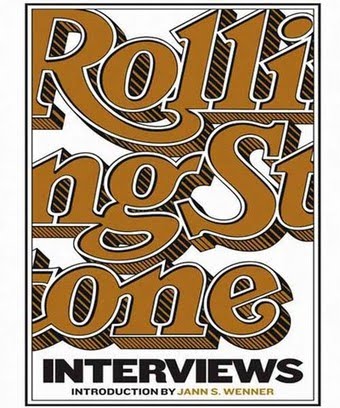
The Rolling Stone Interviews


The Rolling Stone Interviews
Edited by Jann S. Wenner

Before I get into this, I want to note that I really did like this book. As an entirety, it's a good read and I blasted through its monstrous girth in three days. I don't want the rest of this blog post to sway anyone from reading The Rolling Stone Interviews. It is very, very worth it.

This book made me feel old. Allow me to explain in a slow and convoluted way.

Growing up, I was obssessed with rock n' roll. Not so much with the cult of personality that surrounds the genre, although that was part of it, but rather with the virtually instantaneous legend-generating power it carried over to its performers. I liked the fact that stuff I was listening to went from obscure to relevant, then iconic then legendary, often in the span of a single calandar year. It's a fun process to watch from the sidelines. I always wondered what it would be like for the performers.

And, of course, I really dig music. Still do.

I never really got into the People Magazine side of the equation. Who was screwing who, what band was suing what other band and what sorts of drugs so-and-so was using at the Grammys last night. That stuff didn't concern me nearly as much as the music and the energy it conveyed. Who cares what Kurt Cobain thinks or does? It's all about the guitar riff, It's about the lyrics. It's about the rock. I would like to assume I was too punk-rock for all the other nonsense, though, if I'm honest, I know I wasn't. I was simply nose deep in Michael Creighton novels and Martin Scorsese movies.

So it was interesting to find The Rolling Stone Interviews fall into my lap a couple of weeks back. I'm certainly not insinuating that Rolling Stone Magazine is akin to People Magazine but I never read either growing up. I was blissfully unaware of the personal lives of most of the bands and musicians I enjoyed. I wasn't entirely ignorant, but the details simply didn't interest me at the time. So this book was a revisitation to my music-listening past from a different perspective.

The book itself is an anthology of dozens of interviews ranging back to the beginnings of Rolling Stone Magazine in the mid 1960s and includes interviews with everyone from Jim Morrison in 1969 to George Lucas in 1977 to The Dalai Lama in 2001. It is organized in chronological order so once I got into the interviews conducted after 1980, it was fun to watch my childhood pass as I was reading the chronicles of the stars.

Many of the non-musical interviews proved to be quite interesting. I really enjoyed reading the interviews with Bill Clinton, Johnny Carson, David Letterman and Bill Murray. Other interviews were captivating because Rolling Stone chose an unorthodox interviewer. Andy Warhol with Truman Capote, Robert Palmer with Eric Clapton. But the vast majority of the musician interviews read like laundry lists of petty disputes, drugs and personal problems leaving me wanting to slap the Holden Caufield out of them all.

The fundamental problem with rock and roll interviews is that when you get down to it, rock stars are as humdrum as lawyers, teachers or doctors. Oh, they think they are different (in the case of John Lennon... he knows he's a genius). But when you begin to read these accounts of their lives they all begin to sound oddly consistent.

They have gone from struggling musician (and have you ever talked to one of those? Yeesh!) to ultra-famous and mega-rich, pretty much overnight. And each of them from Pete Townshend to John Lennon to Axl Rose to Eminem answer questions as if they were the first musician in the history of the world to encounter troubles in the trappings of fame. Don't these guys read Rolling Stone Magazine? Didn't they ever listen to The Wall? Or Bob Seger's eponymous hit Turn the Page? It's hard no to notice the droning pattern.

This is a generic sample of the sort of answer you get from (insert name of famous musician here):

"I hooked up with {insert name of mildly famous session musician name here} in (insert the name of American or British city here). We decided to crash at {inesrt hip record company exec name here)'s house for the night. We ended up staying there three weeks tripping on acid and peyote, shooting guns and playing old {insert name of eccentric musical style here} records. It was a wild time, man. We shared something real. The (insert decade here} were a truly magical ride."

Seriously, when did being a rock star become so boring. From Pete Townsend to Eminem and virtually every pop star in between was like reading the same interview over and over. From complaining about singing the same songs night after night to to battling their heroin addictions to dealing with their "personal demons." It's all such a stereotype.

This isn't to say there weren't some really interesting bits. I quite enjoyed reading about David Letterman's friendship with Johnny Carson and Bill Clinton's musings on the evolution of the "Don't ask, don't tell" policy. Jack Nicholson's philosophies on monogamy were a riot, Truman Capote and Andy Warhol were hilariously pretentious, and Tom Wolfe is fascinating.

Nor is it to say that there aren't any musicians with something interesting to say. Patti Smith, Mick Jagger and Leonard Bernstein deliver eloquent interviews that delve a little deeper into the music and the creative process. Perhaps it has something to do with their ages when they were interviewed. Each of them had been in the industry for over two decades once they sat down with Rolling Stone.

Which gets me back to the thesis of this entire blog post. The book made me feel like an era had passed in my life. These guys (Ozzy Osbourne, Kurt Cobain, Neil Young, Eric Clapton, Jim Morrison etc...) who I idolized so much when I was younger just turned out to be snivelling, whiny kids with too many toys and not enough friends. Who really wants to read an interview with a kid with very little of anything to say other than how many drugs he took last weekend? Perhaps to many this isn't such a momentous realization but for me, someone who didn't read the gossip rag side of the music indusrty until recently, it has really spilled the smack out of the plunger.

Ironically, it is old man Mick Jagger who puts it so succinctly when he says:

"I think it's very important that you have at least some sort of inner thing you don't talk about. That's why I find it distasteful when all these pop stars talk about their habits. But if that's what they need to do to get rid of them, fine. But I always found it boring."

Amen, Mick.

Of course, egoism is not nearly enough to devalue the wonderful music many of them made. I will simply go back to listening to the music and turning a deaf ear to their nonsensical ramblings. It only reenforces my opinion of recluses. The less you speak, the more you say.