Friday, March 23, 2012

Welcome To The Monkey House


Welcome To The Monkey House
By Kurt Vonnegut

Interesting. I just finished Welcome to the Monkey House. Two books ago I read Ape House. This is all part of my challenge to read books that refer to primates (other than humans) in some way. Next up: The History of the Decline and Fall of the Roman Empire by Edward Gibbon. It's all opposable thumbs, all the time here at My Life in Books!

OK.... anyway...

Sitting down with a Kurt Vonnegut book is like easing back into your favorite chair to watch your favorite movie while eating your favorite snack food. After months of treading new ground, it's nice to sit back with something familiar. Something unsurprising and solid. Kurt Vonnegut (along with Tom Robbins and Salman Rushdie) are my Rushmore. They are my chicken soup for the reader's soul. They are my safety reads. Goto novels when I feel like I need a refresher on where I came from. I love to revisit these guys and I do so often.

All this revisitation is a bit of a Catch-22, though, because at last count I only have three more novels left before I have read Kurt Vonnegut's entire bibliography. With Robbins, it's one, with Rushdie, it's two. For as much as I read, I have never finished an author's entire career's work (well... except Harper Lee). And while I will be left with collections of short fiction, essays and opinions for all three authors once I complete their bibliographies, as Welcome to the Monkey House shows, this shall be problematic.

Welcome to the Monkey House is one such collection of Vonnegut's early short fiction that I can only assume was published in what he refers to in Breakfast of Champions as "beaver magazines"(actually, after a cursory look on the Wikipedia entry for the collection, most of these stories were first published in reputable sources such as Collier's, Ladies Home Journal and Esquire, but let's not mess with a good story). The stories are predominantly science fiction, although some decidedly not. As with most collections of short stories, the content of Welcome to the Monkey House is uneven. Granted it's the sort of uneven work created by Kurt Vonnegut, which means it's good. But it's still uneven.

Personally, I enjoy Kurt Vonnegut's more traditional science fiction over anything else. Science fiction was the genre in which Vonnegut rarely failed. This turned out to be true on this collection as well. I most enjoyed a story entitled "The Manned Missiles" (1955) in which the father of the first Soviet man in space writes a heartfelt letter to the father of the first American man in space. Their boys' missions, which culminated in each of them dying in space due to the aggression of their respective nations, culminates in a detente between America and the Soviet Union and hints at the end of the Cold War. The story has both heart and social relevance (at least on the date of publication). Furthermore, this story has relevance considering its optimistic view of the future. Many Vonnegut critics have accused him of being overly pessimistic.

The title story, "Welcome to the Monkey House" (which, incidentally is the only story in this collection actually published in what might be construed as a beaver magazine... Playboy) is the centerpiece of the entire collection. It explores the subject of sexuality and overpopulation. In an effort to de-populate the planet people have willingly been robbed of their sexual urges. Furthermore, people are encouraged to visit government sponsored suicide clinics where they are eased off this mortal coil by suggestively clad virgins. When she encounters a Billy the Poet, a man who has not ascribed to the new system, she is shown the nature of this life, which she deems "pointless."The story is rife with sexual and moral tension and is perhaps one of the best stories of Vonnegut's career.

In another excellent story Vonnegut lays out a story about Thomas Edison and his dog that may or may not be a lie to get away from an annoying small town story-teller. In another Vonnegut elaborates on one woman's pathological obsession with home renovation. In yet another he tells the story of the first computer to express human emotions and how it falls in love with a woman.

But there are a few stinkers in the mix here (and no Kilgore Trout anywhere in sight). Like the rockets on the early space program, some of these stories just never seem to get off the ground. They all have that signature Vonnegut style but just don't seem to get anywhere. As one would expect from a collection of an author's early work, the stories read like a young writer trying to find his voice. As a devout reader of Kurt Vonnegut, it was a pleasure to read the trajectory of his young writing and see the origins of the more mature writer that would emerge in the ensuing years. In that sense Welcome to the Monkey House is just as much a piece of literary history as it is a collection of short fiction.

But if you are new to Kurt Vonnegut, I would recommend you pass on this one for the time being and start somewhere more conventional: Breakfast of Champions or Slaughterhouse-Five. As for me, I'm coming full circle. It's just about time I begin my way through Kurt Vonnegut's titles for the second time.

So it goes...

Saturday, March 17, 2012

The Colony of Unrequited Dreams


The Colony of Unrequited Dreams
By Wayne Johnston

Seems fitting that I sit here writing this particular blog post on St. Patrick's Day, three beers into my evening while listening to traditional Celtic folk music. While this novel has little to do with Ireland or the Irish, it does have everything to do with another island that was predominantly colonized by the Irish. Newfoundland owes much to Irish culture and although the cultures are unequivocally unique, they retain many similarities, none of which I'm going to explain here. I just wanted to make note of the fact that the date works well with the blogpost. That doesn't happen all that often. Anyway. I'll be keeping you updated on my beer consumption throughout this post. Hopefully my spelling, diction and clarity do not suffer more than they usually do. Once this gets posted, I promise I will not edit it.

Fourth beer.

Full disclosure: One side of my family is fiercely Newfoundlander (not Newfie, thankyouverymuch) and although I have never been to Newfoundland (one of my life's great regrets thus far) I feel like there is a part of me that belongs on the America's easternmost outpost where, as the saying goes, the trout are easier to catch than tuberculosis.

I grew up in the shadow of "Down Home" via my grandparents (displaced Newfoundlanders living "away" in Toronto) who retained their uncomplaining Newfoundland character, their barometer on the wall and their thick pea-soup accents (my Grandfather, Cornerbrook... my grandmother, Greenspond, both locations are mentioned in this book, by the way). While they were not nationalists of any sort, there always remained within them a real sense of where they came from. Newfoundland was never far from any topic of conversation in my family growing up.

I vividly recall discovering my grandfather's Newfoundland flag in the basement of their Toronto home when I was about 11 years old. I'd never known anyone in my family to own a flag and it's beautiful colors were too much for a young boy to leave unmolested. I pulled it out of its hiding spot and brought it to my grandfather to ask what it was. My grandfather was a gruff man. Over the years, my mother and aunt had alluded to the full tilt of his legendary temper, but I'd never seen it until that day I stood in his kitchen, Newfoundland flag dragging through the grime on the kitchen floor. It was a roar that would reduce the toughest men to tears. Mercifully, I never saw it again. Needless to say, Newfoundland was in my grandfather's blood.

Fifth beer.

Most people know that Newfoundland became Canada's tenth province in 1949. What few people remember is that Newfoundland was briefly, like Texas, an independent nation. From 1907 through 1932 Newfoundland was the "other" North American nation. However, the depression hit Newfoundland hard and in 1932 amid a litany of scandals and economic disasters Newfoundland was forced to re-colonialize with Britain (The only instance in history of a nation willingly reverting to a colonial state) until such time that it could sustain itself. When the time came, long-time Newfoundland politician Joey Smallwood championed the notion of confederacy with Canada. After a heated referendum (Smallwood championed confederacy), Newfoundland narrowly decided to throw its hat in with Canada. To this day, Joey Smallwood remains a controversial figure in Newfoundland.

The result is that Canada gained and retained a nation that it did not understand and Newfoundland joined a country that it also did not understand. Seventy years on, and Newfoundland is still considered part of and distinct from Canada. The province that doesn't quite fit the mould. One can lump the provinces into groups. The Western Provinces, Ontario and Quebec (those age old enemies) and the Maritimes. Newfoundland alone stands alone with its odd time zone ("Hockey Night in Canada. Game starts at 7:00pm. 8:30 in Newfoundland). Newfoundland is different.

Sixth beer.

The Colony of Unrequited Dreams is also different. It a strange sort of historical fiction. It centers on the life and times of the aforementioned Joey Smallwood, champion of Confederation. It chronicles his life from poverty in a St. John's slum, through his short stint writing for a socialist newspaper in New York to his return to Newfoundland and his improbable rise to power via the Liberal Party of Sir Robert Squires and, subsequently, his adoption of confederacy with Canada in 1949. From an historical perspective, Colony of Unrequited Dreams is fascinating to anyone interested in Newfoundland history.

The novel takes the form of a lifelong dialogue between Smallwood and a fictional journalist named Sheilagh Fielding and an ambiguous relationship between the two (along with a third fictional character named Prowse). Most of the novel is written in the voice of Smallwood though Fielding's journal entires and chapters from her Condensed History of Newfoundland are interspersed though out the narrative.

I thoroughly enjoyed the sections that dealt with his fictional characters, particularly Fielding (although I must make mention of Johnston's hilarious characterization of Joey Smallwood's father). Fielding is the most compelling character in the entire novel and remains so throughout. It's the character of Joey Smallwood that left me feeling a little nonplussed. Despite being the primary voice of the novel and the most active historical figure in the book, he comes across as a bit of a milquetoast, unsure of himself (and often petty) that it becomes impossible to believe that a man of his sort could possibly rise to the become Newfoundland's first Premier (a position he would hold from Confederation in 1949 until 1972).

Seventh beer.

Perhaps Johnston, a native Newfoundlander, felt constrained by the notion of fictionalizing such an important figure in the history of Newfoundland. Certainly it can't be easy to fictionalize the life of a man still very much in the realm of the collective consciousness. It would be like writing a fictionalized account of the presidency of Ronald Reagan during which he was maintaining a clandestine relationship with Katherine Hepburn. Although Joey Smallwood retired from politics before I was born and died when I was still in high school, from what I understand of the man, he was a political idealist. A man of big ideas and big dreams. None of that character comes out in Johnston's characterization, and I think the overall story suffers as a result.

The Colony of Unrequited Dreams is by no account a bad book. In fact in many respects (historical, social, literary) it is Wayne Johnston's opus and worthy of a read, especially if you enjoy Canlit and/or anything to do with Newfoundland. I just can't abide cardboard characters, especially one that I think deserved a bit more love and attention. It sort of feels like Johnston is dragging Smallwood's personality across the floor of my grandparent's kitchen. Good thing my grandfather ain't around to see this, Johnston. Good thing, indeed.


OK, time to go pass out. 


Sláinte.

__________

Canadiana Addendum...

This is a Canadian novel and thus must be put through my patented CanLit Test.


These are the 11 scientifically chosen questions that determine how Canadian a novel (in this case The Colony of Unrequited Dreams) really is. This is science, people... pay attention!:


1. Novel set between 1900~1945.
Yes. Almost exclusively.

2. Novel is set in/on a small town/island/northern settlement.
Newfoundland is indeed an island.

3. Novel involves a strong/complicated/deranged female protagonist on a journey of self-identification.
Sheilagh Fielding.

4. Novel involves one or more conservative/despicable/sexually deviant men.
You bet. Smallwood's father, Hines, Fielding's Father, Prowse, Reeves.

5. Story involves one or more hard-boiled sidekicks.
Fielding is the very definition of hard-boiled.

6. Story involves an unwanted pregnancy/abortion/infant mortality.
Um..... yes.

7. Story mentions the Dionne quintuplets/Edward's abdication/Vimy Ridge.
Much discussion of World War I. Yes!

8. Story involves a major snowstorm.
Of course. What we in the rest of the world would call the "end of the world," a Newfoundlander calls.... rain.

9. Story contains mild to overt anti-Americanism.
Just a smidgen.

10. Story explores multiculturalism.
No.

11. Story contains mild to overt anti-Religion themes.
Oh boy, yes!

The Colony of Unrequited Dreams gets 10/11 on the My Life In Books CanLit Tester. 'Oly 'Thunderin' Jesus, 'tis a dory'ful o' screech, bye.

Sunday, March 11, 2012

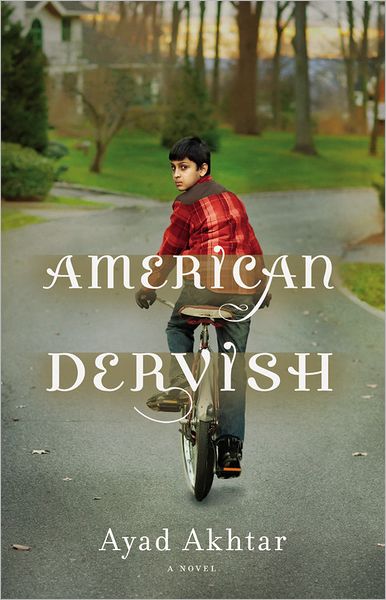
American Dervish


American Dervish
Ayad Akhtar

What follows is definitive proof that my Kindle was money well spent.

I listen to Fresh Air on NPR while I run. I find that it's more interesting than music and a great way to stay informed about cultural, political and social issues while sequestered in one of the most out of the way places on the planet.

A few weeks back, Terry Gross (my favorite radio host) interviewed Ayad Akhtar about his new novel American Dervish. I was intrigued by the premise of the book but, like most things I hear on Fresh Air, I filed it away in my brain. A week later, I read a rave review of the novel in The Atlantic. Two mentions of the book in a week coupled with my weakness for novels with strong religious themes sent me racing to Amazon.com to purchase the book for my Kindle.

Before my Kindle I would have had to wait until A) Someone brought the book to town and saw fit to lend it to me B) I went to Taipei and, with any luck, happened to see it in one of the two English bookstores in the city or C) Asked someone from back home to buy it for me and send it overseas. Option A is a crapshoot, option B happens about three times a year and option C is rarely, if ever, invoked for fear of inconveniencing anyone back in Canuckistan.

For the first time in a decade I have the power to read books that are current (aka published in the same calendar year as I read them) and comment on actual trends as they happen as opposed to years later. For me, the Kindle isn't so much a neat toy in which to download novels and save money and paper, it has rendered me relevant for the first time since 2002. For that I am grateful.

Now, onto American Dervish.

American Dervish is a poignant novel about growing up Muslim in the American midwest (Milwaukee, to be specific). The narrative follows the early adolescent years of Hayat Shah, the impressionable (and repressed) son of a successful, areligious Pakistani-American doctor and his wife. While life in the Shah household is far from perfect, it is turned upside down with the appearance of Mina (a friend of the family escaping an abusive relationship in Pakistan) and her some Imran. Mina presents Hayat with his first Quran and proceeds to instruct him on the nature of Islam, and encouraging him to become a hafiz, one who knows the Quran by heart. What follows is a spiritual awakening (of sorts) within Hayat that skirts dangerously close abject racism and extremism.

I have read other books that have had Muslim protagonists (though, I admit, not that many) and, for the most part, Islam is treated with a degree of respect and awe. I've not come across a lot of novels that have really tackled some of the more nefarious aspects of the faith. While there are literally thousands of novels that question (and even berate) Christianity, I have found that most novels about Islam tend to handle the subject with kid gloves (non-fiction is a different story, of course). Mercifully, American Dervish is not guilty of such evasiveness.

Maybe I haven't read enough novels about Islam but I have read The Satanic Verses. Salman Rushdie has been living in hiding for decades due to what he wrote about Islam in his 1988 novel and I didn't think it was anywhere near as inflammatory (for Muslims, I presume... not me) as American Dervish. I cannot pretend to know much (anything) about the modern Muslim-American experience but Akhtar does not paint the brightest picture. In fact, this book can be quite bleak in its portrayal of Muslims in America (and Muslims in general). Akhtar spends a lot of time discussing the clashes between old world and new world interpretations of Islam which is the root much of the conflict in the book.

At points in this book the author seems to seethe with anger and frustration at the Muslim community in America and raises some pretty provocative questions about racism toward Jews, women's rights, Sharia Law and contradictory Quranic scripture. In the novel, Hayat's father in particular spits vitriolic venom at the established Muslim-American community and their apparent herd-like mentality. But the novel stops short of descending into a acrimonious anti-religion diatribe. Behind the anger and disappointment there is a genuine feeling of warmth and affection for Islam and a real desire to raise questions about the modern nature of a very old religion. It's a testament Akhtar that he can walk the line between disloyalty and fidelity to the faith that has remained under the social and political microscope for over a decade.

I'm not going to lie, although this book is highly entertaining, it is difficult to read in places. There are some real uncomfortable moments when the reader is expected to check their judgmental self at the door and admit to themselves that they cannot understand the cultural mindset (unless, of course, you are a Muslim and have read this book. Then perhaps you could enlighten me as to whether this is an accurate depiction of the Muslim community in America. Obviously I have no idea). Furthermore, I found that more than once I felt as if Akhtar is treading water in the narrative, unsure of where to go next. There is an uneven feeling in the story that bogs it down in places.

But none of this should dissuade you from reading this novel. I think this novel and its over-arching themes were a long time in coming. In a world that has spent a lot of time and energy pigeon-holing and vilifying Islam, it's high time a novelist took it upon himself to spend some time navel-gazing the tradition and its position in the modern world. In 2012, it is refreshing to see a novelist that is prepared to embrace the often contradictory nature of Islam and examine the persistent tensions that arise within the community struggling to reconcile old world tradition in the New World.

As for me, I'm feeling refreshed as well. If for no other reason than I might be ahead of the reading curve for the first time in a decade.

Tuesday, March 6, 2012

Ape House


Ape House
By Sara Gruen

(Mild spoilers ahead)

Ah, the airport thriller. There's nothing quite like a novel about a plucky journalist who uncovers a nefarious plot while his/her personal and professional life is crumbling all around. These sorts of books are usually described as "gripping," a "wild ride" or "compelling." Not that there's anything wrong with airport thrillers, mind you. I've been known to be compelled into the grip of a wild ride from time to time, but I was a bit surprised to find that Sara Gruen, the author of Water For Elephants, had written one. And as it turns out, it's better than most.

To be frank, I was ready to hate this book after the first 100 pages. It all seemed too absurd. Too Cathy Lamb. The novel centers on a troupe of highly intelligent bonobos living in a research lab who are able to use sign language to communicate with humans. Their closest human friend is a woman named Isabel. Isabel is socially awkward and feels more at home with the bonobos than she does with other humans. Her fiancé was recently put in charge of the research and is immediately introduced as a creepy slime ball who has cheated on her with Isabel's only other friend: a hip, vegan, Lisbeth Salander-esque character named Celia.

Meanwhile, John, a down on his luck journalist from the Philadelphia Inquirer has been working on an article about the lab for an on-going piece about great apes, though his partner, an unscrupulous tiger woman aptly named Cat has been scooping his story from underneath him. John's wife, Amanda, is a struggling writer with the world's most annoying mother has been given a chance to write a television series in Hollywood with a man she has met on the Internet. Given Amanda's recent struggles with depression, this opportunity coupled with John's recent troubles with his job, send their marriage into a tailspin. Will it survive? Read on!

All this is trouble enough, but a terrorist explosion rocks the lab and severely injures Isabel. In the aftermath, Isabel is left to mend, John is fired from the Inquirer and the lab is closed down. Somehow, the bonobos are sold to a known pornographer and installed in a house with cameras in every room where they become the unwilling stars in America's new hit reality TV show, Ape House.

Of course all of this seems so improbably stupid that you'd keep reading, too. And it's not that the book gets any less stupid. It's not Water For Elephants if that's what you are thinking. But Gruen does handle the airport thriller genre with a certain flare and depth that others in the field often lack and I ended up liking the book in the end (though not loving it). There were more than a few times when I was sure I had the plot figured only to have Gruen surprise me with a neat little twist. And that's all anyone should really ask of an airport thriller. Good plot, surprises and twists. So I'm not complaining. It's a solid read and I doubt very many people will throw it away in disgust. If you do, you probably are not a hit at parties, either.

But the novel does have a certain degree of social import that deserves mention. Among many other things, Gruen has a lot to say on the vulgarity of our celebrity-obsessed culture and reality television. A solid half of the novel delves into the sleazy side of reality television with its unscrupulous creators. One could almost smell the mustache wax  secreting from the bad guy while he wrung his hands in evil glee at the thought of making millions off this "stupid little monkeys." Why is could have been Donald Trump himself! Naturally, the show becomes a hit and a nationwide success. In that respect, Ape House reminded me a lot of Ben Elton's novel Dead Famous.

Certainly there is a lot to say about our TMZ unfused lives and the saturation of our televisions with such reality nonsense as Survivor, The Bachelor, Big Brother etc... These shows are the cultural equivalent of Big Macs and Twinkies. Indeed, we should spend more time worrying about our cultural diet and what out viewing habits are doing to the collective intelligence of our society, or some such social science-speak. And juxtaposing this obsession with "reality" and celebrity by way of intelligent apes (who continuously display more maturity than the humans in the book) is an ingeniously sly backhand against society as a whole. But my question to Sara Gruen is: Aren't you preaching to the choir, sister?

I mean, anyone who is reading your novels (or, sadly, reading at all) is more than likely already well aware of the degrading nature of celebrity gossip and reality television. The sorts of people that read Sara Gruen books are already the sorts of people who probably don't waste their time surfing Perez Hilton or watching Keeping Up With the Kardashians. They're probably eager to pick up the next Tom Robbins (or whoever...) novel on their bookshelf and forego the antics of overly-tanned, tribal-tattooed 20-somethings cavorting in hot tubs and arguing over who used all the ketchup in the fridge.

Readers are, by nature, cultural vegetarians. They are picky about their pop culture due to the time and effort they invest in their medium of choice. For a reader it's not simply a matter of flicking on the show, mid-episode and picking the themes up mid-sentence. Reading requires time and patience and readers become adept at protecting those commodities. Perhaps this is why readers tend to shun television. It has always been the cultural junk food. Besides, airport thrillers are the reader's equivalent to junk food (though I like to equate them to decadent desserts). They are, along with Young Adult fiction and books about zombies (or vampires) the reader's guilty pleasure. A refreshing slice of sweetness after the heftier meals of which we are accustomed...

Riiiiiiight..... Anyway, for fear of coming across as a snob, I am well aware that I am speaking in gross generalities (and tasty metaphors), but I think I'm getting my point across.

I  do admire Gruen's verve in detailing the unfortunate cultural phenomenon that is the cult of celebrity. Sure, Ape House tackles other issues such as animal rights, the absurdity of extreme groups (both right and left) and the decline of print media to name a few. And one shouldn't lose sight of the fact that it is, after all, just a story. But I couldn't help ponder Gruen's motivation for even bothering with the world of reality television. While I agree with Sara Gruen about everything she says on the subject of reality television and celebrity culture, I can't imagine that many of her readers came to an epiphany about the subject while reading this. Explaining the absurdity of reality television and celebrity culture to an audience of readers is like explaining snow to an Inuit. Totally unnecessary.

But I digress.

OK, perhaps I'm looking too far into an airport thriller for something to write. Perhaps none of this really needs to be said.  Perhaps I should just shut my yap and enjoy this gripping, wild ride.

Good book.

Not great.

Friday, March 2, 2012

The Virgin Suicides


The Virgin Suicides
By Jeffery Eugenides

Before I get into this, I have a recommendation to make for anyone thinking about reading this novel. Do not, under any circumstances, read this book while feeling sad. Don't read it if you feel depressed, down, off, low or even slightly unhappy. And, for the love of God, do not read this book if it has been raining consistently in your vicinity for more than a week (in my case, three weeks). I'm not the sort to suffer from depression (mild or sever) but this book put me in a serious funk.

OK, on with the show...

The Virgin Suicides is the 1993 debut novel by Jeffery Eugenides. It is a book I have been meaning to read for over a decade but circumstances have conspired against me all that time (conspiracies include: forget about the book when I'm in the bookstore, bookstore doesn't have the book, living too far away from bookstore, book is obscenely expensive and I refuse to buy it). After reading and reviewing Eugenides more recent novel Middlesex last year, I decided that enough was enough, ordered it on my Kindle and finally sat down and read it. So to say that this book was built up in my mind is an understatement. There was literally a decade of anticipation burbling under the surface as I delved into this one.

Without going into too much detail, the story is about five sisters who, in the course of a year, each commit suicide. It charts the build-up and execution (no pun intended) of the first suicide and the slow, painful descent of the Lisbon family in the wake of tragedy. It also follows the trajectory of the neighborhood who don't seem to have the emotional capacity to deal with the disintegration of a member group in the community. The novel itself seems often reads like a community coping mechanism, albeit too late. In a broader sense, The Virgin Suicides encapsulates the social and emotional isolation of suburban America. Heady issues for a debut novel, Mr. Eugenides!

Eugenides employs the seldom utilized first person plural narrative, which took some getting used to. The narrator, as far as the reader can tell is a boy within a very large social circle living in the same community (although nameless, clues in the narrative suggest that the community is somewhere in suburban Detroit circa the mid 1970s) who speaks for everyone in his social circle from a point several years after the suicides. The narrative reads like a formal introduction (via collection of evidence and interviews) for some sort of investigation (or perhaps memorial) into the suicides, but the reasons for the formality remain unclear to the very end. It had the effect of reading a modern myth narrated by a Greek chorus.

Once I settled into the narrative style, I decided I liked it for several reasons. The first person plural encapsulates the thoughts, memories and opinions of a large group of people in the community and, therefore creates a semi-omniscient narrator. We experience the story through the eyes of the entire community, which gives the feeling of an urban legend (myth) come true. A lot of the details in the book are gained by heresy and conjecture only adding to the obvious distortion of the truth throughout the novel. Many of the "facts" contradict and there is often a measure of dissent among the interviewees on specific details. All this makes The Virgin Suicides a pleasure to read for those who love narrative nuance.

But the narrative style works very well on a second level. Despite the semi-omniscience of the community, it never penetrates into the actual thoughts, memories and opinions of the Lisbon girls, which is the crux of the story, after all. The narrative style builds a metaphorical wall around the girls (to go with the literal one that is their house and parents). This distance from the subjects places them firmly on a pedestal in the mind of the narrator and, in turn, the mind of the readers. The girls are literally and figuratively out of reach. They are completely intangible and, therefore, lapse into the realm of legend in the minds of the local boys. The girls achieve a distant, almost ephemeral quality in the novel. They are already ghosts at the beginning of the novel and only seem to drift farther from reality as the story progresses. These girls exist only in myth and the motives of the narrator suggest myth making.

Surely, if the narrator had gained more access to the girls while they had been alive, they would have been more human. There are glimpses of their humanity in the book but the narrator seems to miss willfully miss them in order to preserve the girls mythical status. But one gets the impression that the narrator has no intention of humanizing these girls. The Lisbon girls have infected the boys in this community so thoroughly that they will never full recover from what transpired and their particular coping mechanism is to mythologize rather than humanize.

On a second level, this novel deconstructs the deep isolation of the post-World War II North American suburban experience. Eugenides does a spectacular job with setting (as he did in Middlesex). He encapsulates the loneliness and tedium of life in these communities. And this story derives from the dichotomous desires of people who want calm and serenity while simultaneously desiring chaos and disorder. This is best represented in the book during the sub-plot involving the on-going community plan to eliminate Dutch Elm disease in the community trees by cutting them all down, reducing the neighborhood to a barren, naked landscape. The plan is both systematic and chaotic, much like the quietly desperate lives of those who live in the suburbs.

Did this book live up to its reputation (a ten year build up)? Absolutely. Eugenides proved (to me) with Middlesex that he is a significant force in the literary community. Going back and reading The Virgin Suicides only confirms that the pedigree was always there. My recommendation is that if you have not yet read this book, do so. It deserves to be recognized as a modern classic. I finished the book the day before writing this and since I insist on writing my blog within a day of completing a book (to keep it fresh as well as to see what sort of spontaneous nonsense comes out of me) this blog post cannot and will not do this novel justice. There is so much to this book and I fear I will need to re-read this book before too long.

I just hope it doesn't rain when I do.

Sunday, February 26, 2012

A Clash of Kings: Book Two of A Song of Ice and Fire


A Clash of Kings: Book Two of A Song of Fire and Ice
By George R.R. Martin

I'm doing good on my new year's resolution to make some progression in the multitude of series I have begun over the past couple of years. Of all the series I have started, it was the Game of Thrones series I was most excited to continue, because it kicks ass, but also most frightened to pick up, because it's over 1000 pages. I'm not frightened of large books so much as the investment of time a thousand page book presents. Since I never, ever put a book down (no matter how much it sucks), I have to be pretty sure a thousand page book is going to entertain. That's a lot of potentially crappy pages to read.

I needn't have worried. George R.R. Martin puts out.

For those of you living under a rock, this is the second book in the Song of Fire and Ice series by Martin. For those of you who have already read all five of the books currently available and came here for information on the upcoming sixth and seventh novels, I can't help you. For those who are a fan of the television series and haven't read the books, there might be some spoilers. I dunno. I'm light years behind in the novel series and I've only watched the first two episodes of the television series. Don't you roll your eyes at me! I'm lucky I've gotten this far considering the way I acquire books. It's not like I can walk down to the local bookstore. The closest English bookstore is a three hour train ride away! Back off!

Anyway...

A Clash of Kings starts up where A Game of Thrones left off. King Robert is dead, Joffery Lannister is sits on the Iron Throne at King's Landing, Eddard Stark has been executed as a traitor, Eddard's son has ceded from the Seven Kingdoms and declared himself King of the North and all hell is breaking loose. Meanwhile, somewhere in Mongolia (I mean the Dothraki Plains and the Red Waste), Daenerys Targaryen, the last surviving offspring of the Targaryen royal family rambles on with her newly hatched dragons and not much else. MEANWHILE, north of The Wall, Mance Rayder (that's a Star Wars name if I ever heard one) is rumored to be amassing an army to advance on the Seven Kingdoms who are not paying attention (due to the aforementioned Civil War). Giants and mammoths and shape shifters are rumored to be involved.

Along with King Joffrey, King Robb and Queen Daenerys, three more contenders to the Iron Throne emerge throughout the book (though some of them die along the way) and hints at a few others that may make a play in the forthcoming (for me) books. It's all very confusing, but that's the nature of Seven Kingdoms politics. It's a damned good thing the Westeros doesn't have 24-hour news programming and screaming pundits pettifogging the already murky political landscape south of the Trident. It takes all 1000 pages of this novel to untangle this bureaucratic Gordian Knot. Even then, there's still five books to come. Jeez Louise, why would anyone even want to sit on that damned throne. It's cursed.

For me, this series always hinges on it's relationship with classic Tolkien-style fantasy, which I despise. The reason I loved the first book so much was that magic and dragons and elves and all that nonsense was virtually non-existent throughout. While the fantasy element is scaled up a bit in this novel, it was done in such a way as to assist non-fantasy fans like me into the idea of perhaps accepting a little of the unexplainable. It was like easing myself down into a scalding hot bathtub. It took some time, but ultimately I got comfortable enough. There were times that I had to remind myself that I was reading fantasy. That's encouraging news for book three.

But....

I do have a few complaints about the second novel, and the series as a whole.

First, I'm a little dismayed by the fact that George R.R. Martin stacks his readers so heavily behind the Starks of Winterfell. He has done such a wonderful job of creating this world with competing families plotting and scheming and allying themselves with each other. It seems unlikely that one of those families would be as noble as the Starks (and still be able to compete in this cutthroat environment). And it seems that Martin writes his book with the intent of making his readers cheer for the Starks. They are wonderful and all, but the entire family reminds me of the Seavers from Growing Pains. Too blandly righteous. Well, I'm having none of that! Go Team Targaryen!

And while we are on the topic of teams, what's with the Lannister's? How the hell are they so feared among the families of the Seven Kingdoms? The Lannister's remind me of the Bluth Family without the Banana Stand. Tyrion is Michael, Cersei is Lindsay/Lucille, Jaime is GOB, Joffrey is Buster and Twyin as George. Add Varys as Lupe and the circle is complete. With this comparison firmly entrenched in my head, it was so hard to take them seriously throughout this book. I do like Tyrion, though.

Finally, I had a really hard time with the amount of dream sequences in this book. I'm already bogged down in a thousand pages of reading, four page dream scenes involving direwolves and symbolic  foreshadowing really dragged me down. In fact, I'm really uninspired by the trajectory of the Bran storyline. Every time I got to the beginning of a Bran chapter, I audibly groaned. Furthermore, the Daenerys storyline was hampered by a litany of acid trips (I mean, dreams and trips to weird temples) that really bothered the hell out of me. As much as I like the potential of Daenerys as a character, she did very little in this novel other than loaf around Qarth begging for stuff she never got. Absolutely no progression in her story whatsoever. Shame. She's my favorite.

When the hell is Mance Rayder going to make an actual appearance?

Overall, A Clash of Kings is a solid read and progresses the overall story of the Iron Throne very well. There are lots of nice twists and turns and surprises along the way. Just enough was resolved to give the reader a sense of closure and just enough was introduced or left dangling to make the reader ache for the next novel. While I'm going to take a break from the series once again, it won't be nearly as long as my first hiatus. There's so much more trouble brewing in the Seven Kingdoms. I've been sufficiently sucked in to care how it turns out.

Other reviews from A Song of Ice and Fire:

A Game of Thrones
A Storm of Swords
A Feast for Crows

Thursday, February 16, 2012

Iggy Pop: Open Up And Bleed


Iggy Pop: Open Up And Bleed
By Paul Trynka

Unrelated note about this blog post. Sheila from Book Journey challenged me to use the term "awesome sauce" in a blog post this week. I have fulfilled the challenge. Read on and see how...

Boy, do I ever read a lot of rock and roll biographies. And if you look at them, you can trace a very obvious interest in artists famous for their self-destruction. In the past two years I have read biographies (or autobiographies) about Keith Richards, Ozzy Osbourne, Motley Crue and Anthony Keidis. Iggy Pop: Open Up And Bleed seemed to be the logical end point in a reading trip to the pits of rock and roll depravity and beyond. So to say that I was looking forward to this book it a bit of an understatement. I love rock and roll depravity and there is simply nobody more depraved than Iggy Pop (except, perhaps Phil Spector, but I'll have to wait for that biography).

For anyone who has never read a rock and roll biography, allow me to explain the basic formula. They all follow the predictable pattern from precocious childhood into an adolescence full of talent and promise, a difficult rise to stardom which, in turn, provides the inevitable introduction to drugs, a brief episode of hyper creativity and bliss is always followed by the long, slow and often painful descent into depravity (the bulk of the biography). What follows is the ultimate rebirth of the artist, a phoenix rising from the ashes of self-destruction. It's a career pattern as cliche as rhyming "cry" and "die."

I've been a fan of Iggy Pop and his band The Stooges for a long time and I have always found Iggy Pop to be one of rock and roll's more enigmatic figures. He also stands outside rock and roll to a certain degree. During his peak creative years between 1969 and 1979, Iggy Pop (first with the Stooges and then with David Bowie) created music so ahead of its time that it was seen as (at best) a curiosity or (at worst) noise.

Only year later would critics and music fans comprehend the very real impact that Iggy Pop had on both the punk and new wave movement in the late 1970s and pop music as a whole. But Iggy Pop is simply the myth behind the very real man known as Jim Osterberg. I was ready when I opened the book. I wasn't going to be surprised to find out that Iggy Pop was simply a talented man with substance abuse problems like all the rest. He was (and to a degree, still is) rock and roll's wild child and the stories are legendary. Iggy Pop is the unpredictable madman famous for cutting himself onstage with a steak knife, rolling around in broken glass, throwing feces on his band, exposing himself at every turn and vomiting his awesome sauce all over the audience. If anything, Iggy Pop was known as the performer most likely to die onstage rather than the influential artist he has become over time. This book was going to follow the pattern to a tee and I wasn't going to be surprised.

Except I was.

And for a good portion of the book I was confused.

To say I was disappointed in this book is an understatement. A biography about Iggy Pop should write itself. It's not like there's a shortage of stories about a man who sacrificed his body for his art night in and night out and survived to tell the tale. I mean he spent a large portion of his life in and out of mental institutions and snorted enough blow to power a mission to Mars. He once performed a show entitled: Killing a Virgin. How could this book fail? Get these stories down on paper and let his fans bask in their depravity.

This book bothered me from the very beginning. Paul Trynka's work is so exhaustive, so expansive and so detailed I had to continually check to see whether I was reading the biography of Winston Churchill or John F. Kennedy or some other such historical heavyweight. And for a time I was inclined to trash this book when it came time to write this blog. I very nearly did. But I figured out what it was about this book that was bothering me.

Trynka's research is so painstakingly thorough. He has collected interviews from literally everyone from Jim Osterberg's life (everyone that was still alive in 2007, that is) and combed through reams and reams of material (school records, newspapers, magazine articles, medical records etc...) in order to put this work together. It's not really a rock and roll biography at all. Paul Trynka has written an academic work on the life and work of Jim Osterberg. The book is so scholarly (the endnotes by themselves would make a decent sized biography) that there were points where I had to read passages two or three times over. Iggy Pop: Open Up And Bleed is an opus. It's so definitive that I can't imagine anyone ever writing another word on the subject of Iggy Pop, unless it was a revisionist history (and if someone did hypothetically write another academic work on the life of Iggy Pop, I suppose someone would then have to write the historiography. Egads!).

While the research is obviously sound, Trynka's agenda is sometimes suspect. Trynka often overstates Iggy Pop's contribution to the world of pop music. While I would, personally, place Iggy Pop extraordinarily high on the list of the most influential artists of the 20th century, Trynka often oversteps academic objectivity and proceeds into hero-worship and often dives straight into pretension. I actually tossed the book aside in disgust at one point when he compared Iggy Pop's collaboration with David Bowie as the greatest meeting of creative minds since Gauguin and Van Gogh worked together at the Yellow House. C'mon! Really? Such nonsense has no place in a scholarly biography and only served to pile on the pomposity and compromise the integrity. Unfortunately, this book has stretches when it drips with pomposity.

In the space of 375 pages, Trynka managed to name-drop literally every single human being of consequence since the French Revolution. Again, I know Iggy Pop is an influential character in the history of rock and roll, but dropping names like Vaslav Nijinsky and Napoleon Bonaparte and Eldridge Cleaver even though hey have little to no importance to the life of Iggy Pop. I got the feeling that Trynka was trying (valiantly at times) to authenticate the mythology of Iggy Pop while his thesis was obviously an attempt to humanize him. This conflict was apparent to me throughout the book.

Despite this, Paul Trynka is fast on his way to becoming a very erudite biographer of artists that have, until now, not been given the academic treatment. This is probably a good thing. I just hope  he can keep his myth-making in check. That's the artist's job (and Iggy Pop has spent his career shrouding himself in his own myth). The biographer's job is to cut through the myth. Trynka seems to do this inconsistently at best.

However, it's difficult to dislike this book. Paul Trynka has put everything he had into this book and it will stand as the conclusive work on the career and legacy of Iggy Pop. For that reason alone, it's a must read for anyone who is interested in this particular genre of music. But it's not a typical rock and roll biography. I have since learned that Trynka has written a similar work on the career of David Bowie (which makes sense since Bowie plays such a major role in the career of Iggy Pop). I can only imagine that it too will prove to be conclusive.

Sunday, February 12, 2012

By Grand Central Station I Sat Down and Wept


By Grand Central Station I Sat Down and Wept
By Elizabeth Smart

I thought I was the local Canadian Literature know-it-all. Turns out, someone has been holding out on me. I visited a South African friend a few weeks back to deliver a couple of books from our growing library in town. I had put the books aside because I knew he would enjoy them and later decided to pay a personal visit one afternoon when I had a little extra time. I always like hanging out talking books with him, so it seemed like a nice afternoon distraction for me.

As we were sitting around, enjoying a beer on a rare sunny day in winter he suddenly gets up, runs over to his bookshelf and pulls down a copy of By Grand Central Station I Sat Down and Wept.

"Have you read this?"

"I've never even heard of it."

"It's by a woman from Canada."

"The hell you say." I snatch the book from his hands.

I'm incredulous. My friend's notion of Canadian literature was Margaret Atwood (to be fair, before I met him, my notion of South African literature was nil). He's notsupposed to have some sort of inside scoop to all things maple! How did this come to pass? No explanation is forthcoming, but I am informed that By Grand Central Station I Sat Down and Wept is a classic in the genre of poetic prose. And there it is in black and white on the inside cover of the book. Elizabeth Smart: born in Ottawa, Ontario. I'm nonplussed.

"I'll take it! Any good?"

"It's poetic prose."

Oh boy. I can't say no now because he's offering a book (a precious commodity in small town Asia) but more importantly he's offering me a Canadian book and I do love me some obscurity. But poetic prose? I've had some bad luck (read: trouble understanding) with highly metaphorical novels in the past. Dare I go all in and read actual poetic prose?

Ah hell, why not.

Turns out it's not so bad. Sure there were points in the novel where I had to remind myself that I was reading serious literature and should really concentrate and take it seriously. Often I would lapse and read the work in the voice of Jim Morrison. It did sound similar in many places. Lts of Apollonian imagery and there were deserts and snakes and such. Very American Prayer. I'm not going to pretend I'm an expert on poetic prose, poetry or anything like that. I'm not. But I know what I like and I think I liked this. Here's what I gathered after a first reading...

By Grand Central Station I Sat Down and Wept is a short work, clocking in at just over 100 pages and divided into 10 parts.  As far as I could tell the novel focuses itself on the often dark and destructive thoughts of a woman in love with a married (and possibly homosexual) man. An affair takes place and, after much heartache, the man returns to his wife leaving our protagonist alone to pick up the pieces. The entirety reads like a febrile dream, a protagonist simultaneously in the throes of extacy and agony for her lover. She is indecisive as you what to do, where to go as she deals with the complex emotions of love, hate and loss. Over the course of the novel no less than three lives seem to be ruined by the consequences of their actions (though one more than the others). One gets the impression that the unnamed female protagonist writes these ten histrionic rants as an act of phyrric revenge.

The voice is urgent and desperate in points and Smart plays with the language like a deft craftsman plying her trade. She is about to conjur the rawest of raw emotions and set them to paper with an intensity that burns deep into the human psyche. Only poets have that ability. Novelists tend to get lost in the pretensions of story, plot, theme and character to really slice for the emotional jugular. Poets, set free from such shackles, take us into places we are often too afraid to go. By Grand Central Station I Sat Down and Wept is that sort of work.

My favorite episode of the novel is an interrogation between the protagonist and the Arizona border police where she bears her soul to the authorities. At first the police seem to be eager to interrogate her about her illicit fornication but her passion and zeal are so bright tht even the authorities shrink from them. Eventually the policeman admits: "I have no authority."

Indeed.

Anyway, By Grand Central Station I Sat Down and Wept defies any sort of real review. And if it is possible, I'm not equipped to do so. So let me say this: It's short. Short enough for an attempt. You are going to love it, hate it or furrow your brow trying to decide. Regardless, you will be forced to come face to face with pure human emotional extract and that's a rarity in literature.

Saturday, February 11, 2012

On Writing


On Writing
By Stephen King

I owe a lot to Stephen King. 

I'm not sure if I have ever told this story on this blog before (and I'm far too lazy to go back and check). Fact: I developed my love for reading from my mother and, by extension, Stephen King. It is not a sordid tale that had my mother traveling to Maine ever fortnight. It's rather more simple than that. Allow me to explain.

For as far back as I can remember, my mother was a reader. When I was very young there was never a time when there wasn't a book sitting next to her purse on the kitchen counter (next to the dishwasher) when she got home from work at night. At the time, she was partial to those immense paperbacks of the supermarket variety. I'm not sure but I would hazard a guess that a lot were written by James Clavell, James Mitchner and Arthur Haley. I couldn't read at the time, but they were books of that size, dimension and paper quality. I was awed by the fact that my mom could read so many pages without any pictures.

Ironically, it was the lack of pictures that drew me in. Since I couldn't read, I used to obsess over the covers of the novels my mom brought home. Especially the horror books. They always seemed to be a bloodshot eye or a scary looking cat or an ominous looking building on a hill with a tree and maybe, maybe a.... ghost! I both dreaded and yearned for covers that had ghosts on them. Those where the ones that fascinated me and to this day I still enjoy perusing mass market paperback shelves in supermarkets and airports looking at the covers. They are always so jazzy.

This was during the late 70s and early 80s. At the time, novelty cut-out covers were all the rage. You still see them now and again, but at the time it seemed that every other book had an odd cut or that little window on the cover that opened to a bigger, scarier picture on the inside (or did they open to something more disappointing inside? I can't remember clearly. Probably a page of blurbs). To me, those covers represented the Lambourghini Countash of novels. Value added for illiterate 5-year olds (back in the days when it was normal for 5-year olds to be illiterate). I concocted whole stories from those pictures. Some of them were probably better than the novels themselves. I don't know. Never will.

For whatever reason, I was always obsessed with what my mom was reading and how far her bookmark had traveled through a book on any given day. I was always asking her how much longer it would take her to finish this particular novel. Two days? Three days? Do you already have a new one? Where is it? Can I see it? Where do you get your new books? There's a store for books? (I don't recall even knowing what a bookstore was until my town got it's first shopping mall and I discovered the Choose Your Own Adventure series, circa 1983).

Later, once I started to read, one of the first names I recall seeing on those covers was Stephen King. I recall Firestarter and Salem's Lot and Pet Semetary all passing through our house and spending time on the counter next to the dishwasher. When I asked about them, I was told that Stephen King wrote scary books and I wasn't old enough to read him yet.

...

Oh really?

Challenge accepted.

It took me a few years and a few false starts with The Shining (you'd think I'd pick a less daunting book) but I managed to make my way through Cujo at the age of 10 and by the end of high school I had added CarrieSkeleton Crew and (finally) The Shining to my list of Stephen King books read. He never became my all-time favorite novelist, but I was always happy to immerse myself into his world when I had a chance. And some of his stuff still keeps me up at night, specifically The Jaunt.

But of course, like so many children who defy and rebel against their elders, I went through a long period where I scoffed at the very notion of Stephen King. He was simply a mass market paperback hack. He wrote for the money. He wrote for the movie contracts. He was the literature version of a pop star. Shiny and cool on the outside but devoid of any meaningful artistic merit. Pfft. As you can well imagine, I went through this stage during university and my "idealistic" 20s. I think I even sported a soul patch for a good portion of that time to complete the pretentious dick persona... Yeah, i was that guy, probably pretending to read Ulysses.

But I (think) I have demurred with age and have come full circle on Stephen King. Okay, sure he's a wildly inconsistent writer, but who am I to judge, right? While I wouldn't consider myself the worst writer on the planet, I've not written so much as a short story since high school. I just like to read books and talk about them. Besides, for every Tommyknockers and Gerald's Game there is The StandNight Shift and The Shining. He's written some absolutely outstanding novels and short stories. Anyone who thinks that Stephen King hasn't left a lasting impression on the world of literature is kidding themselves. He exemplifies an era, like it or not.

King has redefined horror writing and, for the past thirty years, has single-handedly kept the short story genre from sliding into a literary black hole. His legacy is positively assured. Stephen King has absolutely nothing to prove to himself, the literary world or anyone. Wipe your hands, turn the lights out on your way out, there is no more need for discussion. 

So it was more than a shock to discover that he went ahead and wrote what is, in my opinion, best book I have ever read on the subject of writing: On Writing. Furthermore, it might just be the best thing he has ever written. I have not read extensively on the subject of writing, but I've read more than enough to know that, by and large, books on the subject of writing are dull, dreary and chock full of nonsense. Listening to a writer go on for 300-400 pages about the process of writing only to tell you that, no, he/she doesn't know why some people can write well and others can't, but if you keep at it even the worst writers can become Charles Dickens.

King cuts through that bullshit right quick. Bad writers will always be bad writers (d'you hear that, Cathy Lamb?). great writers will always be great. But with a lot of hard work and careful honing of your craft, good writers can become marginally better. Might as well take you down a few notches before doling out the good stuff. I like that brand of realism. King himself is not a great writer. But he is a very good one who has over the years, made himself just that much better and he's perfectly willing to tell you how he's done it. 

On Writing can be divided into three equally fascinating books. The first part discusses his childhood and how he developed his love of reading and writing. It chronicles his family life along with his early struggles to get published, first in short story (and pornographic) magazines and then novel form as well as his struggles with substance abuse. The second part of the book is nifty little toolbox of advice for would-be writers. From the mechanics (vocabulary, grammar and Strunk & White) to the {insert number here} habits of highly effective writers. I am humbled that King has the same opinion on adverbs as I do. The third section of the book is a clinical account King's accident (he was hit by a van while taking a walk) and recovery while writing On Writing

While all three parts intertwine into a nice little package it was the second part that interested me the most. Perhaps it's because the book is called On Writing and it was in the second part that I got what I paid for, advice on writing. It's short, to the point, filled with anecdotes about himself and other little factoids about idiosyncratic writers. More importantly, it strips out all the crap about what you should do and what you shouldn't do, rules and plotting and character studies and all such nonsense. King outlines how he approaches writing, discusses how others approach their writing and they offers habits that will serve to help. In the end it really boils down to: Always read. Always write.

Of course there's more to writing than that and I encourage anyone with an interest in writing to read this book (of course, if you have an interest in writing you have probably read this book before. Probably more than once). Beyond the "how to" section there is invaluable information on how to get your work published, what sorts of roadblocks and troubles you might expect along the way, how to get an agent, how to present a manuscript etc... All this information is an invaluable resource for would be authors looking to get their work published.

Stephen King has gotten a lot of unnecessary criticism from both the literary community and myself over the years, most of it undeserved. The truth is, Stephen King has done a lot for the world of books and literature and me. It's time he get the recognition he deserves for all hie has achieved. 

But if I may be so bold: On Writing is his greatest addition. There is so much in this book that I will use (and have already started to use) in my writing. I learned more about writing in five days than in all the years I have spent out of school. On Writing is a book that I will keep on-hand for a long time to come. I'm really excited to put his suggestions to task.

Thanks again, Mr. King.

Sunday, February 5, 2012

The Poisonwood Bible


The Poisonwood Bible
By Barbara Kingsolver

Disclaimer: Mild spoilers ahead.

I had never heard of Barbara Kingsolver nor the Poisonwood Bible before last week. It was a finalist for the Pulitzer Prize, won several other awards and was on the Oprah Book Club list at one point but somehow skipped past my radar. Now I'm more than slightly embarrassed that I hadn't read it. Written in 1999, The Poisonwood Bible is the sort of novel that ends up on people's "best of" lists pretty quickly, which is how I found it (full disclosure). This excellent, if sometimes heavy-handed, novel simultaneously traces the history of The Belgian Congo/Republic of Congo/Zaire/Republic of Congo and the disintegration of an evangelical Baptist family from the American south. What's not to love?

I really enjoy novels that weave narratives around actual historical events, especially when A) the events factor heavily into the narrative (but not so much that the historical figures become characters themselves) and B) when the historical events are unfamiliar to me. In this case, I got both.

Yes!

I am vaguely aware of Mobutu Sese Seko and the tumultuous history of The Democratic Republic of Congo/Zaire, but when I say "vague" I mean, "I've heard of Mobutu and I can extrapolate from what I know about African politics in general to hypothesize that his leadership didn't turn out particularly well for anyone except him." Throw in the Rumble in the Jungle and the Ebola virus and you have the totality of my knowledge on Congolese history. The Poisonwood Bible fleshed out my understanding of central African politics in a way a history book might not have been capable. And, to say that Mobutu was a bad leader is perhaps the single greatest understatement since "Genghis Khan may have killed a couple of people." So it was interesting to witness history unfold behind Kingsolver's narrative.

And what a narrative! If there is another literary motif that I enjoy, it is when bad guys (and particularly those of the Christian fundamentalist variety) get their comeuppance. While Kingsolver seems to love her five narrators (the four daughters and the mother) and develops their voices with tenderness and care from their childhood through middle age, she seems to have very little love loss for Nathan Price, the tragically misguided evangelical Baptist determined to "save" an entire nation. After a series of disasters that culminates in the death of one of the daughters, the remaining women in the family proceed to march off into the jungle and disperse.

Nathan Price is the worst kind of character. Partly because he is so plainly out of his element but also because he is so germane. Nathan Price is the sort of very real evil that exists in today's world and infects it in such unholy ways. He truly believes that he is doing God's work but, in reality is doing nothing but irreparable damage to himself, his family and the people he is determined to "save." There is no need for a suspension of disbelief to accept his brand of malevolence.

And while we are at it, what better metaphor for the relationship between Africa and America since the first European colonies gained independence than a Christian missionary in the jungle. The white man's burden. The noble savage revisited. All those heathen souls to be saved. And while we preach salvation in the eyes of our God, we'll take some of that cobalt and some of those diamonds along with us. Convert and corrupt. America's legacy in Africa, no doubt. I mean, who helped a monster such as Mobutu gain political power and supported one of the most corrupt regimes in the history of the world for over three decades? Nathan Price embodies all the swagger and arrogance of American policy in Africa. It's such a pleasure to watch his downfall. It's a shame it's only fiction.

So if Nathan Price represents America in this novel, who represents Africa, you ask? Well, this is where Kingsolver shines as an author. Much like Detroit in Jeffrey Eugenides stellar novel Middlesex, Kingsolver has a way of adding mass to her setting. So much so that Africa becomes a character in itself. No need for representative characters. The Africa in The Poisonwood Bible is s real it practically pulses out of the pages. Part of the reason Kingsolver is so successful is her use of history, as mentioned above. Her characters become involved in the very real (and often desperate) politics of the Congo. Much of those politics revolve around such basic ideas: food, clean water, medicine and transportation. It's hard for anyone, anywhere not to get politically active when a land's primary needs are so primal.

But Kingsolver's setting is more than that. Africa (and here I mean the Congo in specific, but also the continent in general) seeps into the pores of each member of the family (in different ways) and infects them (literally and metaphorically) for the rest of their lives. For me, as an expatriate living and working in Asia for the past decade, Kingsolver expresses the way a land can inhabit a soul, in a way that I could never. I relate to her characters completely (albeit with far less tragedy and malaria). Asia has infected my both literally and metaphorically to the point that my home country looks and feels more alien each time I return.

But I digress.

There are so many reasons to read this book, almost none of which I have described here. Although I did mention the novel was a tad heavy-handed at points... especially during Leah's narration, The Poisonwood Bible is worthy of the praise that has been heaped on it since it was published in 1999. I'm really glad I stumbled upon this gem of a novel and my only regret is that I didn't find it sooner. Of course, given my similarities to the character's relationship with their adopted home, one might argue that it found me at just the right time.

Recommendation: Read at your earliest possible convenience.

Post-Script: The downside of the Kindle (besides the fact that you can't smell the book) is that you never get to see the cover of the book. This is the first time I have seen the cover of The Poisonwood Bible and it's gorgeous. Now I'll need to find a print copy of it.