Showing posts with label television. Show all posts

Tuesday, October 2, 2012

Fahrenheit 451


Fahrenheit 451
By Ray Bradbury

As part of Banned Book Week I am honored to be taking part in an event hosted by Sheila at Book Journey. When she posted the notice a couple of weeks back I was compelled to participate. I mean, how do you pass up the chance to get up on your soapbox and rain invective upon those who would ban books? It sounded like fun and indeed... it was a pleasure to write.

I chose to write about Fahrenheit 451 because I've read it almost a dozen times over the last three years (mainly with students). I have a real affinity for this book and I wanted to take the chance to delve a little deeper into it, flesh out a few of my ideas and theories concerning the novel, why it has gained such a controversial reputation and what it has to offer. In short, this is a long overdue review. Sorry... No giveaways. I'm way over in Asia and sending books off this continent is cost prohibitive.

First, the nuts and bolts...

Fahrenheit 451 was published in 1953 at the very start of the television generation. In 1953 television was just beginning to establish itself as a viable mass media. Approximately 44% of American households had televisions in 1953 compared to only 9% three years earlier and over 70% three years later. Certainly, television was at the front and center of American popular culture at the time of publication and obviously a subject of much debate. If you listen to Ray Bradbury, Fahrenheit 451 is ostensibly a simple science fiction story about the incursion of television on society and a possible future hyper-focused on the newfound instant mass media. In Bradbury's version of America, books have been banned in lieu of the rise of television and a cadre of "firemen" have been formed to root out and burn all remaining books.

But the novel is also so much more than that. It is a veritable tirade (oft-times strident) against censorship, populism and government control. It is a constant reminder of the responsibility inherent in the concept of free speech and how our worse enemy in this world are not governments or corporations but rather ourselves. The agent of governmental and corporate change always and forever boils down to public pressure. They ostensibly work for the majority whether for votes or profits and they act in accordance to our wants and needs (whether we know what they are or not). In the immortal words of Radiohead: "We do it to ourselves."

And for that, Fahrenheit 451 is one of the most often banned books in North America.

Just imagine this. A book about banning books is a banned book in real life. Sounds to me like there is a host of parents, teachers, legislators and concerned citizens out there that don't understand the definition of irony. Talk about meta-banning! Banning a book about banning books? If it wasn't so infuriating, it would be the pinnacle of hilarity.

So, why is Fahrenheit 451, the book about banning books, banned?

Well, I have heard a few reasons. First, Fahrenheit 451 contains strong language. Second, there are instances of violence in the story. But let's be serious here. These are merely excuses. Books don't get banned for language or violence. If they did, the Bible itself could be banned.

Well, damn! There has to be more, right?

There sure as hell better be!

Montag does burn a Bible at one point in the novel and it has been banned for that particular reason in the past. But that doesn't seem to make much sense either since the main characters are trying so very hard to make sure the Bible is not burned and go to great pains to save it the best they can. The novel itself seems to speak favorably of the Bible and the reader is expected to feel a great sadness when the Bible is finally incinerated. So it would seem that those offended by a burning Bible are missing the point a bit.

Another reason for the ban that I found was the negative portrayal of women in the novel. Admittedly, Mildred and her friends are shallow, callous, stupid and weak to the extreme. When compared to Montag, Faber and even Captain Beatty, these women are nothing more than pathetic, television-obssessed cutouts who represent the pathetic, television-obssessed populace of America in this particular world. Mildred's idea of a good time is sitting in front of her three televisions all day watching inane programming then nagging her husband to buy a fourth television when he gets home. If things escalate with Montag she is liable to head out into the county in her car and run down dogs and rabbits for fun and one of her friends has had ten abortions. But then again, Clarisse McClellan is the catalyst for Montag's spiritual awakening and she's a woman. Furthermore, there are any number of books out there with no strong male characters. Those books surely aren't banned.

Another reason I discovered was the negative portrayal of minorities in the book. Contrary to popular belief, it is not the government itself that bans the books in the world of Fahrenheit 451 but rather it is pressure from the people themselves, specifically minorities (and here Bradbury is referring to literally any group of people who don't represent the majority be they black, white, doctors, hairdressers, cat lovers etc...). Captain Beatty lays it out in explicit detail when he notes that minorities don't want to be offended and the government obliges them in their quest for social equality. In bending to the will of minorities the government is pressured into banning literally every book ever published, owing to the fact that literally every book ever published has the capacity to offend someone, somewhere. In this way, Fahrenheit 451 can be seen either as a polemic against un-fettered democracy or perhaps a reminder that un-fettered democracy can theoretically give rise to populism which, in turn, can give rise to fascism. Interesting notion, that.

But that doesn't really work either, and here's why:

Throughout the novel the populist fascism that has overtaken American society is represented by fire. Fire is the agent of forgetting. It is the force in which the powers that be destroy unwanted social friction (i.e. books). The alternative to this is the ragtag group of intellectuals roaming the country outside the major urban areas. There are thousands of former professors living a feral life in the woods. After Montag hops into the river (Montag's baptism) to escape the Mechanical Hound, this ragtag group seems to be represented by water.

But water, just like fire, has the ability to destroy a book. So what is Ray Bradbury trying to say? Is he saying the the opposite of forced equality is also dangerous? I haven't worked that out. Probably nothing literal, but I'm sure there is something metaphorical in the shift from fire to water. It all sounds vaguely ominous at the end anyway. I've never seen the end of Fahrenheit 451 as hopeful or uplifting. It's as bleak as the beginning. Perhaps bleaker. But Bradbury isn't offering easy answers to these questions.

Anyway, back to why the book is banned.

My guess as to why Fahrenheit 451 is really banned is just as ironic as the the fact that it's banned in the first place. The novel itself is a very long diatribe against censorship. And those in the censorship game, be they parents, teachers, or legislators, would be hard pressed to censor anything with anti-censorship books mulling about. Let's call it a literary pre-emptive strike. Ban the books about free speech before they can gain a foothold in order to pave the way for more bans. One might imply that Fahrenheit 451 was simply banned for promoting anti-establishment sentiments, but I think it goes a bit deeper than that. Fahrenheit 451 is a virtual beginner's guide to critical thinking and the Socratic Method. As a teaching tool, it allows students to use reason, logic and their own judgment to formulate conclusions. Kids that master these skills tend to make up their own minds about things and don't swallow whole what parents, teachers, and legislators have to say. In effect, Fahrenheit 451 has the potential to promote open dialog, create free thinkers and encourage creative and dynamic thought.

Of course, trying to wrap your head around all this irony is akin to watching every episode of Twin Peaks on twelve hits of acid. Perhaps it's not worth the time and effort trying to understand the ban. It's meta-crazy!

If I were designing a one year intensive course in English literature for students between 14-17 years of age, Fahrenheit 451 would be a non-negotiable inclusion on the course syllabus. As far as I'm concerned, Fahrenheit 451 is required reading for all high school kids. As I mentioned about, it's a veritable textbook in reason. It's a brilliant introduction to the Socratic Method (I tend to teach Plato's Allegory of the Cave along with the book) and it literally begs students to think for themselves.

School isn't something to simply be endured for 13 years. It's a lifelong concept of human growth and discovery. The humanities in general (and English in particular) aren't simply a series of bird courses peppered between the job-creation subjects (math, science, business). They are the fundamentals tools that teach us how to remain students long after our institutional schooling is finished. In that respect literature plays an important role in teaching us what it means to be human. We can't simply pick and choose from the human experience.

In an age of ultra-accessible information via the Internet, Wikileaks, Occupy Wall Street, The Arab Spring, the Westboro Baptist Church, scandalous Mohammed cartoons, and any number of other examples, Fahrenheit 451 remains more important than ever. It continues to promote reason, reflection, critical thought and intellectual judgment in the face of irrational belief, superstition, greed and control. We owe it to our students to extol such questioning of authority rather than submission to it. Banning books such as Fahrenheit 451 sends a clear message to our kids that we simply don't trust their judgment.

Their judgment couldn't possibly be worse than our own....

Could it?

Friday, June 22, 2012

Son of Rage and Love


Son of Rage and Love
By Thomas Raymond

A couple of weeks back when I reviewed the Hunger Games I got a little nasty on the subject of Young Adult fiction. I didn't (and still won't) say that I dislike the genre, but it bores me to tears more often than not. A few days later I got an email from Thomas Raymond, the author of the YA novel The Son of Rage and Love. Raymond agreed with me on many of my points about the formulaic nature of YA novels and assured me that his novel was different.

Turns out he was right. (Well, he would know... he wrote it, after all).

The Son of Rage and Love is about Daniel the 12 year-old son of an irresponsible C-list celebrity named Maya. Due to her career (and drinking problems), Daniel and his sister are being raised by their over-bearing grandmother. Daniel has been diagnosed as ADHD and takes medication to maintain his mood though the pills he takes cause all sorts of side effects such as hallucinations and paranoia. A steady diet of television, video games and structured time-wasting organized by his materialistic grandmother keeps Daniel out of trouble. Daniel's sister has spent years in therapy in order to prepare her for the career in acting she does not want. Needless to say, the sedated calm (or fog, as Daniel refers to it) that envelopes the household is a virtual prison for Daniel and his sister. That is, until a publicity gaffe forces Maya to adopt a precocious 13 year-old Haitian orphan named Jean-Maurice in order to rescue her ailing career. That's when the house of cars comes tumbling down.

The Son of Rage and Love is a breath of fresh air in the YA fiction genre for a few reasons. First and foremost, there are no wizards or vampires and it doesn't take place in a dystopian future. The protagonist does not possess a superpower and the ending is not a neither a neat little ball nor the launching point for a sequel. In fact, The Son of Rage and Love has more in common with Ken Kesey's celebrated novel One Flew Over the Cuckoo's Nest and anything published in the Young Adult genre over the past few years. That's a step in the right direction, if you ask me.

In the Grandmother, Raymond has created an antagonist for the ages. Part Nurse Ratched, part Joan Crawford a la Mommy Dearest, the Grandmother is so unlikeable that the reader would cheer for Voldemort himself to strike her down. I'm always on the lookout for strong, memorable characters and if this book had one it was Grandmother (though I must admit that I have strong affinities toward bad guys). Sometimes a novel needs an over-the-top antagonist to tie all the themes together in a nice little package. Daniel's grandmother is precisely that character.

But the real reason this book succeeds is the themes it addresses throughout, many of which affected me personally as many of them are precisely the reasons why I have decided to live overseas, away from North America. Raymond explores the issues of over-medication (and unnecessary medication) of children and adolescents, the slippery slope of child psychology, the perils of a sedentary lifestyle, the cult of celebrity, the pratfalls of the Nouveau rich, alcoholism, pornography, latent violence, loneliness and social isolation. By introducing a character from a third world nation Raymond makes the unique decision to magnify the problems in North America rather than focus on the problem of poverty in Haiti. Not that poverty in Haiti isn't a problem, but having Jean-Maurice juxtapose a life in poverty against the complex anxieties of modern living in America is a novel approach.

Without being heavy-handed, Raymond weaves these concepts into the narrative. There is no preaching. There is no editorializing. These problems just are, as they would be in Daniel's life. And since Daniel's existence is both limited and encompassed in a narcotic haze, one cannot expect him to have strong opinions about his life (or anyone else's for that matter). Daniel is smart enough to understand that these problems exist but like most normal 12 year-olds not named Harry Potter or Katniss, he feels (and ultimately is) powerless to do anything about them.

What I think this novel delivers is a dose of critical thinking to young readers. Raymond has forced his readers to look at their own lives and the lives of their friends and family. Are we over-medicating our youth? Are were over psycho-analyzing our youth? If so, for whose benefit? Our kids or ourselves? Do we focus too much on the cult of celebrity? Why do their personal lives matter so much to us? The list of questions Raymond attempts to raise is interesting and IO wonder whether this would be an interesting book to study with a class of 11 or 12 year old kids.

If I had one complaint about the novel is that Raymond is long on the set up and a bit short on the follow-through. At 159 pages, The Son of Rage and Love could have been a little longer if it meant a bit more focus on the climax. I felt that the novel ended just a bit too abruptly and would have liked a little more in terms of elaboration. Still, I appreciate that this novel attempts to deal with adolescent adventure in a more realistic fashion and often reality isn't the storybook ending we expect after hundreds of hours of television, movies and video games. So, it's all good.

Anyway, if you are a fan of YA fiction (or even if you aren't) check this one out. Even if you aren't it has enough elements of classic adult fiction to keep you going. As I mentioned before there was so much about this book that reminded me of One Flew Over The Cuckoo's Nest and if that isn't endorsement enough, I don't know what is.

One word review: Refreshing.

Tuesday, May 3, 2011

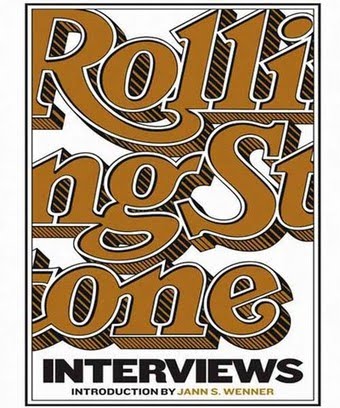
The Rolling Stone Interviews


The Rolling Stone Interviews
Edited by Jann S. Wenner

Before I get into this, I want to note that I really did like this book. As an entirety, it's a good read and I blasted through its monstrous girth in three days. I don't want the rest of this blog post to sway anyone from reading The Rolling Stone Interviews. It is very, very worth it.

This book made me feel old. Allow me to explain in a slow and convoluted way.

Growing up, I was obssessed with rock n' roll. Not so much with the cult of personality that surrounds the genre, although that was part of it, but rather with the virtually instantaneous legend-generating power it carried over to its performers. I liked the fact that stuff I was listening to went from obscure to relevant, then iconic then legendary, often in the span of a single calandar year. It's a fun process to watch from the sidelines. I always wondered what it would be like for the performers.

And, of course, I really dig music. Still do.

I never really got into the People Magazine side of the equation. Who was screwing who, what band was suing what other band and what sorts of drugs so-and-so was using at the Grammys last night. That stuff didn't concern me nearly as much as the music and the energy it conveyed. Who cares what Kurt Cobain thinks or does? It's all about the guitar riff, It's about the lyrics. It's about the rock. I would like to assume I was too punk-rock for all the other nonsense, though, if I'm honest, I know I wasn't. I was simply nose deep in Michael Creighton novels and Martin Scorsese movies.

So it was interesting to find The Rolling Stone Interviews fall into my lap a couple of weeks back. I'm certainly not insinuating that Rolling Stone Magazine is akin to People Magazine but I never read either growing up. I was blissfully unaware of the personal lives of most of the bands and musicians I enjoyed. I wasn't entirely ignorant, but the details simply didn't interest me at the time. So this book was a revisitation to my music-listening past from a different perspective.

The book itself is an anthology of dozens of interviews ranging back to the beginnings of Rolling Stone Magazine in the mid 1960s and includes interviews with everyone from Jim Morrison in 1969 to George Lucas in 1977 to The Dalai Lama in 2001. It is organized in chronological order so once I got into the interviews conducted after 1980, it was fun to watch my childhood pass as I was reading the chronicles of the stars.

Many of the non-musical interviews proved to be quite interesting. I really enjoyed reading the interviews with Bill Clinton, Johnny Carson, David Letterman and Bill Murray. Other interviews were captivating because Rolling Stone chose an unorthodox interviewer. Andy Warhol with Truman Capote, Robert Palmer with Eric Clapton. But the vast majority of the musician interviews read like laundry lists of petty disputes, drugs and personal problems leaving me wanting to slap the Holden Caufield out of them all.

The fundamental problem with rock and roll interviews is that when you get down to it, rock stars are as humdrum as lawyers, teachers or doctors. Oh, they think they are different (in the case of John Lennon... he knows he's a genius). But when you begin to read these accounts of their lives they all begin to sound oddly consistent.

They have gone from struggling musician (and have you ever talked to one of those? Yeesh!) to ultra-famous and mega-rich, pretty much overnight. And each of them from Pete Townshend to John Lennon to Axl Rose to Eminem answer questions as if they were the first musician in the history of the world to encounter troubles in the trappings of fame. Don't these guys read Rolling Stone Magazine? Didn't they ever listen to The Wall? Or Bob Seger's eponymous hit Turn the Page? It's hard no to notice the droning pattern.

This is a generic sample of the sort of answer you get from (insert name of famous musician here):

"I hooked up with {insert name of mildly famous session musician name here} in (insert the name of American or British city here). We decided to crash at {inesrt hip record company exec name here)'s house for the night. We ended up staying there three weeks tripping on acid and peyote, shooting guns and playing old {insert name of eccentric musical style here} records. It was a wild time, man. We shared something real. The (insert decade here} were a truly magical ride."

Seriously, when did being a rock star become so boring. From Pete Townsend to Eminem and virtually every pop star in between was like reading the same interview over and over. From complaining about singing the same songs night after night to to battling their heroin addictions to dealing with their "personal demons." It's all such a stereotype.

This isn't to say there weren't some really interesting bits. I quite enjoyed reading about David Letterman's friendship with Johnny Carson and Bill Clinton's musings on the evolution of the "Don't ask, don't tell" policy. Jack Nicholson's philosophies on monogamy were a riot, Truman Capote and Andy Warhol were hilariously pretentious, and Tom Wolfe is fascinating.

Nor is it to say that there aren't any musicians with something interesting to say. Patti Smith, Mick Jagger and Leonard Bernstein deliver eloquent interviews that delve a little deeper into the music and the creative process. Perhaps it has something to do with their ages when they were interviewed. Each of them had been in the industry for over two decades once they sat down with Rolling Stone.

Which gets me back to the thesis of this entire blog post. The book made me feel like an era had passed in my life. These guys (Ozzy Osbourne, Kurt Cobain, Neil Young, Eric Clapton, Jim Morrison etc...) who I idolized so much when I was younger just turned out to be snivelling, whiny kids with too many toys and not enough friends. Who really wants to read an interview with a kid with very little of anything to say other than how many drugs he took last weekend? Perhaps to many this isn't such a momentous realization but for me, someone who didn't read the gossip rag side of the music indusrty until recently, it has really spilled the smack out of the plunger.

Ironically, it is old man Mick Jagger who puts it so succinctly when he says:

"I think it's very important that you have at least some sort of inner thing you don't talk about. That's why I find it distasteful when all these pop stars talk about their habits. But if that's what they need to do to get rid of them, fine. But I always found it boring."

Amen, Mick.

Of course, egoism is not nearly enough to devalue the wonderful music many of them made. I will simply go back to listening to the music and turning a deaf ear to their nonsensical ramblings. It only reenforces my opinion of recluses. The less you speak, the more you say.