A Storm of Swords
By George R.R. Martin
1216 pages later...
Who needs a drink?
I remember when I first started the
Harry Potter series. I enjoyed the first and second book but it wasn't until the third and fourth books in which I thought J.K Rowling really hit her stride. In
The Prisoner of Azkhaban and especially in the
Goblet of Fire, I felt that Rowling had finally developed a sense of comfort and maneuverability within the mythological world she had created. By the fifth book in the series she had done away with the tedious recaps that plagued the opening chapters and was freed from constantly reminding her readers the personality quirks of specific characters. While these interludes and decidedly necessary, especially in the early books of a series, they tend to slow the narrative to a grinding halt at times just because the author needs to get the reader up to speed. Fair game, of course.
In turn, by the third book in any series, the reader has invested time, money and emotion into the characters, narrative and themes. By this point, the author doesn't need to grind the narrative to a halt nearly as often because you know that Hermione always studies hard or that Gryffindor really doesn't get along with Slytherin or that Snape really dislikes Harry. What was necessary backstory in book one becomes tacit understanding in book three. If the series has a cast of hundreds, one must logically assume that the reader has them (for the most part) figured out and doesn't need to be constantly reminded by the writer about their history and allegiances.
George R.R. Martin is such a writer.
While I am certainly not taking anything away from the first two books in Martin's epic saga
A Song of Ice and Fire,
A Storm of Swords is head and shoulders above its precursors largely because Martin, by this point, is free from the constraints of explanatory writing and can concentrate on simply moving the plot along at breakneck speed. Anyone picking this novel up more than likely understands the world of Westeros and the politics therein. Any minute detail that one has forgotten is wriggled into the narrative as deftly as possible without resorting to flashbacks or recaps.
And what a narrative it is!
For fear of spoilers, I will speak in generalities that are known for anyone thigh deep in this series but not yet at the end of this installment. A friend of mine scolded me after reading the second novel that George R.R. Martin obviously hates women given the way in which he treats his female characters throughout the narrative. While I would agree that many, if not all of the women in this series are treated rather harshly, it seems to me that the women neither give nor receive more or less punishment than the men and children in these books. Martin seems to be equally evil toward all his characters as if he's siting in his writing room thinking to himself: "You've had your leg cut off, your husband was butcher in front of your eyes and your newborn baby was skewered and cooked while you watched... what other atrocities can I heap onto your already frail psyche?"
Those familiar with the series know that Martin has no hang-ups with killing his most central characters. We've known that since the first novel, but it is here in the third novel where Martin's bloodbath really begins. Since Martin's story is populated by scores of characters, they often appear, disappear and die with jarring regularity. If you are gearing up for this book, do not get comfortable with anyone. Martin will only break your heart.
As with the previous novels, Martin divides the chapters by character.
A Storm of Swords is told from the perspective of ten characters interacting in four distinct theaters of action: The South (King's Landing), The Riverlands, The Wall (and beyond) and Essos. This was the first book in the series in which I enjoyed each and every narrative strand (I was bored to tears by Sansa Stark's story in the first novel and Theon Greyjoy's story in the second novel, while obviously necessary, lacked any real excitement). In
A Storm of Swords I especially liked the character progression for Jon Snow and Arya Stark who are rapidly gaining on Tyrion Lannister as my favorite characters in the series (Alas, Tyrion's story in this novel was my least favorite, though it was still damned good). And Jaime Lannister turns out to be a far more complex character than I could have ever assumed. At this point, I desperately hope Martin uses Cersei Lannister as one of his character perspectives in the next novel,
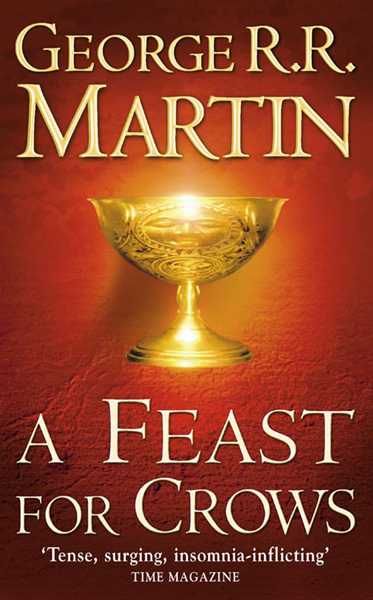
A Feast for Crows. Or Varys....
Varys.
Frightening character.
Anyway...
I also love the way Martin toys with his readers. He spent two novels urging his readers to hate the House Lannister only to turn the entire series on its head in the third book and paint the family in a more sympathetic light as it disintegrates under the crushing reality of power. At this point in the story I couldn't even begin to guess who will rule Westeros at the conclusion of this conflict but for the first time I can honestly say that it doesn't matter. Each and every candidate for the Iron Throne has their merits (though I'm still throwing my hat in the ring for Daenerys).
My only real complaint about this novel and the series as a whole is its realism. It's a small complaint and has no bearing on my enjoyment of this series but it's worthy of a rant, so here goes:
When I reviewed the first book,
A Game of Thrones, I commended the novel and the series for being the most realistic fantasy novel I have ever read thereby intently becoming the only fantasy novel (and series) I have ever enjoyed. Martin downplayed the traditional ingredients of the fantasy genre and focused primarily on the human story rather than dragons and warlocks and spells. While these ingredients are ramped up in the second and third novels, they are still incidental elements to the broader story and haven't yet made much difference in the narrative (though it's coming, one can plainly see). Furthermore, Martin has thrown in enough non-traditional fantasy fare (reanimation, wargs and wights) to entice non-fantasy readers such as myself. More succinctly, Martin a capable writer and doesn't need to crutch on gimmicky elements to tell his story.
However, his ultra-realism is beginning to bite him in the ass. With such a crippling (economically, socially, demographically, psychologically and ecologically) war of succession raging throughout Westeros and as many as six kings claiming the throne and maintaining influence over particular parcels of land, what of the common citizens of Westeros, or as Martin calls them: the smallfolk? Kings are only kings because the majority of people allow authority in return for protection of their rights. It's what Thomas Hobbes calls the Social Contract. Without said contract, society reverts to a "state of nature" which is "solitary, poor, nasty, brutish and short." This defines the current state of Westeros perfectly, but Westeros is a society with a Social Contract (or one presumes). So what gives?
In Martin's version of Westeros, not a single king has ever once discussed a matter of state. You know things such as the rising price of grain or price tariffs or the impact that this devastating war should be having on seasonal harvests and, in turn, their food supply. There is a modicum of justice but it seems to exist only for those involved in the War (i.e. those committing crimes against the state). Rarely, if ever, do any of the kings, queens, hands or greatjons hold court for the grievances of their populations. Hell, rarely are their populations mentioned. You know, the populations from which they gain their legitimacy. In short, these would-be kings spend all their time conniving to consolidate their power via war, intrigue and subterfuge and absolutely zero time attending to the affairs of the state or the rights of their citizens. What is this, North Korea?
What of the common people? Are they starving? Are they scared? Are they being butchered? Are there mass migrations of refugees moving toward safer territories in the Free cities or the relatively safe lands of the Eyrie? If the land is not being tilled or pastured and entire villages and towns have been abandoned (or slaughtered), where is the food coming from? Are taxes being levied and collected? If so, by who? Knights have zero regard for the lives of the people they are supposed to protect. Why are these guys vying for the throne anyhow? Not a single one of them seems to have a grasp on how to rule over actual people. People with jobs and trades and families and such.
Isn't it plainly obvious to a blacksmith or a farmer or a shepherd or a prostitute that their government quite obviously doesn't give a shit about them, whatsoever? Doesn't it gall them that the people who supposedly rule over them plot and counter plot against each other without a single thought about their people's welfare? By the third of fourth political assassination, wouldn't the common innkeeper in the local ale tavern say: "Anon, methinks yonder royals want not heed our grievances. Perchance we could undertake improved governance." Wouldn't the people of this realm have risen against such blatant corruption? Why isn't there a people's revolution against the stifling and brazenly prejudice tradition of entitlement in Westeros? Christ, if you are not born into one of the ruling families (either major or minor), your life is worthless. It's oligarchic apartheid for chrissakes!
Certainly there are one or two low-born or bastard-born people in Westeros that see the complete disregard for governance and would begin a grassroots organization to bring rule of law and justice to the land. Sure, it took Medieval Europe a couple of thousand years and more than their fair share of war to get to that point, but the war in Martin's series makes the shenanigans between the Carolingians and Merovingians look like a lesson in state diplomacy and bureaucratic prudence. And we all know what happened to them, don't we...
/end rant
Anyway, like I said, it's a small complaint and one I am more than happy to overlook. Despite it's realism,
A Song of Ice and Fire is fantasy and one is supposed to suspend their disbelief. If you haven't yet read this series, get going. You won't be disappointed.
Other reviews from A Song of Ice and Fire:
A Game of Thrones
A Clash of Kings
A Feast for Crows