Showing posts with label a storm of swords. Show all posts

Tuesday, May 21, 2013

A Dance With Dragons: Book Five of a Song of Fire and Ice


A Dance With Dragons: Book Five of A Song of Fire and Ice
By George R.R. Martin

I'm there. I'm finally there!

Two years and 4884 pages later, I'm finally caught up. As of today (May 21, 2013, 26 days after starting the latest installment) I am completely up to date on The Song of Fire and Ice by George R.R. Martin. It's been a long and grueling road. At points I thought I'd never get to this point. I'd like to thank R'hollor, the Seven and the old gods as well as my agent, Petyr Baelish, my publicist, Cersei Lannister and my spin doctor, Davos Seaworth. Davos! Dude! We did it! I owe you a bushel of onions! Wait... wait! Before you cue the music, I'd just like to say that now that I am caught up, I wish I wasn't. I wish I could dive right back into Martin's world.  I'm completely hooked in and I'm not sure what I'm going to do while waiting for the next installment. 

Yeah, that's right. I'm a fully converted and completely unrepentant Game of Thrones fanboy. Sue me.

So it should come as no surprise that I say, without hyperbole, that this series has been the single greatest undertaking in my reading career. It has been every bit as monumental as reading the Old Testament, as thoroughly time-consuming as Infinite Jest and as satisfying as completing my first Shakespeare play in the ninth grade (Twelfth Night for those keeping score at home). But what sets Martin's series apart from those other reading peaks is the sheer scale of the series. 

A Song of Fire and Ice has thrice the number of characters as the Old Testament (There might be more Freys alone than characters in the entire Book of Genesis), four times the amount of pages as Infinite Jest and.... well, okay, Shakespeare is still a better writer than George R.R. Martin, but he's at least in the same ballpark when it comes to writing epic histories. And there's still two books to go!

Furthermore, As of today I join the legion of fans eagerly awaiting The Winds of Winter. More precisely, because I have not seen a single second of the television series I can count myself among the bookishly elite uber-nerds who have forsaken the television series in a vainglorious quest to keep the series intellectually pure. My vision of Daenerys Targaryen is a unique snowflake that will remain untarnished by the creative limitations of the boob tube. How many of the readers of the series can say that? Sometimes living in Taiwan has its perks. One of them is the ability to completely avoid American popular culture if the need arises (as it does here and in the case of Justin Beiber, reality television and the cult of celebrity).

As well, I can now join the increasing cacophony of impatience bombarding Martin as he works furiously (alas, not furiously enough to satisfy this reader) to finish the series (Please take care of yourself Mr. Martin and, please, consider moving closer to a healthcare provider in case you suffer any unexpected medical emergencies). Sure, I'm joining the back of the line, but I am officially in that line and I'm guessing that you are now. (The law of averages says that the last sentence will be true of most of the visitors to this site. If that last sentence does not pertain to you, trust that I didn't mean YOU).

So, what of A Dance With Dragons? Well, I do not want to be the bearer of spoilers for those either A) still mired deep in the printed series or B) those unfortunate souls who have opted for the television version. I will try my best to maintain a spoiler free take on the novel but please, if you are at all worried, stop reading here.

I thought it unfair of reviewers to have been so hard on the fourth book, A Feast for Crows. As I said in my review of that installment, it wasn't warranted. Oddly enough, I might be inclined to be a little hard on the fifth novel given that match of its one thousand plus pages seemed like a never-ending build-up to nothing. I was about 70% into the novel when I realized that very little had yet happened. The proverbial dust from the previous novel settled nicely but following that it was simply a lot of characters moving about Westeros and Essos without actually doing much of anything. Fortunately the final third of the novel more than made up for the slow-pace of the first two-thirds and there were enough holy-shit moments in the last few chapters to satisfy even the most jaded fans of the series. 

There are a could of narrative specific thought I had while reading that are worth noting: 

It took five books but Martin finally managed to generate some heated interest in the story lines emanating out of Dorne. Up until A Dance With Dragons, I cringed at a Dornish chapter heading. Now, Dorne finally figured into the storyline in a more concrete and meaningful way. Now if he can just do that for anything happening in the Eyrie all bases would be covered. 

Tyrion continues to be my favorite character, though he lost a little something now that he's off his high horse. Here's to hoping for a return to form in the next installment. I also liked the inclusion (finally) of Barristan Selmy as a POV character. He's always been one of my favorites. But the one character that I want to see done as a POV is the one I fear will never be done: Varys.

I've never been a huge fan of Bran Stark's storyline but it took such a boring, pseudo-spiritual turn in this book that almost stalled out in his chapters. I know Martin is gearing up for something special with Bran but I wish he'd keep the hocus pocus to a minimum.

I'm hoping that Martin gives us a POV character from the House Martell in The Winds of Winter. Of the seven kingdoms, Highgarden is the only one that has yet to have its own POV character and I would really like to understand their motivations better. Or perhaps I'm not supposed to know.

And who the hell is Robert the Strong?

Anyway, as I said, A Dance With Dragons started out slow but those last few chapters made the entire ride so very much worthwhile. So many changes. So many questions. So much uncertainty. My only fear is that, like so many mediocre writers, Martin will end up creating such a masterful set up that he will be unable to follow through. I sincerely hope he knows where this narrative is going because other than in the most general terms, I haven't the foggiest. The rightful holder of the Iron Throne could be Stannis, Tommen, Daenerys or Moon Boy, for all I know. 

And of course, I know nothing.

Monday, December 31, 2012

My Year of Reading: 2012


My Year of Reading: 2012

Welcome to 2013! Another year of reading in the... um.... books.

This marks the beginning of the third year I have kept this blog. In that time I have written up on every single book I have read in that time. I've blogged through sickness, vacations, typhoons and pregnancy. I'm the blogosphere's version of the postal service! I've even managed to maintain the blog through the first six weeks of my daughter's life. Why stop now, hey? Here's to continued reading success in the new year.

I'm not one for memes, though I like to follow what others are reading. I think reading challenges are a clever idea, but I've never felt compelled to force myself to do more or less of anything literary. I see a lot of bloggers stating that they will read ten classics this year or that they will endeavor to finish at least five books over 700 pages or that they will read more non-fiction or Charles Dickens or less erotica or whatever. I respect the diligence and discipline, but I've always considered the act of reading (no matter what I am reading) as diligence and discipline in and of itself. Furthermore, reading challenges often narrow a person's reading rather than broaden it. So I vow to continue reading whatever I may get my hands on over the next twelve months.

So what's new in 2013? Well, for one thing, I will be sharing a portion of my reviews with the good people over at I Read A Book Once.... If you haven't been over there yet, I sincerely urge you to do so. Jonathan is doing some stand up work and the resources he is amassing put this little corner of the net to shame. And since this blog is strictly reviews I might even get around to posting a rant or two along the way. I'll be sure to let everyone know when I have posted something new over there.

Otherwise, let's get to the main event, shall we? We're all here to get a load of my year end lists. And without further ado, here they are in no particular order...

Best Fiction of the Year

1. The Poisonwood Bible by Barbara Kingsolver
This novel absolutely blindsided me. When someone asks me my favorite novels, this one always seems to pop in my head.

2. A Storm of Swords by George R.R. Martin
I could have chosen any one of three of the George R.R. Martin novels I read this year, but I'll go with my favorite.

3. Crooked Letter, Crooked Letter by Tom Franklin
This is one of those solidly written novels that you carry with you for years. 

4. The Remains of the Day by Kazuo Ishiguro
Ishiguro made my top five last year and manages to find his way on again with this nuanced masterpiece.

5. The Virgin Suicides by Jeffery Eugenides
Speaking of making my list two years in a row, Here's Eugenides again. I had wanted to read this novel for ages and it did not disappoint.

Best Non-Fiction of the Year

1. Bossypants by Tina Fey
The great thing about this book was that its awesomeness was completely unexpected.

Yeah, sure the writing is atrocious but I double dog dare you to read this book without a)bawling and b) becoming a huge Anvil fan.

3. Cinderella Ate My Daughter by Peggy Orenstein
Perhaps it was the impending birth of my daughter, but this diatribe on the insidious marketing strategies aimed at young girls really struck a chord. Everyone with a daughter should read this.

This book got a lot of undeserved slack. It's a very open and honest book about parenting and worth reading.

5. The Tragedy of Great Power Politics by John J. Mearsheimer
Anyone even remotely interested in the larger workings of world politics should read this book. Whether you agree or disagree, Mearsheimer presents some compelling evidence.

Worst Books of the Year

Note: I'm not implying that these are bad books when I list them as the worst books. These are books that either disappointed me or failed to live up to certain expectations. I still stand in awe of the fact that these people are able to sit down and write novels. I have unwavering respect for that.

After Cloud Atlas, how was Mitchell ever going to maintain expectations? This book is fine, but ultimately disappointing.

2. The Hunger Games by Suzanne Collins
...and a million YA readers wept. Sorry.

3. The Postmistress by Sarah Blake
Meh.

4. The Story of O by Pauline Reage
Shocking erotica that failed to shock or eroticize. Fifty Shades of Snore.

5. Tinker Tailor Soldier Spy by John le Carre 
Seriously, WTF was going on?

Anyway. Hope everyone had a great New Years and I look forward to continuing the blog into 2013.

Wednesday, December 26, 2012

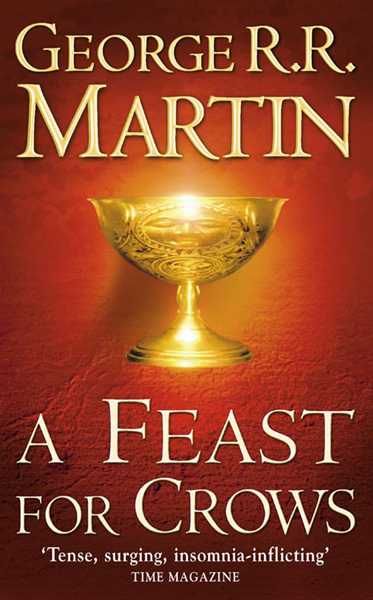
A Feast for Crows: Book Four of A Song of Ice and Fire


A Feast for Crows: Book Four of a Song of Ice and Fire
By George R.R. Martin

Note: I promise, there are no overt spoilers in this post.

Trying to avoid Game of Thrones spoilers on the Internet is like trying to shield yourself from the end of Star Trek II: The Wrath of Khan two decades on. Everyone knows that Spock was going to die in the end and everyone knows A Feast for Crows is the weakest of the Song of Ice and Fire series. Or so the Internet would like you to believe.

I admit it, I had put off reading the fourth installment of the series because it has been roundly discussed over the Intrawebs that this book is the bad apple in the proverbial bushel, the weakest link in the maester's chain, if you excuse my nerdiness. If Sesame Street did a 30 second bit on the series it would the one thing that doesn't belong. If A Feast for Crows were a movie it would be Indiana Jones and the Kingdom of the Crystal Skull or The Godfather III. If it were television, it would be the first season of The Simpsons. If it were music it would be post-David Lee Roth Van Halen. Hell, even George R.R. Martin himself felt the need to write an epilogue to this installment explaining why it is the way it is. Apparently he had to divide the fourth installment into two books to accommodate the entire story. Fine by me. He shouldn't apologize or explain his work. All this awesomeness came out of his head and nobody else's. He reserves the right to tell his story the way he wants. To hell with us critics, right? So what if A Feast for Crows is different.

And make no mistake, A Feast for Crows is indeed the odd man out of the series in a lot of ways. Rather than continue the stories of Bran Stark, Daenerys Targaryen and Tyrion Lannister, Martin opts to introduce narratives from a host of other characters, most notably Cersei Lannister and a bunch of Vikings, I mean Iron Islanders. As well, Martin introduces a few extremely dull characters from Dorne (yawn). But seriously, if you have been on Team Cersei through the first three books, this is the book for you. A solid 40% of the book is told from the perspective of the cruelest of the Lannister clan. By the end of this novel I'm not sure whether I want to punch Cersei in the throat or take her out for a nice seafood dinner. Either way, I don't think her behavior would have been at all believable without the first hand account of why she does what she does. If nothing else, one could regard A Feast for Crows as a primer for all things Lannister.

Furthermore, by adding characters into the narrative mix Martin fleshes out the situation in Westeros a lot more. Up until now, the happenings in Dorne, the Vale and the Iron Islands, have been sorely ignored. This was the first novel in which I got the feeling that things were afoot in all corners of the realm. Though I'm going to be honest here... I'm still entirely uninterested in what is happening in Dorne. Who cares about the Dornish? They are even less interesting than the Tullys.

And despite radio silence from my two favorite characters (Daenerys and Tyrion) and a complete lack of The Others, Martin hasn't abandoned all the familiars. Sansa and Arya Stark, Brienne of Tarth, Jaime Lannister and Samwell Tarly are all represented and their stories have progressed sufficiently. And the absence, for a novel, of Varys was refreshing. Don't get me wrong, Varys is a great character, but he's creepy and there was enough Robert Arryn and The Brotherhood Without Banners in A Feast for Crows to keep the creep factor high.

So, to make a long blog post short, A Feast for Crows isn't as bad as people say it is. It's different, that's for sure, and it doesn't follow the formula of the previous three novels and there is absolutely zero Tyrion represented (that did sting) but it's all logical progression and I finished the novel excited to sink my teeth into A Dance with Dragons. Am I glad to be over the hump? Yes. Was it as painful as it could have been? Well, if I had read this when it came out and had to wait a year for the next novel, yes, it would have been. As it stands, I can start A Dance with Dragons any time I want and that makes a load of difference.

Previous reviews in this series:

A Game of Thrones
A Clash of Kings
A Storm of Swords

Sunday, August 12, 2012

A Storm of Swords: Book Three of a Song of Ice and Fire


A Storm of Swords
By George R.R. Martin

1216 pages later...

Who needs a drink?

I remember when I first started the Harry Potter series. I enjoyed the first and second book but it wasn't until the third and fourth books in which I thought J.K Rowling really hit her stride. In The Prisoner of Azkhaban and especially in the Goblet of Fire, I felt that Rowling had finally developed a sense of comfort and maneuverability within the mythological world she had created. By the fifth book in the series she had done away with the tedious recaps that plagued the opening chapters and was freed from constantly reminding her readers the personality quirks of specific characters. While these interludes and decidedly necessary, especially in the early books of a series, they tend to slow the narrative to a grinding halt at times just because the author needs to get the reader up to speed. Fair game, of course.

In turn, by the third book in any series, the reader has invested time, money and emotion into the characters, narrative and themes. By this point, the author doesn't need to grind the narrative to a halt nearly as often because you know that Hermione always studies hard or that Gryffindor really doesn't get along with Slytherin or that Snape really dislikes Harry. What was necessary backstory in book one becomes tacit understanding in book three. If the series has a cast of hundreds, one must logically assume that the reader has them (for the most part) figured out and doesn't need to be constantly reminded by the writer about their history and allegiances.

George R.R. Martin is such a writer.

While I am certainly not taking anything away from the first two books in Martin's epic saga A Song of Ice and Fire, A Storm of Swords is head and shoulders above its precursors largely because Martin, by this point, is free from the constraints of explanatory writing and can concentrate on simply moving the plot along at breakneck speed. Anyone picking this novel up more than likely understands the world of Westeros and the politics therein. Any minute detail that one has forgotten is wriggled into the narrative as deftly as possible without resorting to flashbacks or recaps.

And what a narrative it is!

For fear of spoilers, I will speak in generalities that are known for anyone thigh deep in this series but not yet at the end of this installment. A friend of mine scolded me after reading the second novel that George R.R. Martin obviously hates women given the way in which he treats his female characters throughout the narrative. While I would agree that many, if not all of the women in this series are treated rather harshly, it seems to me that the women neither give nor receive more or less punishment than the men and children in these books. Martin seems to be equally evil toward all his characters as if he's siting in his writing room thinking to himself: "You've had your leg cut off, your husband was butcher in front of your eyes and your newborn baby was skewered and cooked while you watched... what other atrocities can I heap onto your already frail psyche?"

Those familiar with the series know that Martin has no hang-ups with killing his most central characters. We've known that since the first novel, but it is here in the third novel where Martin's bloodbath really begins. Since Martin's story is populated by scores of characters, they often appear, disappear and die with jarring regularity. If you are gearing up for this book, do not get comfortable with anyone. Martin will only break your heart.

As with the previous novels, Martin divides the chapters by character. A Storm of Swords is told from the perspective of ten characters interacting in four distinct theaters of action: The South (King's Landing), The Riverlands, The Wall (and beyond) and Essos. This was the first book in the series in which I enjoyed each and every narrative strand (I was bored to tears by Sansa Stark's story in the first novel and Theon Greyjoy's story in the second novel, while obviously necessary, lacked any real excitement). In A Storm of Swords I especially liked the character progression for Jon Snow and Arya Stark who are rapidly gaining on Tyrion Lannister as my favorite characters in the series (Alas, Tyrion's story in this novel was my least favorite, though it was still damned good). And Jaime Lannister turns out to be a far more complex character than I could have ever assumed. At this point, I desperately hope Martin uses Cersei Lannister as one of his character perspectives in the next novel, A Feast for Crows. Or Varys....

Varys.

Frightening character.

Anyway...

I also love the way Martin toys with his readers. He spent two novels urging his readers to hate the House Lannister only to turn the entire series on its head in the third book and paint the family in a more sympathetic light as it disintegrates under the crushing reality of power. At this point in the story I couldn't even begin to guess who will rule Westeros at the conclusion of this conflict but for the first time I can honestly say that it doesn't matter. Each and every candidate for the Iron Throne has their merits (though I'm still throwing my hat in the ring for Daenerys).

My only real complaint about this novel and the series as a whole is its realism. It's a small complaint and has no bearing on my enjoyment of this series but it's worthy of a rant, so here goes:

When I reviewed the first book, A Game of Thrones, I commended the novel and the series for being the most realistic fantasy novel I have ever read thereby intently becoming the only fantasy novel (and series) I have ever enjoyed.  Martin downplayed the traditional ingredients of the fantasy genre and focused primarily on the human story rather than dragons and warlocks and spells. While these ingredients are ramped up in the second and third novels, they are still incidental elements to the broader story and haven't yet made much difference in the narrative (though it's coming, one can plainly see). Furthermore, Martin has thrown in enough non-traditional fantasy fare (reanimation, wargs and wights) to entice non-fantasy readers such as myself. More succinctly, Martin a capable writer and doesn't need to crutch on gimmicky elements to tell his story.

However, his ultra-realism is beginning to bite him in the ass. With such a crippling (economically, socially, demographically, psychologically and ecologically) war of succession raging throughout Westeros and as many as six kings claiming the throne and maintaining influence over particular parcels of land, what of the common citizens of Westeros, or as Martin calls them: the smallfolk? Kings are only kings because the majority of people allow authority in return for protection of their rights. It's what Thomas Hobbes calls the Social Contract. Without said contract, society reverts to a "state of nature" which is "solitary, poor, nasty, brutish and short." This defines the current state of Westeros perfectly, but Westeros is a society with a Social Contract (or one presumes). So what gives?

In Martin's version of Westeros, not a single king has ever once discussed a matter of state. You know things such as the rising price of grain or price tariffs or the impact that this devastating war should be having on seasonal harvests and, in turn, their food supply. There is a modicum of justice but it seems to exist only for those involved in the War (i.e. those committing crimes against the state). Rarely, if ever, do any of the kings, queens, hands or greatjons hold court for the grievances of their populations. Hell, rarely are their populations mentioned. You know, the populations from which they gain their legitimacy. In short, these would-be kings spend all their time conniving to consolidate their power via war, intrigue and subterfuge and absolutely zero time attending to the affairs of the state or the rights of their citizens. What is this, North Korea?

What of the common people? Are they starving? Are they scared? Are they being butchered? Are there mass migrations of refugees moving toward safer territories in the Free cities or the relatively safe lands of the Eyrie? If the land is not being tilled or pastured and entire villages and towns have been abandoned (or slaughtered), where is the food coming from? Are taxes being levied and collected? If so, by who? Knights have zero regard for the lives of the people they are supposed to protect. Why are these guys vying for the throne anyhow? Not a single one of them seems to have a grasp on how to rule over actual people. People with jobs and trades and families and such.

Isn't it plainly obvious to a blacksmith or a farmer or a shepherd or a prostitute that their government quite obviously doesn't give a shit about them, whatsoever? Doesn't it gall them that the people who supposedly rule over them plot and counter plot against each other without a single thought about their people's welfare? By the third of fourth political assassination, wouldn't the common innkeeper in the local ale tavern say: "Anon, methinks yonder royals want not heed our grievances. Perchance we could undertake improved governance." Wouldn't the people of this realm have risen against such blatant corruption? Why isn't there a people's revolution against the stifling and brazenly prejudice tradition of entitlement in Westeros? Christ, if you are not born into one of the ruling families (either major or minor), your life is worthless. It's oligarchic apartheid for chrissakes!

Certainly there are one or two low-born or bastard-born people in Westeros that see the complete disregard for governance and would begin a grassroots organization to bring rule of law and justice to the land. Sure, it took Medieval Europe a couple of thousand years and more than their fair share of war to get to that point, but the war in Martin's series makes the shenanigans between the Carolingians and Merovingians look like a lesson in state diplomacy and bureaucratic prudence. And we all know what happened to them, don't we...

/end rant

Anyway, like I said, it's a small complaint and one I am more than happy to overlook. Despite it's realism, A Song of Ice and Fire is fantasy and one is supposed to suspend their disbelief. If you haven't yet read this series, get going. You won't be disappointed.

Other reviews from A Song of Ice and Fire:

A Game of Thrones
A Clash of Kings
A Feast for Crows