Monday, January 7, 2013

Mao's Last Dancer


Mao's Last Dancer
By Li Cunxin

Whenever I read a book blurb that describes a book as "an extraordinary adventure," or a "captivating journey." I am immediately skeptical. These sorts of catch-all descriptions are so commonplace that they have become trite. They are simply rote platitudes used to get something (anything!) that someone (anyone!) said about the book on the front or back cover in an effort to move stock.

Of particular note is the word "captivating." In the world of literary review it has become the ubiquitous term for anyone determined to get their name on the jacket of a book. It has gotten so bad that I will not read a book if it has the word "captivating" anywhere on the cover (I'll excuse its use on the back, otherwise I'd never read any books at all). I have read enough crappy books deemed "captivating" I could fill a truck. Critics and reviewers have rendered the word entirely obsolete.

Well, almost.

Mao's Last Dancer, is the autobiography of Chinese born ballet dancer Li Cunxin. The first half of the book chronicles his childhood living on a peasant commune in China during the reign of Chairman Mao. The story tells of how he was selected (quite possibly at random) at age eleven from a group of local students to study dance at Madame Mao's Arts Academy in Beijing. It recounts his gradual awakening into the world of dance and his indoctrination into the communist system. The second half of the book recounts events that lead to his defection to the west in 1981, his rise to the top of the world of dance and the fallout of the defection on him, his relationships and his family in China. It's a great book, no doubt. But more than anything, this book reaffirmed my faith in the word "captivating."

To me, a captivating book evokes a sleepless night, stealing seconds, not minutes, to read just a few more paragraphs, creating reasons to sit down in waiting areas in order to read a few pages, endangering my relationships with my wife and daughter, reading while walking and all sorts of other pathological behavior that I do not exhibit while reading other books. A captivating book denotes an almost hysterical compulsion to finish the book. It doesn't necessarily mean the book is good, it's just captivating. That describes Mao's Last Dancer perfectly. I desperately needed to know how things turned out. Whether he would ever see his niang and dia again. Whether he would be allowed back into China.

I admit it, I simply could not put this book down. Part of the reason is that Li Cunxin comes across as a genuine, humble man who truly loves his family and is devoted to his career. He seems like the sort of person you'd like to know and the book is written as if he's already met you and is telling you a story over dinner. His story has the ability to make you cry no matter how it is written, and it does, in many places. I admit it.

Also, it's unique. It's one thing to read about life in Maoist China, its another to read one person's account of life inside a commune during the Cultural Revolution. It is quite another to read an account of someone growing up under such oppressive conditions to become one of the world's most famous people in a particular discipline. When you get down to it, Li Cunxin's story is literally one in a billion. To escape Maoist China and become one of the world's great ballet dancers is a astounding. Following his story as he slowly discovered the truth about his own country is fascinating (and at times hilarious).

Don't get me wrong, it's not the best book ever written. I couldn't care less about ballet and I found that when his narrative shifted back to his dancing I couldn't read fast enough to get back to the interesting parts. While ballet is a necessary backdrop to the overall narrative, I think the majority of readers are invested in the story of his upbringing, training, initial impressions of the West and the defection. The consistent talk of his career seemed to betray the spirit of the book as a whole. It was never about the ballet. It was about perseverance and dedication and the ability to get out of an oppressive situation to allow a talent to flourish. I didn't much care whether he left the Houston dance company to join the Australian company. It's inconsequential to the main narrative. But what do I know? I'm an uncultured boor.

But regardless of your views on ballet, Mao's Last Dancer is the very definition of the word captivating. It's the sort of book whose unrelenting narrative begs you to read one more chapter before going to bed. Even if you, like me, don't know the different between ballet and the circus, I dare you to put this book down once you begin.

Or maybe, I dunno, maybe I'm just getting sentimental in my old age.

Note: The word "captivating" does not appear on the cover.

Other books about China:

A Traveler in China
Why China Will Never Rule The World

Wednesday, January 2, 2013

Post Office


Post Office
By Charles Bukowski

In the morning it was morning and I was still alive.
Maybe I'll write a novel, I thought.
And then I did.

These are the last three sentences in Charles Bukowski's first novel, Post Office, published in 1970. These words will resound in my head forever. Perhaps some of the best closing words I've ever read.

I have always equated Charles Bukowski with Tom Waits. The similarities are actually pretty obvious. Both obsess themselves with the margins of humanity. The losers, low-lifes, freaks, hookers, junkies, flunkies, gamblers and bums. Both have the ability to transform the mundane experiences of failure into something slightly magical (in a bleak, tragic sort of way). Both sure as hell know how to tell a story and both have achieve an almost mythical place among their contemporaries and peers. It is no surprise that I read Post Office in Tom Waits's voice.

Once upon a time, Charles Bukowski, the poet and novelist, worked in a Los Angeles post office. Legend has it that the owner of Black Sparrow Press, John Martin, offered Bukowski $100 a month for the rest of his life if he would quit his job and write full time. Bukowski accepted the offer and wrote Post Office in less than a month in what is one of the great tongue in cheek moments in the history of literature. Until that point, Bukowski was a poet on the fringe of the fringe of the poetry world. Post Office marks his entry into the fringe of the fringe of the literary world, a place he would occupy until his death in 1994.

And I admit it, I always seem to forget about Charles Bukowski. When I'm thinking about artists of his particular generation and style I have no trouble remembering the likes of Alan Ginsberg, William S. Burroughs, Hunter S. Thompson and R. Crumb to name a few. But somehow Bukowski's name consistently eludes me despite the fact that I actually like his work more than his peers (I don't much care for the work of Ginsberg, Kerouac or Burroughs). It speaks to the way in which Bukowski haunted the borderlands of the literary work for years without really, truly breaking out. Much like the characters in his novels, Charles Bukowski will forever be the forgotten man. A genius of 20th century literature buried under the weight of names with half his talent.

Post Office is a stark, autobiographical novel recounting the life of Hank Chinaski, a down and out alcoholic that stumbles into a full-time gig with the... ahem... Los Angeles post office. It is a existential account of life as a U.S. postal employee and how grinds Chinaski down into a shell of his former self. The Post Office becomes a metaphor for the relentlessly systematic manner in which life needles away at the human spirit, one compromise at a time. Post Office is also depressingly prophetic of the notion of "going postal," a gruesome idiom that would wriggle its way into the common lexicon a couple of decades after the publication of this novel (though the idiom has absolutely nothing to do with this novel, lest you are wondering).

At its core, Post Office is a quintessential Bukowski offering and Chinaski is the stereotypical Bukowski anti-hero: the unrepentant bachelor who is was he is and does what he does without apology or shame. A marginal man with virtually nothing going for him in life except his next paycheck, his next night at the track, his next fifth of whiskey, his next floozy girlfriend. The vicious circle of mediocrity. Charles Bukowski's work may repulse readers with its prosaic style and narrative, but one often forgets that this was Charles Bukowski's life, once upon a time.

As a writer, he was honest and Post Office (along with a slew of his other work) is Bukowski's life as a work of fiction. The alcoholism is real. The self-destructive lovers are real and the abject resignation is real. This is the very definition of quiet desperation in the American male. Post Office is perhaps one of the most poignantly honest accounts of the marginalization of a man ever written. Hank Chinaski is marginalized emotionally, intellectually, professionally, romantically and physically over his 11 year career as a post office clerk. He gets it from all sides and takes it on the chin like the down-trodden man he is. Chinaski lives for the simple pleasures: getting drunk, going to the track and a roll in the hay with his girl. The rest is inconsequential.

If you have never read any thing by Charles Bukowski, first of all shame on you! But fear not! there's still time. Post Office is a perfect primer. It is a brilliant account of the slow, incremental tragedy of life, an existential shoulder shrug with a dash of sly, self-deprecating humor. In that sense, it is a definitive Bukowski novel and, not surprisingly, it would make a perfect Tom Waits song.

I'd call it: Once Upon A Time.


Monday, December 31, 2012

My Year of Reading: 2012


My Year of Reading: 2012

Welcome to 2013! Another year of reading in the... um.... books.

This marks the beginning of the third year I have kept this blog. In that time I have written up on every single book I have read in that time. I've blogged through sickness, vacations, typhoons and pregnancy. I'm the blogosphere's version of the postal service! I've even managed to maintain the blog through the first six weeks of my daughter's life. Why stop now, hey? Here's to continued reading success in the new year.

I'm not one for memes, though I like to follow what others are reading. I think reading challenges are a clever idea, but I've never felt compelled to force myself to do more or less of anything literary. I see a lot of bloggers stating that they will read ten classics this year or that they will endeavor to finish at least five books over 700 pages or that they will read more non-fiction or Charles Dickens or less erotica or whatever. I respect the diligence and discipline, but I've always considered the act of reading (no matter what I am reading) as diligence and discipline in and of itself. Furthermore, reading challenges often narrow a person's reading rather than broaden it. So I vow to continue reading whatever I may get my hands on over the next twelve months.

So what's new in 2013? Well, for one thing, I will be sharing a portion of my reviews with the good people over at I Read A Book Once.... If you haven't been over there yet, I sincerely urge you to do so. Jonathan is doing some stand up work and the resources he is amassing put this little corner of the net to shame. And since this blog is strictly reviews I might even get around to posting a rant or two along the way. I'll be sure to let everyone know when I have posted something new over there.

Otherwise, let's get to the main event, shall we? We're all here to get a load of my year end lists. And without further ado, here they are in no particular order...

Best Fiction of the Year

1. The Poisonwood Bible by Barbara Kingsolver
This novel absolutely blindsided me. When someone asks me my favorite novels, this one always seems to pop in my head.

2. A Storm of Swords by George R.R. Martin
I could have chosen any one of three of the George R.R. Martin novels I read this year, but I'll go with my favorite.

3. Crooked Letter, Crooked Letter by Tom Franklin
This is one of those solidly written novels that you carry with you for years. 

4. The Remains of the Day by Kazuo Ishiguro
Ishiguro made my top five last year and manages to find his way on again with this nuanced masterpiece.

5. The Virgin Suicides by Jeffery Eugenides
Speaking of making my list two years in a row, Here's Eugenides again. I had wanted to read this novel for ages and it did not disappoint.

Best Non-Fiction of the Year

1. Bossypants by Tina Fey
The great thing about this book was that its awesomeness was completely unexpected.

Yeah, sure the writing is atrocious but I double dog dare you to read this book without a)bawling and b) becoming a huge Anvil fan.

3. Cinderella Ate My Daughter by Peggy Orenstein
Perhaps it was the impending birth of my daughter, but this diatribe on the insidious marketing strategies aimed at young girls really struck a chord. Everyone with a daughter should read this.

This book got a lot of undeserved slack. It's a very open and honest book about parenting and worth reading.

5. The Tragedy of Great Power Politics by John J. Mearsheimer
Anyone even remotely interested in the larger workings of world politics should read this book. Whether you agree or disagree, Mearsheimer presents some compelling evidence.

Worst Books of the Year

Note: I'm not implying that these are bad books when I list them as the worst books. These are books that either disappointed me or failed to live up to certain expectations. I still stand in awe of the fact that these people are able to sit down and write novels. I have unwavering respect for that.

After Cloud Atlas, how was Mitchell ever going to maintain expectations? This book is fine, but ultimately disappointing.

2. The Hunger Games by Suzanne Collins
...and a million YA readers wept. Sorry.

3. The Postmistress by Sarah Blake
Meh.

4. The Story of O by Pauline Reage
Shocking erotica that failed to shock or eroticize. Fifty Shades of Snore.

5. Tinker Tailor Soldier Spy by John le Carre 
Seriously, WTF was going on?

Anyway. Hope everyone had a great New Years and I look forward to continuing the blog into 2013.

Every House is Haunted


Every House is Haunted
By Ian Rogers

Note: This is my first review in partnership with the good people over at I Read A Book Once.... Although all the reviews I write for them will also appear here, I encourage everyone to pay the site regular visits as it has lots more news, reviews and author interviews. I'm excited to be part of the team.

A blues guitar player whose name I cannot recall once said that the blues isn't about the notes a musician plays, it's about the notes he doesn't play. Horror works in exactly the same way. A horror writer is responsible for providing a precise amount of detail that is necessary to frighten a reader. No more, no less. Not enough detail and the reader cannot picture the scenario, too much detail and you eliminate the fundamental criteria in all scary stories: the reader's imagination. It's a literary balancing act that is often destabilized by a writer's overwhelming desire to add more (in this case unnecessary) detail. The writer should provide only what is absolutely necessary for the reader to conjure up the most horrifying aspects of their own imagination.

As P.T. Barnum may or may not have said: "Always leave them wanting more." While this is true of virtually every situation in life, this truism is especially true for horror writing. Good horror should end in a hair-raising climax that wraps up enough (but never all) of the story's loose ends. The unresolved (or unrevealed) issues at the end of a horror story are the most crucial. In my humble opinion, horror should leave the reader alone with their own imagination as to what happens next. Does Carrie rise from the dead and terrorize the town of Chamberlain? There should be room for infinite imagined terrors to occur in the readers mind after the last word has been written.

The reader, on the other hand, has responsibilities of their own when entering into a horror story. He or she must enter into a horror story with an open mind, devoid of preconceptions and biases and prepared unequivocally to suspend their disbelief beyond its usual boundaries. Unlike other genres of fiction, I make it a policy to enter into a horror story with no expectations. If you project your expectations onto a writer they are bound to disappoint. I will hereafter refer to this phenomenon as the Late-Era Stephen King Anomaly.

So as you can see, horror fiction is a social contract of sorts between a writer and a reader. A symbiotic relationship that, when it works, results in extraordinarily fun reading but when it doesn't.... egads!

So it was nice to sit down with Ian Roger's new collection of short stories with a wide open mind and be pleasantly surprised to find an eclectic anthology of stories that are not only well-written but also offer the precise amount of detail while leaving all the climaxes as open ended as possible. No awkward reveals, no detailed descriptions of monsters that never, ever live up to expectations and no not once was I disappointed with an ending. That's a difficult feat to achieve.

Every House is Haunted is a loosely intertwined collection of stories that range from paranormal to science fiction to strict horror. I'm not going to summarize over two dozen stories for you, so you'll just have to go find this book yourself if you are interested. I will tell you that it is cleverly divided into five sections, fittingly entitled The Vestibule, The Library, The Attic , The Den and The Cellar. A literary house tour, if you will.

Although Rogers notes in his introduction that his greatest influence was Stephen King (and who am I to question that?) I thought his style throughout the collection was predominantly reminiscent of Robert McCammon's short fiction. However, "The Tattletail" is a nod to J.K. Rowling. H.P. Lovecraft is manifest in "Charlotte's Frequency" and, most tellingly, "Winter Hammock" evokes the ghost of Kurt Vonnegut. Certainly not literary lightweights. If Rogers is running on even half capacity compared to those writers, you can't miss. I'll go so far as to say he's pacing them rather well, indeed.

Of course, I don't want to imply that Rogers doesn't have a distinct literary voice. He most certainly does. But short fiction is a difficult genre. The writer has to get straight down to business, often at the expense of details that either the writer or the reader would have otherwise like to have been privy. Maintaining the trust of the reader is difficult when you are trying to craft as story only 20 pages long. It doesn't take much to disappoint a reader in a short span. So voice and pacing become an especially important aspect, one that Rogers handles adeptly. One does not want the same voice in each and every story. A certain amount of homage is an ingenious way to ensure each narrative employs a different tone and voice.

So what, exactly am I rambling about? Is this book any good or not? Should you go out and buy the damned thing or not bother? Well, like most titles in the horror genre, this is not the sort of collection that is going to win over new fans. There is little to no cross-over potential here. If you like romance, you'll find none of the cross pollination one finds in titles such as Twilight. However, if you are constantly on the lookout for new and interesting work in the paranormal genre, this is a can't miss title. Well crafted stories, well crafted characters, no condescension and boat loads of fun to read. In Every House is Haunted, Ian Rogers doesn't play all the right notes.


Wednesday, December 26, 2012

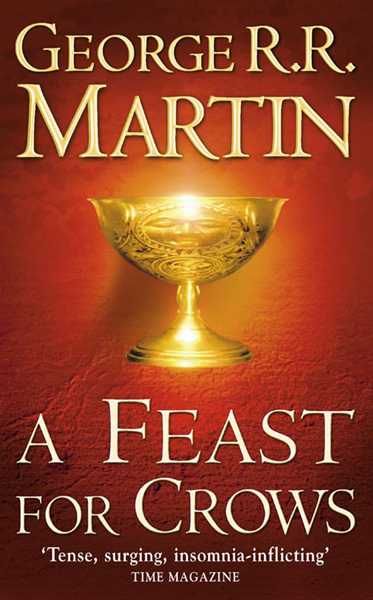
A Feast for Crows: Book Four of A Song of Ice and Fire


A Feast for Crows: Book Four of a Song of Ice and Fire
By George R.R. Martin

Note: I promise, there are no overt spoilers in this post.

Trying to avoid Game of Thrones spoilers on the Internet is like trying to shield yourself from the end of Star Trek II: The Wrath of Khan two decades on. Everyone knows that Spock was going to die in the end and everyone knows A Feast for Crows is the weakest of the Song of Ice and Fire series. Or so the Internet would like you to believe.

I admit it, I had put off reading the fourth installment of the series because it has been roundly discussed over the Intrawebs that this book is the bad apple in the proverbial bushel, the weakest link in the maester's chain, if you excuse my nerdiness. If Sesame Street did a 30 second bit on the series it would the one thing that doesn't belong. If A Feast for Crows were a movie it would be Indiana Jones and the Kingdom of the Crystal Skull or The Godfather III. If it were television, it would be the first season of The Simpsons. If it were music it would be post-David Lee Roth Van Halen. Hell, even George R.R. Martin himself felt the need to write an epilogue to this installment explaining why it is the way it is. Apparently he had to divide the fourth installment into two books to accommodate the entire story. Fine by me. He shouldn't apologize or explain his work. All this awesomeness came out of his head and nobody else's. He reserves the right to tell his story the way he wants. To hell with us critics, right? So what if A Feast for Crows is different.

And make no mistake, A Feast for Crows is indeed the odd man out of the series in a lot of ways. Rather than continue the stories of Bran Stark, Daenerys Targaryen and Tyrion Lannister, Martin opts to introduce narratives from a host of other characters, most notably Cersei Lannister and a bunch of Vikings, I mean Iron Islanders. As well, Martin introduces a few extremely dull characters from Dorne (yawn). But seriously, if you have been on Team Cersei through the first three books, this is the book for you. A solid 40% of the book is told from the perspective of the cruelest of the Lannister clan. By the end of this novel I'm not sure whether I want to punch Cersei in the throat or take her out for a nice seafood dinner. Either way, I don't think her behavior would have been at all believable without the first hand account of why she does what she does. If nothing else, one could regard A Feast for Crows as a primer for all things Lannister.

Furthermore, by adding characters into the narrative mix Martin fleshes out the situation in Westeros a lot more. Up until now, the happenings in Dorne, the Vale and the Iron Islands, have been sorely ignored. This was the first novel in which I got the feeling that things were afoot in all corners of the realm. Though I'm going to be honest here... I'm still entirely uninterested in what is happening in Dorne. Who cares about the Dornish? They are even less interesting than the Tullys.

And despite radio silence from my two favorite characters (Daenerys and Tyrion) and a complete lack of The Others, Martin hasn't abandoned all the familiars. Sansa and Arya Stark, Brienne of Tarth, Jaime Lannister and Samwell Tarly are all represented and their stories have progressed sufficiently. And the absence, for a novel, of Varys was refreshing. Don't get me wrong, Varys is a great character, but he's creepy and there was enough Robert Arryn and The Brotherhood Without Banners in A Feast for Crows to keep the creep factor high.

So, to make a long blog post short, A Feast for Crows isn't as bad as people say it is. It's different, that's for sure, and it doesn't follow the formula of the previous three novels and there is absolutely zero Tyrion represented (that did sting) but it's all logical progression and I finished the novel excited to sink my teeth into A Dance with Dragons. Am I glad to be over the hump? Yes. Was it as painful as it could have been? Well, if I had read this when it came out and had to wait a year for the next novel, yes, it would have been. As it stands, I can start A Dance with Dragons any time I want and that makes a load of difference.

Previous reviews in this series:

A Game of Thrones
A Clash of Kings
A Storm of Swords

Wednesday, December 5, 2012

Pariah


Pariah
By Bob Fingerman

What is it about the zombie genre that makes it such a tenacious sub-genre in our popular culture? Certainly it is not the nuanced characterization of the walking undead. From the opening scene of George Romero's 1968 genre-setting film Night of the Living Dead  to present, zombies, with very few exceptions, have been rather two-dimensional in scope. They are reanimated corpses who have a singular existential urge: to devour human flesh. Not the most rounded characters. And yet they seem to have more staying than vampires, wizards and werewolves which lend themselves to complex characterization.

So what gives?

The difference is the secondary characters. While other similar styles of horror focus the narrative on the specific creature (be it vampires, werewolves or what have you), what many people fail to understand about (most of) the zombie genre is that the zombies are actually inconsequential to the story being told. Zombie lore, at it's finest, is social satire. The writer or director uses the notion of a zombie apocalypse as a way in which to render society down to a microcosm of our complex social networks. Zombies focus the multitude of humanity's ills and places them under a microscope for the writer or director to examine in detail.

The zombie element is simply a clever and visually exciting backdrop to the real story: the human drama unfolding in the farm house or the shaping mall or the tenement building. When zombie lore strays from this nowhere-to-run motif it often falls flat on its face (note: this does not include anything that is written or filmed from the perspective of the zombie... that's genre deconstruction and worthy of its own discussion. See Dust). George Romero himself is guilty of straying in some of his more recent work, especially Day of the Dead.

All this is not to say that those working within the zombie genre are entirely reined in with respect to how they tell their story. There is still more than enough creative leeway within the genre to sustain it for years to come.

Case in point, Bob Fingerman's novel Pariah. The novel begins months into the apocalypse. The streets of New York are wall to wall zombies. A group of people living in a building in (or near) the Bronx have barricaded themselves inside their own building and are slowly starving to death and/or going crazy. As with so much zombie lore, each character represents a specific social stereotype that the author wants to throw into his own personal meting pot. What would happen if we put a misogynistic jock, an elderly Jewish couple, an artist, a woman who has recently lost her husband and infant daughter, the son of a mid-western Jesus freak and a middle aged black dude all together in a tiny space? What if they couldn't leave? How would that pan out?

This story could just as easily take place on a lonely spacecraft in deep space or a collapsed mine or an Antarctic base during the winter. Really, it would work in any local that offered no immediate escape. It would just be difficult to explain how an elderly Jewish couple ended up in Antarctica. That's where the zombies come in handy. It doesn't hurt that they are creepy and gory and scary as well.

This is what Fingerman understands so well. Rather than try to re-invent the wheel, Fingerman stayed true to the spirit of that old farmhouse in Romero's original film. Pariah is very much about humans trying and failing to co-exist in times of extreme duress.

But if that was all there was to Pariah, why would it merit such a lofty discussion on the nature of zombie lore? Thankfully, Pariah brings more to the table than simply another retelling of the same rat-in-a-cage trope. Fingerman, in what can only be described as a moment of undead clarity, introduces the concept of zombie immunity. What if specific individuals, for whatever reason, repelled the walking undead? What if certain people were simply unappetizing to zombies and could walk among them entirely unmolested? How would that work?

Pariah isn't a perfect novel. I found that Fingerman threw far too many pop culture references into his dialogue and internal monologue. While I fully understand the pervasive nature of books, music, films and the like, I don't think that people living under these conditions would reference SCTV or Dumb and Dumber that often. A lot of the pop culture references felt shoehorned into the narrative as a way for Fingerman to sound off about his own views rather than develop his characters. Unless, of course, he was insinuating that the sum of our culture doesn't amount to anything more than what we know about The Addams Family. In that case, this book is even more depressing than I initially thought.

But that's a minor inconvenience to an otherwise thought-provoking addition to the zombie oeuvre. I'm not one for spoilers so I'm just going to urge those who enjoy all things zombie to read Pariah. I'll admit that if you aren't a fan of the genre I don't think this will be the novel to turn you on to zombies, but if you, like me, crave all things living dead, this is a can't miss novel. It maintains all of the standard features that drew you into the zombie sub-genre to begin with, stays true to the mythology established by George Romero and throws just enough monkey wrench into the cogs to leave you asking more questions that it answers. Pariah is certainly a next step sort of work and, in time, should be considered canon for the keepers of zombie lore.

Thursday, November 29, 2012

Sex With Kings


Sex With Kings: 500 Years of Adultery, Power, Rivalry and Revenge
By Eleanor Herman

Sex With Kings is the sort of niche history that really gets me going. I love it when a historian bites off a little corner of history and chews on it for 200-300 pages, especially if it is a subject that has otherwise been left to rot on the side of the plate. Subjects such as the etymology and evolution of the word fuck or the history of the human fear of premature burial arouse in me a curiosity that must be satiated.

When I came across Sex With Kings: 500 Years of Adultery, Power, Rivalry and Revenge (via someone else's book blog, but I forget whose. If you read this and it was your blog let me know and I will edit in your credit) my insatiable curiosity was roused. How could a history of royal mistresses not fail to entertain as well as inform. So long as it didn't focus on the detritus one finds in the British tabloids, this should have been a fantastic read.

Well, it is.

And it isn't.

First, one must give Eleanor Herman her dues. This book is an exhaustive piece of research. One wonders whether she was able to get her hands on every single existing letter written by or about royal mistresses since the reign of Louis XIV and if it isn't the definitive work on the subject, it should be.

This book is stuffed with juicy details into the private lives of the kings and queens of Europe. From the sorcery that some mistresses performed to maintain their relations with the king to the knifing ways in which they batted off pretenders to their position to the manner in which each of them was cast aside upon the death of their royal benefactor. It is a veritable historical gossip rag full of exposes and scandals.

But it that was it, if the sole purpose of Herman's work was to satisfy the leering eyes of historical royal worshippers then this book would be pointless. Herman also examines the ways in which mistresses have shaped the history of Europe. How some wars were the direct result of the meddling and others were settled due to the soothing hand of a king's dangerous liaison. In the case of King Ludwig of Bavaria, his mistress Lola Montez directly caused the revolution of 1848 that eventually forced the King to abdicate his throne and move into exile.

But I did have some problems with this book. First and foremost is the title of the book. When I first heard about this title I was excited to read the way in which mistresses were kept and perceived in a wide variety of royal and imperial settings. Sex With Kings suffers from excessive Euro-centrism. This wouldn't have bothered me so much had it been mentioned in the title. something like Sex With Kings: 500 Years of Adultery, Power, Rivalry and Revenge in Europe, but it wasn't called that. I wanted to know about the Imperial courts in Japan and China, the harems of Middle Eastern kingdoms and the such. But it concentrated primarily on Europe (and if I'm being honest, it focused even more primarily on Western Europe, Russia and Serbia only factoring in on a couple of occasions).

I also didn't enjoy the organization of the book. I understand that this is always a problematic point for anyone writing history. Do you write your subject chronologically, thematically or do you write it as a character study. Here, Herman chooses a thematic organization with such chapter headings as Beyond the Bed - The Art of Pleasing a King and Loving Profitably - The Wages of Sin. I suppose this organization was as good as any other but I found it difficult to juggle the names of kings, queens and mistresses from chapter to chapter. When Herman refers to Madame du Pompadour for the umpteenth time in chapter 10 I was forever trying to remember whether she was the mistress of Louis XIV or Louis XV. I would have preferred a character study that was divided either by king or by mistress.

Nevertheless, Herman is forgiven any personal problems a reader might have with her work. As it stands, she has bitten off a chunk of history to call all her own. As of this moment, Eleanor Herman is the official authority on the history of royal mistresses in Europe.

Thursday, November 22, 2012

Narcopolis


Narcopolis
By Jeet Thayil

Note: Apologies, this blog post is rushed and poorly written due to the fact that my wife and I have just recently had our first child and things are a little hectic around the house. I hope I can figure out how to maintain the quality of this blog over time without neglecting my duties as a father. Let's see.

It's tough to write a different book about India.

Lots of writers write about India. It's one of those mystical locales that was tailor made for story telling with its bouquet of culture, its irrepressible sights, sounds and smells and its rich history, India has been the setting for dozens of novels that have achieved serious critical acclaim. In fact, since 1997 three Man Booker Prize winning novels have been written by Indian novelists and if you go back through the history of the prize you find that, aside from the Indian winners, many of the winning novels were set in India. 

But something I have noticed over the years is that every modern book I read about India invariably returns to the same themes over and over, most notably the continuous reverberations of colonialism and a level of navel-gazing that rivals Canadian literature. While they are always well written and interesting, I have been waiting to get my hands on something a little different from the sub-continent for some time. Jeet Thayil's novel Narcopolis is just that book.

While Narcopolis didn't win this year's Man Booker Prize, it did make the short list, and thank god for that. Thayil dared to write a novel about India without resorting to the aforementioned safe themes of his contemporaries. Instead, Thayil's narrative is a gritty, no holds barred view into the world of drugs and prostitution in the slums of Bombay. It is a side of India that is rarely mentioned in the English literature from India. While I'm not sure if I'd want to read a glut of books about opium dens in Bombay, I sure would like to read about India from some new angles.

Fittingly, the novel begins with a seven page run-on sentence and doesn't let up from there. I say "fittingly" because what follows is a dream-like narrative that follows the lives of several noted junkies and prostitutes that frequent the opium dens that were popular in Bombay prior to the 1990s. The story begins in a sort of heyday and the slow demise of the den's popularity parallels the decay of the characters.

Written as a series of entwined anecdotes surrounding Dimple, an opium addict and prostitute in Bombay. Dimple was born a boy but was castrated during childhood and lives her life as a woman. Other characters bob in and out of the narrative and each have their own debauched story to tell. The entire book exudes a certain hazy tone and the novel progresses like the literary equivalent of opium smoke languidly wafting through the air. Often many of the stories drift off into nothingness while others that seem like tangents join with the larger narrative structure and continue on from there. Stories braid themselves around each other throughout and Thayil's style has a lazy, unhurried feel as if he is chewing on the sentences one word at a time, thoughtfully relishing each word and placement in relation to the entire work. The language is debased, vile and at time shockingly graphic, but in the hands of Thayil they are impossible to ignore.

Narcopolis is the first of the 2012 Man Booker Prize short-lister that I have read. For the language alone it is worth the read. Given that it did not win, I am excited to see what may have been deemed better than this carefully crafted work. Furthermore, it's really nice to see some more unorthodox Indian literature getting recognition. Perhaps this means we can expect a run of post-post-colonial literature out of India over the next few years.

One can hope.

Wednesday, November 14, 2012

The Amazing Adventures of Kavalier and Clay


The Amazing Adventures of Kavalier and Clay
By Michael Chabon

It took me an eternity to get around to this book. I read Michael Chabon's book The Yiddish Policemen's Union last year and enjoyed it, but not enough to go rushing out and read another of his books, especially one that is over 600 pages long. But I kept hearing these things about this book. People kept telling me how it was one of the best books of the past ten years and totally deserving of the Pulitzer Prize. It simply weighed my bookcase down for far too long and I had to pick it up.

Glad I did.

The Amazing Adventures of Kavalier and Clay is exactly what books and literature is all about. It's good writing and a great story about well-formed characters that deserve and gain the respect and empathy of their readers. It is well researched, impossible to predict and, as everyone seemed to tell me prior to reading, entirely deserving of the accolades it has garnered. OK, so I just sort of started vomiting attributes. Let me slow it down and explain.

First and foremost, Michael Chabon is a fantastic writer. I don't mean "fantastic" in the way we over use the word but rather in its more traditional usage as fanciful. But I knew this to be true when I read The Yiddish Policemen's Union  Of all the things I didn't like about that book (and there were a few things), Chabon's abilities as a writer were never questioned. He has an undeniable ability with tone, pace and, most of all, setting. I could practically smell 1940s Manhattan throughout this novel in the same way I could the Sitka Settlement in The Yiddish Policemen's Union.

As an aspiring writer myself, I find Chabon an intimidating novelist to read and appreciate. Reading a single paragraph is liable to send me to my bedroom a blubbering puddle of delicate emotions wrapped in a flimsy eggshell of a man not to be heard from for the remainder of the weekend. I mean how does he write that eloquently? Damn him! (And when I say "damn him," I mean he's fantastic (And when I say he's fantastic," I me... oh never mind)).

You can be a fantastic writer but if the story doesn't jive with readers, all those pretty paragraphs and succinct sentences (and all that alluring alliteration, I might add) are for naught. This was my fundamental problem with The Yiddish Policemen's Union. Great writing. Excellent characters. Wonderful tone. Good pacing. Boring-assed story. Not so with The Amazing Adventures of Kavalier and Clay. I especially loved the fact that each character has their own story to go along with the common story of the novel. As in, each of the characters in the novel has their own problems and tribulations to deal with outside the bubble of the central story. And whereas some authors (coughcathylambcough) tend to spread the issues and drama on thick, Chabon knows exactly how much drama and stress to foist onto his characters shoulders without inducing reading induced epileptic seizures brought on by repeated eye rolling.

I genuinely cared for every single character in this novel (Yes, even Sheldon Anapol). They were rendered in such three dimensional detail that they seemed to have genuine texture and depth. I really felt like these guys existed in the annals of comic book lore. Surrounding him with real life comic book names such as Stan Lee and Bob Kane only augmented the illusion of reality. A very definite blur was put into effect.

And that's something else that deserves mention. Michael Chabon quite obviously researched the hell out of the comic book industry in the 1940s (and the Second World War as fought on the continent of Antarctica as well). As a fan of historical fiction I appreciate the attention to detail. But I also appreciate Chabon's determination to make shit up whenever it pleased him. I like Chabon's attitude toward history: Render it as close as possible to the truth whenever possible but throw it out the window when it doesn't fit the story he's trying to tell. Excellent lesson for any writer.

Speaking of the story, it is not only riveting (as I mentioned earlier) but it is also unpredictable. At no point during this narrative did I have a single clue where Chabon was taking me. There's nothing wrong with predictable story lines, good writers can take you down familiar roads and show you different sights along the way, but it's always nice to have someone show you an entirely different path. I, at no point in the reading of this novel, knew where Chabon was taking me. Furthermore, there were episodes in this novel that I could not have predicted in a thousand years of predictions.

So it won the Pulitzer Prize. Did it deserve it? Of course, I don't know. I haven't yet read everything published from 2000. But it couldn't have been the worst option. As I said off the top, The Amazing Adventures of Kavalier and Clay is everything that a reader should expect from literature. Good writing, strong characters and a romping good story.

I mean, seriously, in literature, what else matters?

Friday, November 9, 2012

Catcher in the Rye


Catcher in the Rye
By J.D. Salinger

Note #1: Never seen that cover, but I'd love to have a copy of it.

I've been a little reticent about writing a blogpost about Catcher in the Rye. It seems a little personal. Of all the books I've read, Catcher in the Rye and I have the closest relationship. It is not my favorite book ever written but it is close and it is the book I have read the most often (I think the last reading was my twelfth or something). I feel like I'm a bit too close to this story to write anything remotely coherent in blogpost so I'll refrain from that. But I can tell you exactly how my relationship with Holden Caulfield has changed over my years of reading.

I picked up my first copy of Catcher in the Rye at a used bookstore in Campbellville, Ontario when I was 16 years old. It was in an Anything for a Quarter box sitting outside the shop and didn't even have a cover. At the time I was only vaguely aware of the book as something iconic but I think the appeal lay solely in the fact that it was the only book in that box that wasn't a fifteen year old computer manual and I had a quarter in my pocket so... why the hell not, right?

Upon first reading, I didn't get it. It all seemed to be about some dumb, horny kid who doesn't care about school, goes to New York, does a bunch of weird stuff in a few bars, goes to a museum, then gets sick. I remember finishing and wondering what all the fuss was about. I also told myself that was the last time I would ever read that nonsense.

A couple of years later I found myself without a book to read or money in which to buy one (18 year old me does not use libraries). It was the summer before university and I wanted to intellectualalate and academicize myself before my sojourn into the world of higher education. For whatever, reason, the book clicked with me on that second reading. Perhaps it was because I had a couple of years under my belt and I had gone and done weird things myself (Sadly, none of them involved prostitutes in seedy hotel rooms). I found myself empathizing with Holden in a way I could not have a couple years prior. While I couldn't exactly understand his aversion to school or growing up, I could totally understand a lot of what made him tick. He was a kid who didn't get all this adult stuff. I totally understood what he was getting at. Holden was a telling it like it was. Adults were all fake and, while I didn't much care for his disregard for education, I could identify with his passionate dislike for those in positions of power.

I didn't pick the book up again for a decade. It wasn't until my first year in Taiwan that I returned to the football field of Pencey Prep. At the age of 28 I wanted to reach into the novel and slap the living daylights out of Holden. He seemed to me to be a sniveling, whiny, entitled little snot of a kid who, granted may have lost his brother and may have the most uncaring parents on the planet, but he just didn't seem to see all the advantages he was being given. He was allowing so much to slip through his fingers. He had no idea how hard it was all going to be once he was really out of school and none of these well-meaning people like Mr. Antolini and Mr. Spencer would be around to try and help him. I fell hard for Phoebe on this reading. I felt terrible for her and the influence he seemed to have on her. This reading really made me think about my own relationship with my own sister and how I might have warped her.

I've picked the book up over a half dozen times over the last three years as I have found it is a particularly excellent book to teach to Taiwanese high school students. The vocabulary isn't difficult (Holden has a very limited vocabulary) and the kids seem to relate to Holden's angst about school, parents, growing up and life in general. The students and I have a ball discussing and analyzing the bit when Holden describes his dream job of being the catcher in the rye who stops children from running off the cliff into the abyss. It is perhaps the best example of metaphor I have ever used as a teacher since it can be interpreted in so many interesting ways.

As for me, my recent readings of the novel have softened my opinion on Holden. I don't want to tear out his trachea anymore. In fact, I find that I have an unlimited ability to pity him. Talking and slapping would never do Holden any good, anyway. He's got the world figured out and there's very little anyone around him is going to say or do to tell him otherwise (Mr. Antolini comes closest but blows it by being A) drunk and B) creepy). I feel bad, but Holden is the sort that is going to have to learn life's lessons the hard way.

To me, Holden is and remains entirely disconnected from the world around him. He, at no point during the relation of the narrative, recognizes that he represents so many of the qualities he describes as phony. He is both a child and a man and totally disaffected. He's completely innocent and understands nothing about the world that is rapidly changing around him. He is caught up in a maelstrom of emotions and trauma, most likely stemming from Allie's death and cannot seem to move forward with his life. His academic, social and eventual physical failure are entirely due to his refusal to grow up despite the fact that everyone and everything around him is screaming at him to do just that. And after all the madman stuff that happened around that Christmas, he learns exactly what you should be expecting him to learn.... Absolutely nothing.

Like no other character in literature, Holden simply breaks my heart every time I read his story.

At this point, when I read Catcher in the Rye I find myself asking a very singular question: What became of Holden?