Wednesday, January 30, 2013

Rasputin's Bastards


Rasputin's Bastards
By David Nickle

I'm not dumb, you know. You might think I'm dumb because of the casual manner in which I write this blog or my persistent use of street language or the fact that I like to grow bushy Appalachian style mustaches, but I'm not. You know why I know I'm not dumb? I mean, besides the fact that I read books? I like crosswords.

I'm good at crosswords, too. Give me a good crossword and a few hours and I'm a very happy man. There was a time a few years back when the New York Times Sunday Crossword was something I could solve with confidence, usually by Thursday. Hell, I even have strong opinions about Scrabble (the U should be worth 2 points and ZA should be stricken from the Scrabble dictionary). Needless to say, I'm a bit of a wordsmith and, to be sure, I've never met a crossword puzzle I couldn't tackle.

That is, except cryptic crosswords.

You know the crosswords I'm talking about. The impossibly difficult crosswords next to the conventional crosswords that are actually solvable? The weird red-headed step-cousin of the normal crossword? The ones with clues such as: Very cold parrot starting a course of action (solution: Policy... (I mean I see where they got it but, seriously... WTF!?!)). I'm convinced that the cryptic crossword is an elaborate joke played on humanity, the literary equivalent of conspiracy theories and free jazz. Only a handful of ultra-hip crossword nerds are in on the joke and they get together on weekends to laugh there masking taped glasses off at the thought of us orthodox crossworders taking half-hearted stabs at otherwise meaningless puzzles.

Yeah, well, that's what Rasputin's Bastards felt like to me.

Well, to be entirely fair, I have proven to be extremely unreceptive to spy novels as a whole. The few times I have delved into the world of espionage fiction I have emerged with severely sprained brain cells and deeper-than-usual brow furrows. I'm no idiot, but for some reason I find the plots in spy novels to be impossible to follow, no matter how articulately I move my mouth when I I read. All those double crosses and good guys in bed with bad girls who are actually bad guys pretending to be good girls pretending to be bad girls (or something like that). I'm not good with that level of plot twisting. Note my complete and utter confusion in response to John le Carre's classic novel Tinker, Tailor, Soldier, Spy. I'm probably not the best judge of these sorts of novels but this is what I get for choosing to review a novel based on my love for peculiar historical personalities and a stupid Boney M song.

So Rasputin's Bastards is ostensibly a post-Cold War spy novel that is equal parts Inception and Invasion of the Body Snatchers (with a healthy dash of new-agey metaphysics thrown in for good measure). It chronicles two generations of Soviet spies trained at a place called City 512 that may or may not exist somewhere in Russia. These spies have the ability to dream-walk (step into their consciousness and drive them, so to speak) other human beings (known colloquially as sleepers). Some of these dream walkers know who they are, others do not. None of the sleepers know that they are being manipulated by a mysterious Russian woman known as Babushka. The dream-walkers  can also move about in fabricated planes plane known as metaphors. Along the way there is an undersea laboratory in the middle of the Atlantic Ocean populated by (for lack of a better term) Morlocks, mysterious cities on the otherwise barren coast of Labrador, fourteen story hotels in downtown Manhattan that nobody can see, Turkish gangsters with severe memory blocks and lots of giant squids.

Yeah, well, actually when I put it that way, it does sound pretty freaking cool.

The problem for me was twofold. First, I couldn't muster enough connection with the characters to care what happened to any of them. Perhaps I missed it, but I would have really benefitted from a little more back story about dream-walking, how it was used by the Russians during the Cold War and how, exactly, it connected to known points in history and, of course, Rasputin. All of these issues were explained but never with the depth I thought was necessary for full immersion into the narrative. A shame because I would have liked a clearer understanding of this power and how it played out in the context of geo-political power struggles.

Second, the story is so decidedly convoluted, it becomes hopelessly tangled in itself (my fundamental problem with Inception as well, I might add). Complicated plots are all fine and dandy, but complexity for the sake of complexity is silly and given my lack of feelings for the characters I wasn't all that interested in unravelling the Gordian knot that was Rasputin's Bastards. With each subsequent cross, double cross and double-double cross (is that a triple cross?) I found myself drifting away from the narrative only to be sucked back by something so outlandishly absurd that I had to continue reading.

Which brings me to what is right about this novel. Say what I will about spy novels and complex plots, David Nickle is an astoundingly adept writer with a kinetic imagination. Despite my misgivings about Rasputin's Bastards, I must admit that I never once had any idea where Nickle was going to take me next (an ultra-intelligent, breast-feeding infant born of a virgin dream walker? Why not?). For all the things I disliked about this book, it was never, ever predictable and that, alone in this age of formulaic, pain-by-numbers fiction is worthy of the price of admission.

Judging by the dozens of other online reviews of Rasputin's Bastards that I read before writing this review, I'm certainly in the minority among readers in disliking this novel, though I suspect other reviewers are probably fans of this sort of novel in the first place and probably have far more intelligent things to say about the narrative that I do. I'm not interested in disparaging the hard work of David Nickle (or any author not named Cathy Lamb for that matter). I am almost entirely certain that I missed the boat on this novel very early on and my opinions on the book don't amount to a truckload of dead rats. Regardless of what I might say about Rasputin's Bastards, I recognize good writing when I see it and Nickle is certainly a writer to be reckoned with in the spy/science fiction genre. I just with I could follow his plot.

That's what I get for trying to solve the cryptic crossword.

Cool cover, though.

Saturday, January 19, 2013

Uncle Tom's Cabin


Uncle Tom's Cabin
By Harriet Beecher Stowe

Confession.

Until Uncle Tom's Cabin, I had never listened to an audio book. In fact I'm not really an mp3 sort of guy. Aside from a couple of year in high school when I was an anti-social metalhead with a walkman full of Megadeth firmly stitched into my ears in school, I have never really used portable listening devices. I picked one up a few years back when I started running in earnest in order to while away the doldrums of running 10k. I quickly tired of music because it allowed me to subliminally thing about time (each song is roughly four minutes long and if you count the songs, you can count your minutes. Recipe for disaster). I moved from music to podcasts. Fresh Air, Science Friday, Freaknomics, TED. It was all good.

Then another blogger turned me onto LibraVox. LibraVox is a website that allows users to download novels (that exist in the public domain of course) free of charge in mp3 format. I figured this was an ideal way to read classic novels that I would otherwise continue to pass up. It's an hour of uninterrupted reading (something I don't get with actually reading these days what with a two-month old daughter demanding a fair degree of attention).

Needless to say, I'm sold on audio books. It allows me to get more reading done, it lets me combine two of my favorite things (reading and running) and it means I can read marginally more than I used to. Add to that, I will be able to fill more than a few glaring holes in my reading while staying in shape. What a wonderful tool technology can be. Still won't buy a smart phone though.

Anywho.

So, Uncle Tom's Cabin. A novel that I have had on my shelf more than a few times over the years but have always managed to pass by. Perhaps it was its girth or the fact that it was written in that sentimental 19th century style that I grew to loathe in high school. At points Beecher Stowe's brow-beating melodrama loses its effect. In discussing the cruel and inhume treatment of plantation slaves, she is liable to add enough overwrought imagery to pull your heartstrings as taut as a tightrope, losing the effect (or at least I felt that way, 170 years later in a world not troubled by institutional slavery).

The plot is a loose collection of stories that center on the character of Uncle Tom, a pious slave who, for economic reasons, is sold to a slave trader Haley. Haley takes Tom down river to New Orleans where he is sold, first to a reputable family and then to a despicable man. The novel also chronicles the flight of George and Eliza from Kentucky to Canada, thus ensuring their freedom as well a few other strands though out.

One of the major drawbacks of Uncle Tom's Cabin was that often the characters come across as stereotypes: Simon Legree is the cruel-hearted southern slave driver and there is not a single redeeming quality in his entire person, St.Clare is the well-meaning southern gentleman whose every word is infused with folksy southern wisdom, his wife that sends the belle's heart aflutter, and his wife, the delicate ingenue so pro-slavery that the reader hopes that she'd just hurry up and die already. Never mind the slave  characters in the book who would (much to Beecher Stowe's dismay I would imagine) go on to become the "Mammy" and "Uncle Tom" archetypes that would color a good amount of American culture during the Jim Crow years (pardon the borderline pun).

But despite the stereotypes, one characters stood out from the rest in their complexity. The slave trader Haley is both abominable and plaintive. In one instance he is as cruel a master as Simon Legree and at others he seems to have at least a dose of the compassion of Evangeline. Of all the characters in the book (aside from Miss Ophelia) it is Haley alone who I felt evolved. While all the other characters were fully formed prior to the narrative and showed nothing over the course of the novel that could be construed as growth, Haley alone seemed to morph in front of our very eyes from the hardened slave trader to a man questioning their worth in the world. One gets the feeling at the end of the novel that Haley is perhaps not long for his profession and perhaps a full change of character is not far off.

The novel itself is pretty blunt. It drives its point home not with any subtle nuance but with a sledgehammer of melodrama. At points the novel becomes more of a strident diatribe against slavery and it's not difficult to see why this book's reception and success has been attributed as one of the key cultural steps toward The Civil War. But I suspect such harsh treatment of the subject of slavery was decidedly needed at that precise point in American history. Perhaps subtlety and nuance had run their course by then. One wonders when a novel of this sort will appear in regards to the current sectarian divisions in America.

As a modern reader I also had a problem with Tom's religion. Harriet Beecher Stowe was so good about covering all the different facets and angles of slavery, I was surprised that she neglected to discuss this one. She discussed the role of Christianity and spirituality in the slave communities but handled the topic with kid gloves, never asking the tough questions. I guess religion wasn't yet under the microscope when Uncle Tom's Cabin was written. Pity, though. I'd like to know what Tom would have said if someone had pointed out that he was trying to escape one form of bondage for another. Meet the new master, Tom. Same as the old master.

But I'm being hard on Uncle Tom's Cabin. The novel holds up surprisingly well and there is enough action and excitement between the polemics to make this a readable story over and above the issues of the day. Since I listened to this entire book while running, I actually found the chapter dealing with the flight of George and Eliza especially compelling as I felt as though I was running along side them and that every footfall was one more in the direction of freedom. I'm going to miss my runs with Uncle Tom, Eva and George. They helped me through many a difficult kilometer.

Monday, January 14, 2013

Gilead


Gilead
By Marilynne Robinson

In the Bible "Gilead" means the hill of testimony or witness. In Marilynne Robinson's 2004 Pulitzer Prize winning novel, Gilead is a fictional town in Iowa circa 1957. While I am not versed in the geography and topography of the state of Iowa, I have been led to believe that there are very few hills or mounds therefore one must presume at the onset of the book that Robinson is focused on the theme of testimony and witness rather than vertical geological formations. This isn't a particularly important observation, but it will help you get settled into the narrative.

The novel is essentially an extended letter from John Ames, an aging third-generation Congregationalist preacher, to his infant son. Ames, who married and had children rather late in life has been diagnosed with an unnamed heart condition and he feels the need to put pen to paper in order that his young son can shed some light on the history of the frontier town of Gilead and how it was intertwined in the relationship between his visionary (and often militant) abolitionist grandfather and his ardently pacifist father during the time of the Civil War. While the letter is clearly addressed to his son, one cannot help but pity Ames as he struggles to reconcile his love for both his father and grandfather despite their irreconcilable differences.

As Ames's writes the letter (over the course of several weeks, one presumes), events in his own life become more interesting when Jack Boughton the son of a close family friend returns after many years away. Ames's reticence prevents him from writing why this return is of such import, but it's plainly apparent that Boughton's reappearance has raised serious philosophical questions. After a prolonged theological debate with himself, Ames finally reveals the long sordid history of Jack Boughton and the events that have lead him back to town.

Robinson sets a slow, easy pace and a austere prairie town tone and maintains it for the duration of the novel. It's a pot of stew simmering on a country kitchen. The action in the novel is subtle, without the usual dramatics (not even a thunderstorm on the horizon). Gilead strolls along an an even pace, stopping often to smell the flowers or admire the pitching arm of a local boy. If a neighbor happens to invite this novel in for tea, it wouldn't object and the visit would be pleasant enough. But there is much laying under that thick layer of contentment. It is a testament to Robinson's restraint as an author that she allows them to resolve themselves in a series of stoic meditations.

Gilead is so many things at once. It's a deeply personal letter between an elderly father and an infant son. For Ames, who seems to value heritage, the letter functions as a generational bridge that would have otherwise become a chasm once the infirm Ames passes on, leaving his son with no understanding of where he came from. Despite his love for his wife, there is a profound guilt hardwired into the preacher's frontier Protestantism and seems bound by his duty to ensure his son knows and understands his father when they day arises that he should ask.

It  is also a confession of sorts for Ames himself as he recounts his own failings and tries to reconcile the actions of his hardline father and grandfather. In that sense, Ames seems to be the milquetoast of his family line, tending toward compromise and understanding. Ames, far more intellectually and metaphysically inclined preacher than his father and grandfather feels inadequate in relation to their convictions. Jack Boughton puts the preacher's convictions on trial when he seeks spiritual guidance from the man who has yet found the courage to forgive him his past transgressions.

Finally, Gilead is a theological treatise on the nature of love, death, forgiveness and faith. While Ames seems to love his own son unconditionally, there is another: John Ames (Jack) Boughton, the proverbial prodigal son returned. In the letter Ames wrestles with his own nature and meditates on his own relationship with Jack. In an effort to be honest with his son, Ames is forced to honest with himself about his relationship with his godson. Furthermore, Ames struggles with the notion of faith:

"Do you ever wonder why American Christianity always seems to wait for the real thinking to be done elsewhere?"

Incisive stuff.

Gilead is an exquisitely written examination of the self. It is written in the stark, language of turn-of-the-century mid-western Protestantism, the plain language of intrepid frontiersmen looking to forge a home on the desolate Iowan plain. It's about heroic love in the face of fallibility and the monumental task of achieving that sort of forgiveness. But don't go expecting a shootout and a car chase. This is the sort of novel that savors its themes, chews them slowly and ponders quietly. Worthy of the Pulitzer.

Wednesday, January 9, 2013

A Visit From the Goon Squad


A Visit From the Goon Squad
By Jennifer Egan

Jennifer Egan broke my heart. She broke it long and she broke it hard. But more on that in a moment.

A Visit from the Goon Squad is a acute piece of loose-fitting fiction that follows the lives of two generations of friends and acquaintances of varying degrees of connection. The narrative centers around Bennie, an aging punk rocker turned record producer and his mysteriously alluring assistant Sasha. Both Bennie and Sasha have secrets that won't tell and the novel simultaneously unravels and wraps them up tighter. The book starts in the middle and moves from the past to the future with jarring frequency, yet exquisite ease. Over the course of the book, the characters lives are intertwined into a Gordian Knot of wrong turns and lost opportunities. Yet somehow through sheer perseverance (in the sense of not dying) it all turns out and, like all great stories, ends with a concert (don't worry, this is not a spoiler).

As a work of fiction, A Visit from the Goon Squad is a prickly, sardonic ball of literary yarn. Prickly in the sense that it is possesses a hyper-intelligent self-awareness that reflects the emotions and reactions of the characters right back on the reader in terrifying clarity and sardonic in the sense that the novel seems to be hyper-intelligently self-aware of its self-awareness. Its a sort of meta-self-awareness that almost makes the novel too clever for its own good. Almost.

Just as an example, consider this maddeningly astute thought from a writer interviewing a young movie starlet:

I would like nothing more than to understand the strangeness of Kitty's world - to burrow inside that strangeness never to emerge. But the best I can hope for is to conceal from Kitty Jackson the bald impossibility of any real communication between us, and the fact that I've managed to do so for twenty-one minutes is a triumph.

By the end of this novel Egan has me reassessing the depth of my emotional responses. When I cry, am I crying because I am truly sad or am I deeper inside myself watching myself cry in order to illicit sympathy from the closest available acquaintance? And if I cry and think about crying at the same time, which one is the real me? Is there another me even farther back that watches myself watching myself? and so forth...

Like I said, this book is often too smart for its own good. But it's fantastic examination of life and hope and carrying on. As Egan writes: Time's a goon.

But I mentioned that she broke my heart. Well yes indeed she did. But it requires me to delve into what some might consider trivial (and for those of you who do think it's trivial, you don't know me very well). Much of this novel centers around the music industry and specifically the punk rock scene, a scene that I was never part of (too young) but a huge fan of (via unhealthy infatuations with The Velvet Underground and The Ramones that spiraled out of control). In one particularly avant-garde chapter entitled Great Rock and Roll Pauses by Alison Blake (written in a series of slides rather than in narrative form, I might add), Egan discusses an issue near and ear to my heart: Pauses in rock songs, those sudden false endings that sit in the middle of songs to add emphasis, a musical exclamation point via the absence of music.

She cites some exquisite rock and roll pauses including the one in "Good Times, Bad Times" by Led Zeppelin, "Roxanne" by the Police and "Bernadette" by the Four Tops. Great songs and great pauses, no question. But she completely neglects to mention the single greatest rock and roll pause of all time:


Waiting Room by Fugazi


Oh, Jennifer. For someone who name dropped a veritable buffet of my favorite punk rock bands from Black Flag to the Circle Jerks to The Cramps how could you have left out Fugazi? How could you overlook the pause that carries more gravity than all the other pauses in the history of rock and roll? How, Jennifer? You call yourself punk? Shame!

Such a formidable novel, such a criminal omission.

Monday, January 7, 2013

Mao's Last Dancer


Mao's Last Dancer
By Li Cunxin

Whenever I read a book blurb that describes a book as "an extraordinary adventure," or a "captivating journey." I am immediately skeptical. These sorts of catch-all descriptions are so commonplace that they have become trite. They are simply rote platitudes used to get something (anything!) that someone (anyone!) said about the book on the front or back cover in an effort to move stock.

Of particular note is the word "captivating." In the world of literary review it has become the ubiquitous term for anyone determined to get their name on the jacket of a book. It has gotten so bad that I will not read a book if it has the word "captivating" anywhere on the cover (I'll excuse its use on the back, otherwise I'd never read any books at all). I have read enough crappy books deemed "captivating" I could fill a truck. Critics and reviewers have rendered the word entirely obsolete.

Well, almost.

Mao's Last Dancer, is the autobiography of Chinese born ballet dancer Li Cunxin. The first half of the book chronicles his childhood living on a peasant commune in China during the reign of Chairman Mao. The story tells of how he was selected (quite possibly at random) at age eleven from a group of local students to study dance at Madame Mao's Arts Academy in Beijing. It recounts his gradual awakening into the world of dance and his indoctrination into the communist system. The second half of the book recounts events that lead to his defection to the west in 1981, his rise to the top of the world of dance and the fallout of the defection on him, his relationships and his family in China. It's a great book, no doubt. But more than anything, this book reaffirmed my faith in the word "captivating."

To me, a captivating book evokes a sleepless night, stealing seconds, not minutes, to read just a few more paragraphs, creating reasons to sit down in waiting areas in order to read a few pages, endangering my relationships with my wife and daughter, reading while walking and all sorts of other pathological behavior that I do not exhibit while reading other books. A captivating book denotes an almost hysterical compulsion to finish the book. It doesn't necessarily mean the book is good, it's just captivating. That describes Mao's Last Dancer perfectly. I desperately needed to know how things turned out. Whether he would ever see his niang and dia again. Whether he would be allowed back into China.

I admit it, I simply could not put this book down. Part of the reason is that Li Cunxin comes across as a genuine, humble man who truly loves his family and is devoted to his career. He seems like the sort of person you'd like to know and the book is written as if he's already met you and is telling you a story over dinner. His story has the ability to make you cry no matter how it is written, and it does, in many places. I admit it.

Also, it's unique. It's one thing to read about life in Maoist China, its another to read one person's account of life inside a commune during the Cultural Revolution. It is quite another to read an account of someone growing up under such oppressive conditions to become one of the world's most famous people in a particular discipline. When you get down to it, Li Cunxin's story is literally one in a billion. To escape Maoist China and become one of the world's great ballet dancers is a astounding. Following his story as he slowly discovered the truth about his own country is fascinating (and at times hilarious).

Don't get me wrong, it's not the best book ever written. I couldn't care less about ballet and I found that when his narrative shifted back to his dancing I couldn't read fast enough to get back to the interesting parts. While ballet is a necessary backdrop to the overall narrative, I think the majority of readers are invested in the story of his upbringing, training, initial impressions of the West and the defection. The consistent talk of his career seemed to betray the spirit of the book as a whole. It was never about the ballet. It was about perseverance and dedication and the ability to get out of an oppressive situation to allow a talent to flourish. I didn't much care whether he left the Houston dance company to join the Australian company. It's inconsequential to the main narrative. But what do I know? I'm an uncultured boor.

But regardless of your views on ballet, Mao's Last Dancer is the very definition of the word captivating. It's the sort of book whose unrelenting narrative begs you to read one more chapter before going to bed. Even if you, like me, don't know the different between ballet and the circus, I dare you to put this book down once you begin.

Or maybe, I dunno, maybe I'm just getting sentimental in my old age.

Note: The word "captivating" does not appear on the cover.

Other books about China:

A Traveler in China
Why China Will Never Rule The World

Wednesday, January 2, 2013

Post Office


Post Office
By Charles Bukowski

In the morning it was morning and I was still alive.
Maybe I'll write a novel, I thought.
And then I did.

These are the last three sentences in Charles Bukowski's first novel, Post Office, published in 1970. These words will resound in my head forever. Perhaps some of the best closing words I've ever read.

I have always equated Charles Bukowski with Tom Waits. The similarities are actually pretty obvious. Both obsess themselves with the margins of humanity. The losers, low-lifes, freaks, hookers, junkies, flunkies, gamblers and bums. Both have the ability to transform the mundane experiences of failure into something slightly magical (in a bleak, tragic sort of way). Both sure as hell know how to tell a story and both have achieve an almost mythical place among their contemporaries and peers. It is no surprise that I read Post Office in Tom Waits's voice.

Once upon a time, Charles Bukowski, the poet and novelist, worked in a Los Angeles post office. Legend has it that the owner of Black Sparrow Press, John Martin, offered Bukowski $100 a month for the rest of his life if he would quit his job and write full time. Bukowski accepted the offer and wrote Post Office in less than a month in what is one of the great tongue in cheek moments in the history of literature. Until that point, Bukowski was a poet on the fringe of the fringe of the poetry world. Post Office marks his entry into the fringe of the fringe of the literary world, a place he would occupy until his death in 1994.

And I admit it, I always seem to forget about Charles Bukowski. When I'm thinking about artists of his particular generation and style I have no trouble remembering the likes of Alan Ginsberg, William S. Burroughs, Hunter S. Thompson and R. Crumb to name a few. But somehow Bukowski's name consistently eludes me despite the fact that I actually like his work more than his peers (I don't much care for the work of Ginsberg, Kerouac or Burroughs). It speaks to the way in which Bukowski haunted the borderlands of the literary work for years without really, truly breaking out. Much like the characters in his novels, Charles Bukowski will forever be the forgotten man. A genius of 20th century literature buried under the weight of names with half his talent.

Post Office is a stark, autobiographical novel recounting the life of Hank Chinaski, a down and out alcoholic that stumbles into a full-time gig with the... ahem... Los Angeles post office. It is a existential account of life as a U.S. postal employee and how grinds Chinaski down into a shell of his former self. The Post Office becomes a metaphor for the relentlessly systematic manner in which life needles away at the human spirit, one compromise at a time. Post Office is also depressingly prophetic of the notion of "going postal," a gruesome idiom that would wriggle its way into the common lexicon a couple of decades after the publication of this novel (though the idiom has absolutely nothing to do with this novel, lest you are wondering).

At its core, Post Office is a quintessential Bukowski offering and Chinaski is the stereotypical Bukowski anti-hero: the unrepentant bachelor who is was he is and does what he does without apology or shame. A marginal man with virtually nothing going for him in life except his next paycheck, his next night at the track, his next fifth of whiskey, his next floozy girlfriend. The vicious circle of mediocrity. Charles Bukowski's work may repulse readers with its prosaic style and narrative, but one often forgets that this was Charles Bukowski's life, once upon a time.

As a writer, he was honest and Post Office (along with a slew of his other work) is Bukowski's life as a work of fiction. The alcoholism is real. The self-destructive lovers are real and the abject resignation is real. This is the very definition of quiet desperation in the American male. Post Office is perhaps one of the most poignantly honest accounts of the marginalization of a man ever written. Hank Chinaski is marginalized emotionally, intellectually, professionally, romantically and physically over his 11 year career as a post office clerk. He gets it from all sides and takes it on the chin like the down-trodden man he is. Chinaski lives for the simple pleasures: getting drunk, going to the track and a roll in the hay with his girl. The rest is inconsequential.

If you have never read any thing by Charles Bukowski, first of all shame on you! But fear not! there's still time. Post Office is a perfect primer. It is a brilliant account of the slow, incremental tragedy of life, an existential shoulder shrug with a dash of sly, self-deprecating humor. In that sense, it is a definitive Bukowski novel and, not surprisingly, it would make a perfect Tom Waits song.

I'd call it: Once Upon A Time.


Monday, December 31, 2012

My Year of Reading: 2012


My Year of Reading: 2012

Welcome to 2013! Another year of reading in the... um.... books.

This marks the beginning of the third year I have kept this blog. In that time I have written up on every single book I have read in that time. I've blogged through sickness, vacations, typhoons and pregnancy. I'm the blogosphere's version of the postal service! I've even managed to maintain the blog through the first six weeks of my daughter's life. Why stop now, hey? Here's to continued reading success in the new year.

I'm not one for memes, though I like to follow what others are reading. I think reading challenges are a clever idea, but I've never felt compelled to force myself to do more or less of anything literary. I see a lot of bloggers stating that they will read ten classics this year or that they will endeavor to finish at least five books over 700 pages or that they will read more non-fiction or Charles Dickens or less erotica or whatever. I respect the diligence and discipline, but I've always considered the act of reading (no matter what I am reading) as diligence and discipline in and of itself. Furthermore, reading challenges often narrow a person's reading rather than broaden it. So I vow to continue reading whatever I may get my hands on over the next twelve months.

So what's new in 2013? Well, for one thing, I will be sharing a portion of my reviews with the good people over at I Read A Book Once.... If you haven't been over there yet, I sincerely urge you to do so. Jonathan is doing some stand up work and the resources he is amassing put this little corner of the net to shame. And since this blog is strictly reviews I might even get around to posting a rant or two along the way. I'll be sure to let everyone know when I have posted something new over there.

Otherwise, let's get to the main event, shall we? We're all here to get a load of my year end lists. And without further ado, here they are in no particular order...

Best Fiction of the Year

1. The Poisonwood Bible by Barbara Kingsolver
This novel absolutely blindsided me. When someone asks me my favorite novels, this one always seems to pop in my head.

2. A Storm of Swords by George R.R. Martin
I could have chosen any one of three of the George R.R. Martin novels I read this year, but I'll go with my favorite.

3. Crooked Letter, Crooked Letter by Tom Franklin
This is one of those solidly written novels that you carry with you for years. 

4. The Remains of the Day by Kazuo Ishiguro
Ishiguro made my top five last year and manages to find his way on again with this nuanced masterpiece.

5. The Virgin Suicides by Jeffery Eugenides
Speaking of making my list two years in a row, Here's Eugenides again. I had wanted to read this novel for ages and it did not disappoint.

Best Non-Fiction of the Year

1. Bossypants by Tina Fey
The great thing about this book was that its awesomeness was completely unexpected.

Yeah, sure the writing is atrocious but I double dog dare you to read this book without a)bawling and b) becoming a huge Anvil fan.

3. Cinderella Ate My Daughter by Peggy Orenstein
Perhaps it was the impending birth of my daughter, but this diatribe on the insidious marketing strategies aimed at young girls really struck a chord. Everyone with a daughter should read this.

This book got a lot of undeserved slack. It's a very open and honest book about parenting and worth reading.

5. The Tragedy of Great Power Politics by John J. Mearsheimer
Anyone even remotely interested in the larger workings of world politics should read this book. Whether you agree or disagree, Mearsheimer presents some compelling evidence.

Worst Books of the Year

Note: I'm not implying that these are bad books when I list them as the worst books. These are books that either disappointed me or failed to live up to certain expectations. I still stand in awe of the fact that these people are able to sit down and write novels. I have unwavering respect for that.

After Cloud Atlas, how was Mitchell ever going to maintain expectations? This book is fine, but ultimately disappointing.

2. The Hunger Games by Suzanne Collins
...and a million YA readers wept. Sorry.

3. The Postmistress by Sarah Blake
Meh.

4. The Story of O by Pauline Reage
Shocking erotica that failed to shock or eroticize. Fifty Shades of Snore.

5. Tinker Tailor Soldier Spy by John le Carre 
Seriously, WTF was going on?

Anyway. Hope everyone had a great New Years and I look forward to continuing the blog into 2013.

Every House is Haunted


Every House is Haunted
By Ian Rogers

Note: This is my first review in partnership with the good people over at I Read A Book Once.... Although all the reviews I write for them will also appear here, I encourage everyone to pay the site regular visits as it has lots more news, reviews and author interviews. I'm excited to be part of the team.

A blues guitar player whose name I cannot recall once said that the blues isn't about the notes a musician plays, it's about the notes he doesn't play. Horror works in exactly the same way. A horror writer is responsible for providing a precise amount of detail that is necessary to frighten a reader. No more, no less. Not enough detail and the reader cannot picture the scenario, too much detail and you eliminate the fundamental criteria in all scary stories: the reader's imagination. It's a literary balancing act that is often destabilized by a writer's overwhelming desire to add more (in this case unnecessary) detail. The writer should provide only what is absolutely necessary for the reader to conjure up the most horrifying aspects of their own imagination.

As P.T. Barnum may or may not have said: "Always leave them wanting more." While this is true of virtually every situation in life, this truism is especially true for horror writing. Good horror should end in a hair-raising climax that wraps up enough (but never all) of the story's loose ends. The unresolved (or unrevealed) issues at the end of a horror story are the most crucial. In my humble opinion, horror should leave the reader alone with their own imagination as to what happens next. Does Carrie rise from the dead and terrorize the town of Chamberlain? There should be room for infinite imagined terrors to occur in the readers mind after the last word has been written.

The reader, on the other hand, has responsibilities of their own when entering into a horror story. He or she must enter into a horror story with an open mind, devoid of preconceptions and biases and prepared unequivocally to suspend their disbelief beyond its usual boundaries. Unlike other genres of fiction, I make it a policy to enter into a horror story with no expectations. If you project your expectations onto a writer they are bound to disappoint. I will hereafter refer to this phenomenon as the Late-Era Stephen King Anomaly.

So as you can see, horror fiction is a social contract of sorts between a writer and a reader. A symbiotic relationship that, when it works, results in extraordinarily fun reading but when it doesn't.... egads!

So it was nice to sit down with Ian Roger's new collection of short stories with a wide open mind and be pleasantly surprised to find an eclectic anthology of stories that are not only well-written but also offer the precise amount of detail while leaving all the climaxes as open ended as possible. No awkward reveals, no detailed descriptions of monsters that never, ever live up to expectations and no not once was I disappointed with an ending. That's a difficult feat to achieve.

Every House is Haunted is a loosely intertwined collection of stories that range from paranormal to science fiction to strict horror. I'm not going to summarize over two dozen stories for you, so you'll just have to go find this book yourself if you are interested. I will tell you that it is cleverly divided into five sections, fittingly entitled The Vestibule, The Library, The Attic , The Den and The Cellar. A literary house tour, if you will.

Although Rogers notes in his introduction that his greatest influence was Stephen King (and who am I to question that?) I thought his style throughout the collection was predominantly reminiscent of Robert McCammon's short fiction. However, "The Tattletail" is a nod to J.K. Rowling. H.P. Lovecraft is manifest in "Charlotte's Frequency" and, most tellingly, "Winter Hammock" evokes the ghost of Kurt Vonnegut. Certainly not literary lightweights. If Rogers is running on even half capacity compared to those writers, you can't miss. I'll go so far as to say he's pacing them rather well, indeed.

Of course, I don't want to imply that Rogers doesn't have a distinct literary voice. He most certainly does. But short fiction is a difficult genre. The writer has to get straight down to business, often at the expense of details that either the writer or the reader would have otherwise like to have been privy. Maintaining the trust of the reader is difficult when you are trying to craft as story only 20 pages long. It doesn't take much to disappoint a reader in a short span. So voice and pacing become an especially important aspect, one that Rogers handles adeptly. One does not want the same voice in each and every story. A certain amount of homage is an ingenious way to ensure each narrative employs a different tone and voice.

So what, exactly am I rambling about? Is this book any good or not? Should you go out and buy the damned thing or not bother? Well, like most titles in the horror genre, this is not the sort of collection that is going to win over new fans. There is little to no cross-over potential here. If you like romance, you'll find none of the cross pollination one finds in titles such as Twilight. However, if you are constantly on the lookout for new and interesting work in the paranormal genre, this is a can't miss title. Well crafted stories, well crafted characters, no condescension and boat loads of fun to read. In Every House is Haunted, Ian Rogers doesn't play all the right notes.


Wednesday, December 26, 2012

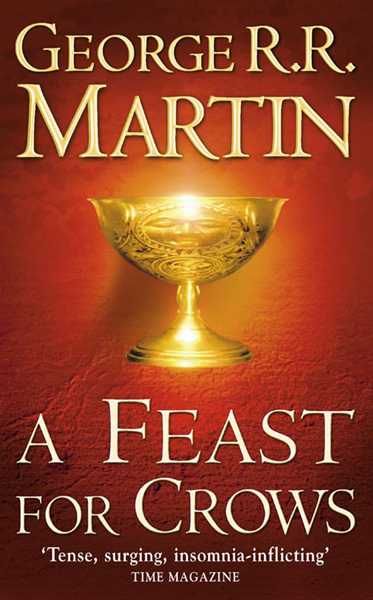
A Feast for Crows: Book Four of A Song of Ice and Fire


A Feast for Crows: Book Four of a Song of Ice and Fire
By George R.R. Martin

Note: I promise, there are no overt spoilers in this post.

Trying to avoid Game of Thrones spoilers on the Internet is like trying to shield yourself from the end of Star Trek II: The Wrath of Khan two decades on. Everyone knows that Spock was going to die in the end and everyone knows A Feast for Crows is the weakest of the Song of Ice and Fire series. Or so the Internet would like you to believe.

I admit it, I had put off reading the fourth installment of the series because it has been roundly discussed over the Intrawebs that this book is the bad apple in the proverbial bushel, the weakest link in the maester's chain, if you excuse my nerdiness. If Sesame Street did a 30 second bit on the series it would the one thing that doesn't belong. If A Feast for Crows were a movie it would be Indiana Jones and the Kingdom of the Crystal Skull or The Godfather III. If it were television, it would be the first season of The Simpsons. If it were music it would be post-David Lee Roth Van Halen. Hell, even George R.R. Martin himself felt the need to write an epilogue to this installment explaining why it is the way it is. Apparently he had to divide the fourth installment into two books to accommodate the entire story. Fine by me. He shouldn't apologize or explain his work. All this awesomeness came out of his head and nobody else's. He reserves the right to tell his story the way he wants. To hell with us critics, right? So what if A Feast for Crows is different.

And make no mistake, A Feast for Crows is indeed the odd man out of the series in a lot of ways. Rather than continue the stories of Bran Stark, Daenerys Targaryen and Tyrion Lannister, Martin opts to introduce narratives from a host of other characters, most notably Cersei Lannister and a bunch of Vikings, I mean Iron Islanders. As well, Martin introduces a few extremely dull characters from Dorne (yawn). But seriously, if you have been on Team Cersei through the first three books, this is the book for you. A solid 40% of the book is told from the perspective of the cruelest of the Lannister clan. By the end of this novel I'm not sure whether I want to punch Cersei in the throat or take her out for a nice seafood dinner. Either way, I don't think her behavior would have been at all believable without the first hand account of why she does what she does. If nothing else, one could regard A Feast for Crows as a primer for all things Lannister.

Furthermore, by adding characters into the narrative mix Martin fleshes out the situation in Westeros a lot more. Up until now, the happenings in Dorne, the Vale and the Iron Islands, have been sorely ignored. This was the first novel in which I got the feeling that things were afoot in all corners of the realm. Though I'm going to be honest here... I'm still entirely uninterested in what is happening in Dorne. Who cares about the Dornish? They are even less interesting than the Tullys.

And despite radio silence from my two favorite characters (Daenerys and Tyrion) and a complete lack of The Others, Martin hasn't abandoned all the familiars. Sansa and Arya Stark, Brienne of Tarth, Jaime Lannister and Samwell Tarly are all represented and their stories have progressed sufficiently. And the absence, for a novel, of Varys was refreshing. Don't get me wrong, Varys is a great character, but he's creepy and there was enough Robert Arryn and The Brotherhood Without Banners in A Feast for Crows to keep the creep factor high.

So, to make a long blog post short, A Feast for Crows isn't as bad as people say it is. It's different, that's for sure, and it doesn't follow the formula of the previous three novels and there is absolutely zero Tyrion represented (that did sting) but it's all logical progression and I finished the novel excited to sink my teeth into A Dance with Dragons. Am I glad to be over the hump? Yes. Was it as painful as it could have been? Well, if I had read this when it came out and had to wait a year for the next novel, yes, it would have been. As it stands, I can start A Dance with Dragons any time I want and that makes a load of difference.

Previous reviews in this series:

A Game of Thrones
A Clash of Kings
A Storm of Swords

Wednesday, December 5, 2012

Pariah


Pariah
By Bob Fingerman

What is it about the zombie genre that makes it such a tenacious sub-genre in our popular culture? Certainly it is not the nuanced characterization of the walking undead. From the opening scene of George Romero's 1968 genre-setting film Night of the Living Dead  to present, zombies, with very few exceptions, have been rather two-dimensional in scope. They are reanimated corpses who have a singular existential urge: to devour human flesh. Not the most rounded characters. And yet they seem to have more staying than vampires, wizards and werewolves which lend themselves to complex characterization.

So what gives?

The difference is the secondary characters. While other similar styles of horror focus the narrative on the specific creature (be it vampires, werewolves or what have you), what many people fail to understand about (most of) the zombie genre is that the zombies are actually inconsequential to the story being told. Zombie lore, at it's finest, is social satire. The writer or director uses the notion of a zombie apocalypse as a way in which to render society down to a microcosm of our complex social networks. Zombies focus the multitude of humanity's ills and places them under a microscope for the writer or director to examine in detail.

The zombie element is simply a clever and visually exciting backdrop to the real story: the human drama unfolding in the farm house or the shaping mall or the tenement building. When zombie lore strays from this nowhere-to-run motif it often falls flat on its face (note: this does not include anything that is written or filmed from the perspective of the zombie... that's genre deconstruction and worthy of its own discussion. See Dust). George Romero himself is guilty of straying in some of his more recent work, especially Day of the Dead.

All this is not to say that those working within the zombie genre are entirely reined in with respect to how they tell their story. There is still more than enough creative leeway within the genre to sustain it for years to come.

Case in point, Bob Fingerman's novel Pariah. The novel begins months into the apocalypse. The streets of New York are wall to wall zombies. A group of people living in a building in (or near) the Bronx have barricaded themselves inside their own building and are slowly starving to death and/or going crazy. As with so much zombie lore, each character represents a specific social stereotype that the author wants to throw into his own personal meting pot. What would happen if we put a misogynistic jock, an elderly Jewish couple, an artist, a woman who has recently lost her husband and infant daughter, the son of a mid-western Jesus freak and a middle aged black dude all together in a tiny space? What if they couldn't leave? How would that pan out?

This story could just as easily take place on a lonely spacecraft in deep space or a collapsed mine or an Antarctic base during the winter. Really, it would work in any local that offered no immediate escape. It would just be difficult to explain how an elderly Jewish couple ended up in Antarctica. That's where the zombies come in handy. It doesn't hurt that they are creepy and gory and scary as well.

This is what Fingerman understands so well. Rather than try to re-invent the wheel, Fingerman stayed true to the spirit of that old farmhouse in Romero's original film. Pariah is very much about humans trying and failing to co-exist in times of extreme duress.

But if that was all there was to Pariah, why would it merit such a lofty discussion on the nature of zombie lore? Thankfully, Pariah brings more to the table than simply another retelling of the same rat-in-a-cage trope. Fingerman, in what can only be described as a moment of undead clarity, introduces the concept of zombie immunity. What if specific individuals, for whatever reason, repelled the walking undead? What if certain people were simply unappetizing to zombies and could walk among them entirely unmolested? How would that work?

Pariah isn't a perfect novel. I found that Fingerman threw far too many pop culture references into his dialogue and internal monologue. While I fully understand the pervasive nature of books, music, films and the like, I don't think that people living under these conditions would reference SCTV or Dumb and Dumber that often. A lot of the pop culture references felt shoehorned into the narrative as a way for Fingerman to sound off about his own views rather than develop his characters. Unless, of course, he was insinuating that the sum of our culture doesn't amount to anything more than what we know about The Addams Family. In that case, this book is even more depressing than I initially thought.

But that's a minor inconvenience to an otherwise thought-provoking addition to the zombie oeuvre. I'm not one for spoilers so I'm just going to urge those who enjoy all things zombie to read Pariah. I'll admit that if you aren't a fan of the genre I don't think this will be the novel to turn you on to zombies, but if you, like me, crave all things living dead, this is a can't miss novel. It maintains all of the standard features that drew you into the zombie sub-genre to begin with, stays true to the mythology established by George Romero and throws just enough monkey wrench into the cogs to leave you asking more questions that it answers. Pariah is certainly a next step sort of work and, in time, should be considered canon for the keepers of zombie lore.