Showing posts with label the shack. Show all posts

Thursday, February 14, 2013

Ishmael


Ishmael
By Daniel Quinn

OK, look. Before I even begin to tell you why this book sucks, I'm going to flat out tell you: Read this book at your first possible convenience. Read that first sentence again if you have to. I didn't make any grammar mistakes. It reads as it should. I know, that doesn't make sense, but bear with me, I'll explain.

If someone were to ask me to summarize Ishmael, the pseudo-philosophical 1992 novel by Daniel Quinn in one sentence I would say:

Sanctimonious gorilla teaches dim-witted man why humanity is doomed.

"Could you expand on that a little?" you might ask.

"Sure," I'd respond. "Ishmael is the name of a telepathic and hyper-intelligent (for a non-homonoid primate) gorilla. His name is apt because he represents the natural world which is like Ishmael, Abraham's first son, in the Old Testament. See, he's named Ishmael because Ishmael lost his birthright and nature also.... oh never mind, you get it.

Anyway, Ishmael is a condescending ape who teaches this really fat-headed man (who remains unnamed throughout the novel) via metaphor, myth and parable about the way in which humanity is hurtling itself off a proverbial cliff and seems to be mistaking the sensation of falling for the sensation of flying (see, metaphor. I can't escape the style even in review). The nameless man takes so long to understand the simple reasoning of the gorilla that this 75 page book concludes about 200 pages later than it should. Seriously, this novel should be called Asshole Gorilla Talks to an Idiot.

Ishmael is not a good book. Not even remotely. It is didactic pablum at its worst (OK, not at its worst... I did read The Shack, but it's still pretty bad). It at times skirts dangerously close to the realm of new age tribalism (think The Alchemist) and really bad science fiction (think L. Ron Hubbard). The writing is at time almost unbearable and, as I mentioned before, it takes 260 pages (and two sequels, apparently) to get to the crux of Ishmael's argument. Furthermore, its love affair with primitivism is nothing short of hypocrisy and its dismissal of the "noble savage" archetype is irresponsible. Its neo-hippy tone is more than a little irritating and it supposes that prehistoric people were psychic vegetarians living in harmony with nature (as if). Lastly its quasi-religious and pseudo-scientific babble seems to be lifted right out of a Paulo Coelho book. Strike three, four, five, six......

That being said, Ishmael is not without its merits, specifically on the subject of mythology.

Ishmael is not so much a novel but a Socratic dialogue on the nature and history human supremacy on Earth, the way that supremacy is woven into the fabric of our ancient and modern mythologies and how we are all doomed if we do not soon alter our worldview. In fact, despite its multitude of deficiencies Ishmael is the sort of book that I would recommend everyone read. And when I say everyone, I don't mean everyone who likes new age books or everyone who is interested in anthropology or everyone interested in the social behavior of gorillas but everyone, without caveat. 

You might think it strange that I am universally recommending a book I ultimately detested. True, it's a bit of a stretch. But for all its shortcomings, Ishmael raises a lot of interesting topics for debate concerning the nature of man, the implications of the agricultural revolution and the notion of sustainable development. Unlike so many better books about the ecological and environmental degradation of the Earth, Quinn offers up very real and very plausible historical, mythological and anthropological reasonings for our destructive behavior. By dividing our culture into two defining categories (Takers and Leavers) he is able to define the exact moment in history in which we started down the path of global annihilation. I'm not saying he's right, but it's a pretty interesting guess, and one that deserves attention.

Of particular note in this novel is the deconstruction of the creation myth as found in Genesis and the way in which it chronicles the literal history of mankind in a way that was both shocking and decidedly obvious at the same time. I found myself harkening back to my university lectures on mythology and wondered what Joseph Campbell would have to say about Quinn's assertions about the mythological reasonings for Adam, Eve, Cain and Abel and how their story is metaphorically intertwined into the fabric of human history.

As I said, there are better books, both in the genre of fiction and non-fiction, that deal with the issues discussed in Ishmael, but none have presented the material in such a way as to show how deep the idea of destruction is imbedded into our very culture via mythology and history. For no other reason, I would recommend everyone read this novel. It deserves conversation.

What are some other bad books that really deserve to be read?

Wednesday, July 27, 2011

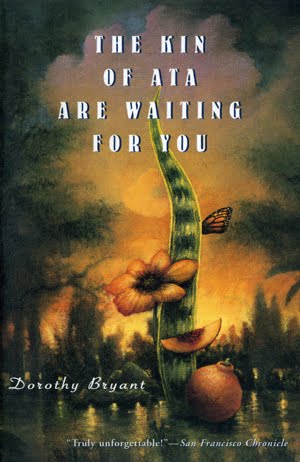
The Kin of Ata Are Waiting For You


The Kin of Ata Are Waiting For You
By Dorothy Bryant

Before I get onto this book, I need to share something that happened today (and it happens to be relevant to this book, so bear with me). I was hanging out at my classroom about an hour before my evening classes when a din from outside brought me to the window. Out on the street below were dozens of Taiwanese aboriginals dressed in traditional garb waiting for the beginning of a parade. Behind them was a group of drummers from Gambia and behind them were another group from Niger.

I rushed out onto the street to find the beginnings of a parade to celebrate the opening of an international meeting of aboriginal peoples. In Hualien, of all places. Cool!

There were groups from Peru, Tahiti, Uruguay, Chile, Canada, Kiribati, the Solomon Islands and New Zealand. Some were dancers, others musicians. The costumes were exquisite and it was one of those spontaneous moments (this event, like so many in Taiwan was poorly advertised and promoted) that makes life in Taiwan so interesting. A random parade in the middle of a Wednesday. Awesome.

But more to the point, it was a showcase of aboriginal culture from around the world. The rhythms and the music and the dance and the costumes that, despite our infinite barreling toward an unreachable level of progress, reminds us that we come from something more temporal. I'm not suggesting that aboriginal culture is somehow primitive or backward. That would be categorically arrogant. It is what it is and we all come from a variation on that theme whether we are Gambian, Uruguayan, Taiwanese or Canadian. But these cultures deserve a great deal of respect for surviving and thriving in this world and there is a great deal we, as modern citizens of the "global community," can learn from these cultures. They possess a certain quality and knowledge of our collective past that we often choose to ignore in our modern societies.

That being said, I think a whole load of people mix up the notion of respect for and symbiosis with nature and preservation of our collective history with the notion of right and wrong. There exists a segment of the world's population that see aboriginal cultures, wherever they my be, and wrongly assume that simple living equals instant happiness, understanding and bliss. That living "in tune with nature" has somehow made these cultures better and more spiritual than larger, more cosmopolitan cultures. Or, to put it more bluntly: primitive, good. Modern, bad.

I hate this crap. Ignorance flows in two directions.

Humanity is always sure that we are currently living in the end of times and that the next generation will see the demise of human civilization via warfare or rapture or environmental degradation or communism or meteor or Minotaur. We blame ourselves and our wayward cultures for cultivating an immoral civilization and if we could only go back to the way things used to be, we'll be A-OK. As if "the way things used to be" was all that and a bag of chips. It wasn't. That's why it isn't "the way it is." Furthermore, "the way things used to be" are simply a variation on "the way things are" and "the way things will be later."

Aboriginal cultures are not the answer to all our suffering. They may live a "simple" life "close to nature" but I can guarantee that the same social ills that exist in the world today exist in the microcosm of a Maasai village. It's all relative. Larger populations deal with larger problems. Like I said, we can learn a lot from indigenous culture, but salvation is not one of those things.

But I digress.

The Kin of Ata Are Waiting For You is the awkwardly titled utopian fantasy novel by Dorothy Bryant that tries to convince its readers that "primitive" (as she continuously refers to it) cultures essentially reign supreme over modern cultures (utopian fantasy indeed). We have strayed from our creation and have become suffering, ugly beings who are lost. The nameless protagonist is an outsider (from this world) that arrives at the mysterious island of Ata where a strange tribe of people (not unlike the Eloi in H.G. Wells' The Time Machine) live a frugal, yet fulfilling life devoid of the trappings of modern (or even pre-modern) living and depend on their dreams as a guide for the living. It all sounds strangely like Aldous Huxley's book Island, without the drugs.

But Aldous Huxley it is not. The plot is paper thin. It is a simple Jesus story of redemption and suffering with all sorts of pseudo-religious undertones. The philosophy is overtly sanctimonious and insanely over-simplified. Dorothy Bryant is obviously the sort of person that thinks we should go back to "the way things used to be," forget all our smart phones and plastic bags and garden hoses. Oh, sure there was more to this book than that, but I had such a hard time getting around these points that the rest seemed to glance over me.

But all was not lost reading this book. I did agree with Bryant on a couple of occasions, namely her take on dogma vs. interpretation. The Eloi, I mean Atans, do not possess a system of writing. they communicate everything orally (and too much oral communication is bad). Their culture is entirely dictated by their dreams and the culture is subject to change, nuance and interpretation rather than the dogmatic manner in which we seek truth (I'm looking at you, Christians and Muslims). While I won't go so far as to say that writing elicits a hardening of the arteries in humanity's heart, insisting on one uncompromising truth in a world with as truths as there are people is pointless. But to go so far as to shun the written language, learning and such, well that's taking things a bit too far, regardless of the message you are trying to convey.

Unless you are truly desperate or you happen to be one of those people who really liked The Shack or the work of Paulo Coelho, pass on this on if it comes your way.

Wednesday, May 11, 2011

Henry's Sisters


Henry's Sisters
by Cathy Lamb

Sweet merciful Jesus, it's rare that I read a book that not only sucks but also unleashes the full force of my ire and disgust. Alas, Cathy Lamb has written such a book. A book so mind-numbingly bad that I came within a camel's hair of putting it down (something I have not done with a book in almost five years). A book so poorly written that I actually read several reader reviews before I sat down to write this, thinking that I could commiserate with other readers about a book that just might be the worse thing I have ever read (and I've read Twilight).

Imagine my shock and horror when I discovered that Henry's Sisters seems to garner favorable reviews around the net. Goodreads, Amazon and Visual Bookshelf readers all seem to like it well enough, which made me check my medicine cabinet to see whether someone has been slipping me crazy pills again. Rest assured, they have not.

The atrocities committed by Cathy Lamb are so extensive that I have spent the last 300 pages (of a 400 page book) mentally cataloging them. I should have written them down because I fear I have forgotten so many that I will not be able to express my loathing in as much detail as I would like, but I will try. I figure the best way to organize this is with a simple list, beginning with:

1. One dimensional characters.

Christ Almighty, this pissed me off by the end of chapter four. Cathy Lamb writes characters like George Lucas creates a planet. Like Lucas' one-climate planets, each character in this book is characterized solely by his/her one defining quirk. Isabelle is a slut. Cecilia is fat. Janie is obsessive compulsive. Momma is cruel. It's as if these (cartoon) characters exist only through their one (and only, mind you) idiosyncrasy. None of these characters ever do anything beyond the bounds of this one, single attribute. By the end of the book when I should have been crying, I could only imagine cardboard cutouts of these characters being moved around on a cheap soap opera stage.

2. Constant reminders of one dimensional characters.

Cathy Lamb does not think much of her readers. I know that writing teachers will always tell a burgeoning writer to "assume your reader knows nothing." But there are limits to this. Lamb reminds me of Isabelle's sluttiness, Cecilia's eating and Janie's compulsions on EVERY PAGE OF THE BOOK! Holy hell, woman, I got it! Mentally disabled Henry is the only sane person in the Bommarito family. I can handle that. No need to hammer it into me every seventh sentence!

3. Characterization of men

This has bothered me in other books, but none more than this one. Aside from Henry (and he's mentally disabled, remember?) all the male characters in this book either rape, abandon their family, cheat, lie, mass murder, say impossibly insensitive things, act like a raging idiot or (just to mix it up) a combination. I'm not anti-feminist or anything, but c'mon! Some of the men in this book were about as intelligent as Curly from the Three Stooges. Great if you are writing absurd comedy. Absurd if you are trying to write great drama. When the only male character written with any compassion is mentally disabled (in case you forgot), perhaps you are trying to send a subtle message?

4. The dialogue is impossibly bad

Seriously. Lamb tried to write witty arguments between these sisters but it invariably sounded like the sorts of arguments that six year-olds have over who's father can beat up everyone else's. Case in point:

"Your momma's got good tits," he told us, smirking, when Momma was out of earshot.
"And you have a small dick," I told him. "Flaccid. Weak."
"And a fat ass," Janie added. "Like blubber cannons. I'd like to chop them off with a hatchet."
"Are you related to a pig? Your nose, it's amazing," Cecilia said. "Piglike. Snort for me, would you, you ugly pig?"

Who talks like that?

5. Mentally disabled people and Vietnamese people speak the same.

Guess who is mentally disabled and who is Vietnamese...

A) "I no take a second. I no want a shot."
B) "I no understand. Your face... Ah Isabelle."

6. The litany of tragedy

I wonder whether this may be Cathy Lamb's last book. I say that because she seems to have tried to squeeze as much tragedy into 400 pages as is humanly possible. Rape, murder, Vietnam flashbacks, cancer, death, abortion, family dysfunction, homelessness, cruelty toward the disabled, messy divorce, serial rape/murder, psychological disorders, abandonment, prostitution etc... etc.... etc.... I know this book is supposed to be about the triumph of the human spirit and the importance of family but jeez, Louise, save an issue or two for your next book, would ya?

7. Telegraphing the reveals

I can visualize Cathy Lamb sitting at her computer (or typewriter or whatever) thinking to herself: "Oh man, when my readers find out the truth behind this deeply imbedded plot tidbit, won't they be surprised. What she fails to understand is that her well-placed clues are dead giveaways for what is coming, which really takes away from the enjoyment of the book when you know exactly what's coming in a couple of dozen pages. The white haired man in the street was really their long-lost father? Imagine!

8. Blatantly obvious statements

Such as: Pancreatic cancer are two words you never want to hear.

You don't say....

9. Thinly veiled devotionalism

This is what really galled me. About halfway through the book I realized that I was reading Christian literature. I knew there was something askew, much like when you realize that the sort-of-good-but-kinda-odd rock you were listening to was actually Christian Rock. This is a novel akin to The Shack, a book I read and detested last year. Which, come to think of it, would explain all the positive reviews this book seems to get online. This is the sort of book that is read by a very specific slice of the reading public. People who are shocked by graphic language and sexuality. Readers who identify with one-issue people because they are one-issue people themselves: Christians.

Anyway, There are a host of other, lesser reasons that this book sucked, I feel like I've wasted enough time and words on this disaster of a novel. I wouldn't recommend this book to my worst enemy. Don't bother.