Wednesday, July 27, 2011

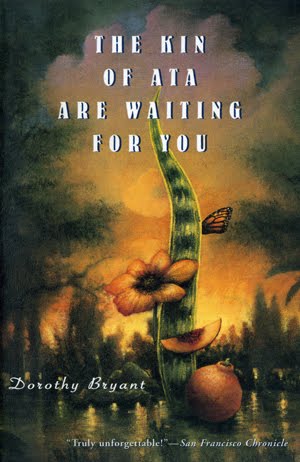
The Kin of Ata Are Waiting For You


The Kin of Ata Are Waiting For You
By Dorothy Bryant

Before I get onto this book, I need to share something that happened today (and it happens to be relevant to this book, so bear with me). I was hanging out at my classroom about an hour before my evening classes when a din from outside brought me to the window. Out on the street below were dozens of Taiwanese aboriginals dressed in traditional garb waiting for the beginning of a parade. Behind them was a group of drummers from Gambia and behind them were another group from Niger.

I rushed out onto the street to find the beginnings of a parade to celebrate the opening of an international meeting of aboriginal peoples. In Hualien, of all places. Cool!

There were groups from Peru, Tahiti, Uruguay, Chile, Canada, Kiribati, the Solomon Islands and New Zealand. Some were dancers, others musicians. The costumes were exquisite and it was one of those spontaneous moments (this event, like so many in Taiwan was poorly advertised and promoted) that makes life in Taiwan so interesting. A random parade in the middle of a Wednesday. Awesome.

But more to the point, it was a showcase of aboriginal culture from around the world. The rhythms and the music and the dance and the costumes that, despite our infinite barreling toward an unreachable level of progress, reminds us that we come from something more temporal. I'm not suggesting that aboriginal culture is somehow primitive or backward. That would be categorically arrogant. It is what it is and we all come from a variation on that theme whether we are Gambian, Uruguayan, Taiwanese or Canadian. But these cultures deserve a great deal of respect for surviving and thriving in this world and there is a great deal we, as modern citizens of the "global community," can learn from these cultures. They possess a certain quality and knowledge of our collective past that we often choose to ignore in our modern societies.

That being said, I think a whole load of people mix up the notion of respect for and symbiosis with nature and preservation of our collective history with the notion of right and wrong. There exists a segment of the world's population that see aboriginal cultures, wherever they my be, and wrongly assume that simple living equals instant happiness, understanding and bliss. That living "in tune with nature" has somehow made these cultures better and more spiritual than larger, more cosmopolitan cultures. Or, to put it more bluntly: primitive, good. Modern, bad.

I hate this crap. Ignorance flows in two directions.

Humanity is always sure that we are currently living in the end of times and that the next generation will see the demise of human civilization via warfare or rapture or environmental degradation or communism or meteor or Minotaur. We blame ourselves and our wayward cultures for cultivating an immoral civilization and if we could only go back to the way things used to be, we'll be A-OK. As if "the way things used to be" was all that and a bag of chips. It wasn't. That's why it isn't "the way it is." Furthermore, "the way things used to be" are simply a variation on "the way things are" and "the way things will be later."

Aboriginal cultures are not the answer to all our suffering. They may live a "simple" life "close to nature" but I can guarantee that the same social ills that exist in the world today exist in the microcosm of a Maasai village. It's all relative. Larger populations deal with larger problems. Like I said, we can learn a lot from indigenous culture, but salvation is not one of those things.

But I digress.

The Kin of Ata Are Waiting For You is the awkwardly titled utopian fantasy novel by Dorothy Bryant that tries to convince its readers that "primitive" (as she continuously refers to it) cultures essentially reign supreme over modern cultures (utopian fantasy indeed). We have strayed from our creation and have become suffering, ugly beings who are lost. The nameless protagonist is an outsider (from this world) that arrives at the mysterious island of Ata where a strange tribe of people (not unlike the Eloi in H.G. Wells' The Time Machine) live a frugal, yet fulfilling life devoid of the trappings of modern (or even pre-modern) living and depend on their dreams as a guide for the living. It all sounds strangely like Aldous Huxley's book Island, without the drugs.

But Aldous Huxley it is not. The plot is paper thin. It is a simple Jesus story of redemption and suffering with all sorts of pseudo-religious undertones. The philosophy is overtly sanctimonious and insanely over-simplified. Dorothy Bryant is obviously the sort of person that thinks we should go back to "the way things used to be," forget all our smart phones and plastic bags and garden hoses. Oh, sure there was more to this book than that, but I had such a hard time getting around these points that the rest seemed to glance over me.

But all was not lost reading this book. I did agree with Bryant on a couple of occasions, namely her take on dogma vs. interpretation. The Eloi, I mean Atans, do not possess a system of writing. they communicate everything orally (and too much oral communication is bad). Their culture is entirely dictated by their dreams and the culture is subject to change, nuance and interpretation rather than the dogmatic manner in which we seek truth (I'm looking at you, Christians and Muslims). While I won't go so far as to say that writing elicits a hardening of the arteries in humanity's heart, insisting on one uncompromising truth in a world with as truths as there are people is pointless. But to go so far as to shun the written language, learning and such, well that's taking things a bit too far, regardless of the message you are trying to convey.

Unless you are truly desperate or you happen to be one of those people who really liked The Shack or the work of Paulo Coelho, pass on this on if it comes your way.

Monday, July 25, 2011

Sweet Soul Music: Rhythm and Blues and the Southern Dream of Freedom


Sweet Soul Music
Rhythm and Blues and the Southern Dream of Freedom
By Peter Guralnick

If you like good music....
(Yeah, yeah)

I had a very musical upbringing. Oh, sure, I can't actually play any instrument well (although I've been known to carry a tune on the clarinet and the guitar from time to time). What I mean by musical upbringing is that music has always played an important role in my life and was a defining element of my personality through adolescence. It's still plays an important role in my life, as one can plainly see via the book choices I have made recently.

Spotlight on me, now.

My earliest recollection of music was my father's record collection. It was standard dad stuff like Elvis Presley, Johnny Cash, Bobby Goldsboro and Neil Diamond with a smattering of good country and a smattering of bad rock (Fleetwood Mac?). It was an unfortunate collection in that it didn't adequately represent the depth of his commitment to country and western music.

I grew up listening to CFGM radio in Toronto while sitting in the backseat of my Dad's Cordoba. He used to sing along to Charlie Pride, Waylon Jennings, Charlie Rich and all the other classic country singers of the era. It was all too embarrassing for a kid who was sort of into Prince and Michael Jackson, but still listening to the odd Chipmunks LP.

My father also liked soul. I recall late night poker games at my house. The adults would listen to radio programs spinning old soul and country music. I fell asleep to the sounds of Motown and Stax long before I had any idea what those two words meant. I still have a soft spot for Diana Ross and Supremes for singing me to sleep at such a tender age.

As I grew up I, like so many other kids, rejected the music of my parents and moved onto things a bit more extreme. First metal, then classic rock, then hip-hop, folk, punk, reggae, alternative, indie, trip-hop, electronic and on and on. Each genre opening the door to new sounds and new ideas. I went through a serious, and entirely self-motivated musical education from the age of eight through college and beyond. I have become, over time, what I refer to as a music snob. I was so engrossed in the idea of listening to the music that I simply never got around to learning how to play the music. But I sure do have opinions on music. Woo-boy. Don't get me started.

But somewhere along the way (probably back in my deepest hipster-music snob days) I returned full circle to the country and western music and soul of my childhood. People say everyone eventually goes back to their roots. Well, I did with a vengeance and I've never looked back. I rediscovered Hank Williams and Willie Nelson, Wilson Pickett and Otis Redding. I dug deeper and listened (really listened) to the likes of Joe Tex, Booker T, Gram Parsons and Ralph Stanley for the first time. I developed new appreciation for the work of James Brown, Aretha Franklin and George Jones. People I had roundly dismissed early on as "My Parent's Music." It was a homecoming of sorts. It was "my parent's music," and they, like so many other things, were right. It was a return to the scorching hot leather interior of my father's Cordoba. And while I love country and western music and northern soul, there has always been a special place in my heart for Southern soul.

Spotlight on Peter Guralnick, now.

Sweet Soul Music: Rhythm and Blues and the Southern Dream of Freedom by Peter Guralnick is a wonderful behind the scenes look at the evolution, rise and eventual demise of Southern soul music. But it's so much more than that. It is a work five years in the making in which Guralnick traveled the length and breadth of America talking to the veritable who's who of soul music in Memphis and the south: Jerry Wexler, Ahmet Ertgun, Ray Charles, Joe Tex, Jim Stewart, Estelle Axton, Booker T, Steve Cropper, Solomon Burke, James Brown, Dan Penn, Isaac Hayes and on and on and on... Thank God he had the foresight to write this book in the early eighties when many of these people were still alive. The history is what makes this book important, but it's the stories that make it seminal.

What really struck me about the scene in Memphis and Alabama in the 1960s was the sense of togetherness and camaraderie among the company men, record producers, writers, musicians and singers. They were hanging out at the studios, making hit records, touring the country and repeating. Everyone was working for each other. Booker T and the MGs would do session work on an Otis Redding tune in the morning, cut their own record in the afternoon and play onstage with Rufus Thomas in the evening. The Memphis horns play on virtually every track ever produced at Stax but were also available to artists at Muscle Shoals and Atlantic. It was all more like family than a business (a fantasy that would nearly sink Stax in 1970, but that's another story). The story of southern soul is a story of a movement rather than simply a genre of music. This was something that could never, ever be recreated no matter how much talent you stuffed into a studio or on stage today. Something was happening and the music was the catalyst.

Spotlight on Otis Redding, now.

At the center of this movement was Otis Redding. His rise to fame and tragic death mirrored (or foretold) the rise and fall of southern soul. His success mirrored (or foretold) the rise and fall of Stax Records. Wile Guralnick seems tempted to hypothesize as to what might have happened had Redding's plane not gone down in northern Wisconsin he backs away from that ledge and let's it be.

Spotlight on Solomon Burke now.

With all due respect to Stax and Ray Charles, I especially enjoyed the stories about the Reverend Solomon Burke (aka The King of Soul... much to the chagrin of James Brown), one of the oddest characters in a genre stocked with odd characters. From his free popcorn giveaways to his recollections of playing a show for the Ku Klux Klan in Mississippi (they thought he was white when they booked him) Burke is far and away the most engaging character in the book. Guralnick and Burke became fast friends during the writing process and it shows. I also enjoyed the various accounts of Aretha's disastrous recording session at Muscle Shoals and the constant political machinations between Memphis, Muscle Shoals and Atlantic Records.

But the book really culminated with the account of the demise of soul. Guralnick does a great job of recounting the events of 1968 through 1970 with an objectivity and clarity that another writer may not have had. It would be easy to place blame entirely on one event or one person (the death of Otis Redding, the assassination of Martin Luther King Jr., the rise of black militancy, Atlantic Record's retreat from the south, the rise of guitar driven rock) but he doesn't. Every detail is chronicled but Guralnick refrains from making any judgment stating that he was simply a fan trying to make sense of a genre that came and went far too fast.

Sweet Soul Music is a must read for any fan of soul music. It really delves deep into the closed-off world that was southern soul (many of these guys hadn't even heard of the Beatles when they turned up on American soil, and most never bought into their sound. Hell, even Motown was too mainstream for many of them). It really was a community. small and tight-knit. But one that changed the face of music in the 1960s and beyond. Without Stax and Muscle Shoals there would never have been funk, modern R&B or hip-hop (at least not as we know it).

Anyway, if you like good music, that sweet soul music, Read this book, now.

Yeah, yeah.

Sunday, July 17, 2011

The Yiddish Policemen's Union


The Yiddish Policemen's Union
Michael Chabon

The Yiddish Policeman's Union is the answer to a very difficult question:

Does there exist a book that is simply too Jewish?

Oi vey! This might be the one.

But, once you get past all the shlemiels, shaydls and shtinkers Michael Chabon has crafted an interesting, if maddeningly incomplete, narrative.

I say interesting because Chabon has taken a historical footnote and supposed that it actually happened. In this case, Chabon takes the controversial proposal made by Harold Ickes in 1940 that a portion of Alaska be portioned out to Jewish refugees trying to escape the expansion of Nazi Germany. Ickes' Alaska proposal was very real, but it was shot down in the U.S. Senate and European Jews were left to their own devices for another eight years before the creation of the state of Israel. In Chabon's world, thousands flood the icy confines of Baranof Island and over-populate the tiny Russian settlement of Sitka (which becomes a seething metropolis of two million souls) which then goes on to host the 1977 World's Fair (the pinnacle of the Sitka settlement, apparently). As well, there exists constant friction between the Sitka Jews and the Tlingit natives in the area.

I say incomplete because Chabon offers up information about this alternate reality like Ebenezer Scrooge offers a two pence raise on Christmas Eve. Chabon supposes that Israel was indeed created in 1948 but was subsequently wiped off the map within six weeks during the Arab-Israeli War. Therefore, it is the state of Israel that is relegated to the status of footnote and the Alaskan proposal that becomes the defining event for post-war Jews.

Trouble is, the Sitka Settlement is still on American soil and the Ickes proposal was simply a 60 year land lease and the narrative takes place five weeks prior to Reversion. Since the holocaust in Chabon's world was nowhere near as devastating as the one that occurred in reality, worldwide attitudes toward Jews haven't changed much. America (and the Tlingit) very much wants the Jews (or the Frozen Chosen as they are referred to in the novel) out of the Sitka Settlement, forcing the Jews back into their centuries old diaspora where pogroms an ghettos are still very much a reality.

Sounds cool (in a alternate-history way, not in the anti-Semitic way), right?

Well it is.

Except that Chabon only gives out tantalizingly few details about the geo-political situation despite the fact that they become important toward the end of the book. His story focuses on a loser police detective in Sitka who is investigating the murder of a heroin junkie who may or may not have been Messiah (Tzaddik Ha-Dor). The investigation, which begins in the sleaziest fleabag hotel in Sitka blows up into an international incident involving extremist Zionists bent on reclamation of Jerusalem and the Holy Land from the Arabs and, of course, chess.

While the primary narrative was alright (but again, incomplete) I was far more interested in the world that Chabon had created. I wanted more information about the state of the world in his alternate 2007. He mentions the Third Russian Republic and the existence of a country called Irkutsk, which raised all sorts of questions about this alternative world and its relationship with the board game Risk. Apparently the Atomic Bomb was indeed dropped on Berlin at the end of World War II (1946). He noted that the major players in the Middle East were Egypt and Persia (!?!) and that Manchuria existed as an autonomous nation, presupposing that China has fractured into another "Warring States" period. There was something called the "Cuban War," JFK married Marilyn Monroe and Orson Welles completed his opus Heart of Darkness. In one flight of fancy that is not too far off from the truth, America is ruled by right-wing evangelical Christian zealots.

I wanted to know more about this world. What of Japan? What happened with them at the end of the war? Or Korea. Or Greece. Two major international crises that followed the war. How did they play out? Or the United Kingdom or France or Germany or Africa or Greenland. The little tidbits of history Chabon drops are like bread crumbs for a starving man. I was insatiable for information about this intriguing world. So much so that I often lost interest in the primary narrative.

This was all too much for me who would have much preferred a travelogue through Chabon's world at some point in the narrative so that I could place these Alaskan Jews into some sort of political and historical context. This would have really eased my mind about what I was reading instead of constantly trying to guess about what had gone on in the world over the prior 60 years. Alas, Chabon focuses on telling his story of crime, justice and redemption at a personal level and I can't really fault him for that. It's his story and he can tell it any way he wants to and frankly, he does tell it very well (and in Yiddish, too), although it begins to sound a little familiar once you break it down...

Meyer Landsman is a hard-boiled cop in a world full of Raymond Chandler characters (if Raymond Chandler characters carried monikers such as Mendel or Yossele). He is instantly detestable and lovable but prone to making really bad decisions that somehow work out in his favor. Berko, his Tlingit-turned-Jew partner, is a metaphor for the topsy-turvy politics of this barren northern settlement and Bina, Landsman's ex-wife and current boss is a careerist cop who plays by the book. A nice little Harry Potter-esque triad of good guys to fight against Slytherin Hou... I mean the Verbover Jews.

Anyway, The Yiddish Policemen's Union is a good book but left me needing more in terms of geo-politics. I suspect that says a lot more about me than it does about this book. So read it yourself and get back to me about what you thought because I'm still day dreaming about Shiite/Sunni conflicts in Arab controlled Palestine and their global implications.

Yes. I'm a nerd.

Sunday, July 10, 2011

A Spy in the House of Love


A Spy in the House of Love
By Anais Nin

I'm a spy,
In the house of love,
I know the dreams,
That you're dreaming of.

Yet another book that left me with a song stuck in my head. Not a single page went by in this book when I didn't hum this song. I've been whistling it for days and not even my old stand-by, Paint It Black, has been able to erase this mediocre Doors song from my head. Poor Anais Nin. I don't think this was her intention when she wrote A Spy in the House of Love.

This was an avant-garde novel about female self-discovery (or self destruction, depending on how you read it). Sabina, the lead character, is a young, attractive and married woman who seems to be on a quest to seduce every attractive man within her limited world. Much of the novel reads as a confessional as Sabina speaks to someone known as The Lie Detector, a person she finds by randomly dialing the telephone. According to what I have read, Nin modeled Sabina after herself, just so you know.

Let's start right off and admit that Anais Nin is a hell of a writer and this is, all things considered, a good book. It was my first attempt at reading Ms. Nin and I'm glad I did. The trouble is that A Spy in the House of Love is not a good book for me. So please, don't let what I write sway you on this book.

I have a hard time with avant-garde books. It's not that I don't understand them (ok, sometimes I don't) but I find avant-garde books are a lot like watching old UHF television channels. If you got the rabbit ears just right and stood in the left corner of the room with your right leg stretched across the back of the sofa you could get a clear picture for a few minutes before the television gods would reset the rules and then you'd have to guess what configuration of furniture and human body would clear the picture once again. If you simply tried to watch UHF as it was, it would invariably be a cacophony of snow and static with periodic glimpses at a program buried deep within the recesses of your television set.

For the young'uns out there, back in the day, watching television was full contact. And we wore onions on our belt, as it was the style at the time.

I find the same issue with avant-garde books. If I concentrate hard enough I can focus on what is happening on the page and in the story for a page or two, but inevitably the picture scrambles again and my mind wanders off in search of other shinier things to think about (or as was often the case during this book, songs to hum). It's a constant struggle to keep the story straight when you are investing so much time in simply keeping the sentences straight.

Like I said, it's not that Nin isn't a great writer. Anyone who writes prose such as...


She smiled indulgently when he lay down on the couch preparing such floral arrangement of limbs, head, hands as to suggest a carnal banquet.

...should be applauded and praised and awarded prizes for their lucid use of English diction. It's that several sentences in a row of such dense imagery really pack a punch. It's like 7.7% beer. Seems like a good idea until you get halfway through a glass and realize you couldn't possibly get another drop down. It's too filling. Anais Nin is a sipping beer, if you pardon my mixed metaphors.

I'm a keg chugger. I enjoy six-packs and two-fours. I'm the frat boy of reading. I can't simply read a page or two of verbosity every day and feel satisfied. I need to be drunk with story. I simply cannot keep my mind focused on novels like this. It takes me three times as long to read because I often read three or four pages before realizing that I have been thinking about other things for the past three or four pages and have to go back and read them again (sometimes even a third time).

If had some success with other writers of this style, most notably Virginia Woolf's Orlando which I really enjoyed. But on the whole I should learn to avoid the avant-garde genre.

Wednesday, July 6, 2011

The Phantom Tollbooth


The Phantom Tollbooth
By Norton Juster

This was a "desperation book."

Let me explain. As a resident of a small town on a non-English speaking island in Asia, I rely on a variety of factors to get books in my hands. Whether it is trips to the big city, shipments from home, overseas orders or loans from friends, getting books is not as simple as walking into the local bookstore and finding my next read. As of the writing of this blog post, there are no English bookstores within 300 km of my house.

All is not entirely lost for this forgotten little town. I'm helping amass books for an English library in town. Great for the English readers in town, but not so much for me. A quick glance through the 800 books we have collected reveals that I have either read them or they are written by Sophie Kinsella or Stephanie Meyer. Sure, I get first crack at new donations, but donations are few and far between, and one has to fill the hours of reading between boxes of books. I don't care what you think. It will be a cold day in hell before I read Eat, Pray, Love.

Yeah, I know. I might be the quintessential target market for the Kindle or E-Reader. I could download books and never worry about availability. I know. It'll probably happen, but I'm resisting. I like the way books smell and feel. Until they can recreate the aroma and texture of the book, I'm staying with paper.

So anyway...

I keep a personal reading pile at home. It's a small shelf. I go through deluge and dearth. Sometimes I have 8-10 books on my shelf that I can't wait to read. Other times I have nothing on hand whatsoever. Currently I have three. Since I have a rule that I always start a book on the same day I finish one, book availability can be problematic. Case in point, The Phantom Tollbooth.

I finished my previous book rather unexpectedly a few days back. I was out of the house and wouldn't be back until late, but I wasn't busy (I like far enough out of town to make return trips home very inconvenient). I had a few hours to kill between classes and whatnot and I was completely want for something to read. Since the cereal boxes in my town are written in Chinese and I haven't seen an English newspaper in a 7-11 in a few years, I was caught in desperate measures.

I scanned through the books at the library. Absolutely nothing stood out to me as something I could sit down and read on a hot summer day. Try as I might, I could not muster the energy to open The Pickwick Papers or The World Is Flat. I wandered out of the library and into my classroom where I noticed a forgotten copy of The Phantom Tollbooth.

A student of mine had brought it in and asked if I had ever read it. I hadn't. He noted that it seemed good, but he had had a hard time understanding it as a second language learner. He has subsequently left it in class and gone on vacation for a couple of weeks, so I picked it up.

My rationale was that if The Phantom Tollbooth truly did suck, it was a quick read with illustrations along the way. I'd be through the book in no time, but it would take me long enough to get home and pick up one of the remaining books on my reading shelf (which is depleting at an alarming rate, I might add). A stopgap solution.

I should mention that I don't read a lot of children's fiction. Sure, I like Roald Dahl and Louis Sachar and I admit that I did love the Harry Potter series but I'm not one of those adults fixated on YA fiction. No arrested development here. I prefer a good Salman Rushdie to Redwall any day. But I'm no book snob. In desperate times, I'll read (almost) anything and I realize that YA fiction is an essential genre for instilling kids with the habit of reading (although I think the genre has wholly too many vampires). It just doesn't interest me anymore. Imagine that. YA fiction not suitable for old man. Shocking developments in cultural anthropology.

So I read The Phantom Tollbooth.

It's a book I probably should have read when I was younger, but it somehow snuck past me through my childhood and adolescence. It's the sort of book I would have devoured at the age of ten or eleven when I was reading in trees and eating grass. Lots of word play (maybe a bit too much Mr. Juster... I think you think kids know more than they actually do), some cool characters, a plot that rambles on unconcerned with tying up loose ends (what happened to Faintly Macabre?) and a hero named Milo (that's my dog's name!). It's also got some really nice illustrations by Jules Feiffer and a map. Books with maps are almost always awesome.

Do I recommend this book? If you are ten or eleven years-old and wear glasses and don't fit in at school and like reading a lot and really like The BFG and think puns are funny? Yes. If you aren't ten or eleven years-old and don't mistakingly wear your pajamas to school and enjoy going to work and prefer reading in armchairs and really liked Cloud Atlas and think irony is funny then you have probably read this book a few times under other names. It's not as good this time.

Sometimes, revisiting your childhood makes you realize why growing up was actually a pretty cool thing after all.

Nice book. No thanks.

Monday, July 4, 2011

The Stranger (L'Etranger)


The Stranger (L'Etranger)
By Albert Camus
Translated by Matthew Ward

Yes, yes. Albert Camus is one of the most important 20th-century French writers and a Nobel Prize winning novelist.

Yes, yes. The Stranger is an exquisitely philosophical novel exploring the themes of colonialism, existentialism and nihilism.

Nihilism? Fuck me. I mean, say what you will about the tenets of National Socialism, but at least it's an ethos!

Yes, yes. Meursault is a champion of free will and a brave literary figure who personifies the meaninglessness of life.

Yes, yes. It's a great read.

All this is true and then some. The Stranger is a really good book on many levels. But the only thing I could think of while reading this novel was: "Well, now I know where The Cure got the title of the song Killing an Arab."

Am I wrong or am I just an asshole?

Thursday, June 30, 2011

Drowning Ruth


Drowning Ruth
By Christina Schwarz

Way back at book twenty-three (Clara Callan if you have forgotten) I wrote out a checklist of things that make for the definitive Canadian novel. There are eleven criteria that make the stereotypical Canadian novel and I have created a scientific scale to gauge exactly HOW Canadian a novel is. This scale is called the Tragically Hip Sacle of Canadiana and it is measured from 0 to 12 hips (a hip is a unit of measure on the THSoC. 1 hip is equal to 1 unit of Canadian-ness). The scale works thusly:

0 ~ 1 hips: Foreign language novel (not set in Quebec), translated into English
1 ~ 3 hips: Native language novel written by non-Commonwealth/American writer (e.g. Singaporean, South African)
3 ~ 4 hips: American writer (excluding border state writers)
4 ~ 5 hips: American writer (border state)
5 ~ 6 hips: Non Canadian, Commonwealth writer.
6 ~ 7 hips: French writers from Quebec writing in French.
7 ~ 8 hips: Writers from Alberta.
8 ~ 9 hips: English writers from Quebec writing in English.
9 ~ 10 hips: Canadian writers trying to be a little different (e.g. Douglas Coupland)
10 ~ 11 hips: Writer has a tattoo of the maple leaf under right nipple and/or right ankle
11 ~ 12 hips: Writer lives on an island, in a northern settlement (probably in an igloo), eats moose meat and Kraft Dinner with ketchup, listens to CBC radio and probably owns more than one Bombardier product, eh?

Realistically, if a novelist measures 9.0 hips on the Tragically Hip Scale of Canadiana then they should be awarded an honorary Giller Prize, Governor General's Award, a Juno, a Genie and a Gemini (if you don't understand 100% of those references, then you must measure lower than 4.3 hips, which means you are Non-Canadian Commonwealth or, worse, American).

Drowning Ruth, a period novel by Christina Scharz is up for scrutiny today. Let's see how it scores on the THSoC scale:

1. Novel set between 1900~1945.

The novel is begins in the early 1900s and ends in 1941, thus spanning almost the exact timeframe deemed to be perfectly Canadian. Score 1.5 hips.

2. Novel is set in/on a small town/island/northern settlement.

The novel is set in a small town in the north and an island figures extremely prominently in the narrative. Score 3 hips.

3. Novel involves a strong/complicated/deranged female protagonist on a journey of self-identification.

Main characters are almost all female. One strong, one deranged and one complicated. Score 1.5 hip.

4. Novel involves one or more conservative/despicable/sexually deviant men.

Of course. Score 1 hip.

5. Story involves one or more hard-boiled sidekicks.

The character of Imogene qualifies as a sidekick, although i would be pressed to admit that she is entirely hard-bolied. Score 0.7 hips.

6. Story involves an unwanted pregnancy/abortion/infant mortality.

Yes. Score 1 hip.

7. Story mentions the Dionne quintuplets/Edward's abdication/Vimy Ridge.

Not entirely, but World War One figures prominently so score 0.5 hips.

8. Story involves a major snowstorm.

More than one. Score 1 hip.

9. Story contains mild to overt anti-Americanism.

This is a complicated answer as you will see in my conclusions. While I can't say for certai that this book has anti-American undertones, it certainly isn'y pro-America. Score 0.4 hips.

10. Story explores multiculturalism.

OK. No. Score 0 hips.

11. Story contains mild to overt anti-Religion themes.

Yes. Score 1 hips.

Final score: 11.6 on a scale of 12. Drowning Ruth is definitively a Canadian novel. In fact, it could be held up as a textbook example of Canadian literature in any University anywhere north of the 49th. A perfect storm of Canadiana. This is entirely strange since Drowning Ruth was written by an American (Christina Schwarz) and is set in Wisconsin (which, last I checked, still lies within the national boundaries of the United States).

I know. I couldn't believe it either.

This is why I was unable to score the Anti-American criterion since it is virtually impossible for an American citizen to actively write an anti-American novel, no matter how much they question authority. There seem to be elements of anti-Americanism but it was not overt enough for me to score scientifically. Pity.

How does an American write the definitive Canadian novel? Perhaps growing up in Wisconsin (which is American in name only) helps. The Great Lakes are far more pourous than the land border. Ms. Schwarz therefore probably grew up with a healthy diet of Farley Mowat, Margaret Atwood and Robertson Davies. She has probably read enough Canadian novels to stop the Edmund Fitzgerald.

Oprah Winfrey, however, obviously does not read enough Canadian literature as Drowning Ruth was selected as part of the Oprah Book Club. If she was familiar whe THSoC she would have known that Drowning Ruth wasn't the mysteriously dark novel she thought it to be but rather a paint-by-numbers example of virtually every book published in Canada since 1945.

Chicago isn't far enough north, apparently.

Tuesday, June 21, 2011

Thinner


Thinner
By Stephen King (aka Richard Bachman)

After a critical reading of Thinner, the last book ever written by Richard Bachman (Stephen King) I only have two questions:

1. Why does a thirty-something year-old man who is a partner at his law firm, has a wife and daughter and is a pillar of the community, allow people in his town to continue to refer to him as "Billy?"

The only adult males who are allowed to get away with the name "Billy" play professional sports.

And...

2. What is it with Stephen King and hand jobs?

Seriously. The hand job doled out by Heidi, the wife of Billy Halek plays a more central part in this Kafka-esque metamorphosis tale than most of the other human characters. King, erm... Bachman, spends more time examining, dissecting and re-evaluating said hand job than he does developing characters such as Taduz Lemke, the mysterious Gypsy who curses Halek after Halek hits and kills his daughter in an automobile accident while the aforementioned hand job was taking place.

Got that? Good.

We learn that this was the first time Halek had ever received a hand job from his wife while operating a motor vehicle ("Why, Heidi? why did you pick that day to give me my first hand job!" whined Billy). We learn that when his car grill made impact with Taduz Lemke's daughter he climaxed, but his wife's kung fu grip retained his ejaculation, thereby causing Billy a moment of both extreme pleasure and extreme pain (this is actually mentioned twice in the novel!). We learn that Billy Halek is capable of harboring a hell of a lot of hate based on a single act of manual stimulation but we never learn a damned thing about who Taduz Lemke is or what he's been up to the past 105 of his 106 years on this planet. Priorities, Mr. King. We have a story to tell and there's a hell of a lot more going on than simply a hand job.

If this were the first instance of Stephen King glorifying the pitiful sex lives of Vanilla America I would excuse it, but King has made a career out of writing badly about sex. Gratuitous breaking-and-entering-turned-masturbation sessions in Cujo, group orgies in It and don't even get me started with Gerald's Game. I know that sex and violence are two of the pillars of the horror genre but I find that sex fits into a Stephen King story the way a Slayer song fits into a romantic mixed tape.

Billy Halek could have been doing literally anything else when he hit that woman. Anything would have made more sense. He could have been eating a Super-Sized McDonald's Valu-Pack or a bucket of KFC chicken when he hit her. Certainly that would have fit the narrative a little more. After all, The old Gypsy curse causes him to get thinner, not receive continuous hand jobs until his penis falls off, which would have made a lot more sense considering Taduz Lemke knew exactly what Billy's wife was doing at the time the car struck his daughter.

Too ironic, you say? OK. He could have been arguing with his wife about their daughter or discussing shady business with Richard Ginelli or pretending he was in the lead at the Indianapolis 500 like I do. Hell, he could have been checking out Taduz Lemke's great-granddaughter's ass in a pair of Jordache Jeans for all the sense the hand job made.

I like Stephen King, but it's high time someone called him out on this. For all his wonderfully freaky storylines he concocts he throws in uncomfortable fornication in virtually everything he writes. He must think that everyone in White Middle America is a potential sexual deviant. It's possible he does this as a way to upset his readers further, but I don't think King's readers go back to the fount again and again thinking: "Geez... he had a bunch of 12 year-olds gang rape their best friend at the end of his last book, let's see what kind of kink he's thrown into Tommyknockers." It's the very definition of the word gratuitous.

Wait a minute.

I'm no right-wing Christian prude nor am I a left-wing cop for political correctness. I'm not implying that these scenes shock me or bother me or, god forbid, offend me. They don't. I've read far raunchier material from better (and worse) writers and enjoyed the hell out of it for what it was worth. Most probably because the debauched acts in those stories furthered the storyline rather than sat alongside it like a red-headed step-child. As a reader I question their existence in the story because I like my stories to be closed circuits where everything happens for a reason and furthers the storyline created. If there's no need for a hand job, why include it? If the narrative begs for a hand job, well sir, write it in, proudly.

Perhaps Stephen King should stick to writing horror and leave the sex in abler hands. I know he has mentioned in interviews that he has trouble writing about sex, which begs the question: Why bother? King is good at so much else, why continue to beat the proverbial dead horse? Perhaps Stephen King is a masochist.

Of course, you didn't need to read this blog to know that.

Saturday, June 18, 2011

Think of Number


Think of Number
By John Verdon

Oh man, I really wanted to like this novel.

For a murder mystery novel it is compelling enough. And as debut novels go, John Verdon should be proud and I hope he does well with it and future books. I like the way this book was paced and never felt like it was dragging on. But Think Of A Number fails in a lot of fundamental ways. Here are a few:

My main problem with Think Like a Number is that Verdon sets up Dave Gurney, his main character, as the expert in hunting and catching psychopathic serial murderers. Think Clarice Starling from Silence of the Lambs. In Verdon's world, there simply isn't a cop alive better equipped to catch a killer than Dave Gurney. He's even a minor celebrity among cops on the Eastern Seaboard. Gurney's a retired cop that has lead the investigations against several high-profile serial killers. In Think Of A Number he gets dragged back into service when a series of strange notes lead to the death of a college friend. Once the crime scene is established and the investigation gets underway I assumed that Gurney was going to take the reader into the mind of the killer, tracing his motives and methods, each more cold and calculating than the first, revealing his madness a little at a time.... you know, like a good murder mystery.

The problem was that I had most things figured out long before Gurney and the cops. And on several occasions it was Gurney's wife, Madeleine, who tells him what I already knew. So much for celebrity expert in the field. My wife continuously tells me that I'm the least perceptive person in the world. I notice very little, and yet I seem to be solving a case a solid week in advance of these experts. That's inexcusable. These guys are supposed to be a professional crime unit. The reader and the retired cop's hippie wife are solving the crime faster than these chumps. Think of the lives that would have been saved if I had Kilgore Trout-ed into the book and taken over. Certainly Detective Sissek would not have perished. We could have spared Mrs. Sissek such a needless tragedy, coming only two weeks before the detective's retirement from the Wycherly Police Department. So much wasted time, fellas.

And that's another thing! Aside from Gurney and his wife, Verdon's characters seem to be merely caricatures of real people, cartoonish in their cliched existence. There's Detective Sissek, as mentioned above. He was only two weeks away from retirement, like I said. In the world of books, television and movies, all cops are within a month of retirement. Police Departments around the world should really address the problem of aging officers. Perhaps departments should give officers an inside job for their last month to avoid these all too common last month murders. Other characters include a clueless DA, a brown-nosing chief of police who insists that the murder follow a more conventional crime pattern, the requisite round peg in a square hole guy and the slightly racist but ultimately professional crime scene officer who nobody likes but everyone respects. Do police departments in America hire specifically for these particular quirks?

Another aspect in which Verdon fails is his sub-plots. He establishes several throughout the novel involving the death of his 9-year-old son, issues with his other son, on-going tension with his wife and a potential affair with an art gallery proprietor. Verdon either fails to develop these sub-plots and wraps them up clumsily in the last ten pages following the resolution of the primary story, leaves them completely unresolved, or, in one particularly galling instance involving a Gurney's burgeoning art career, forgets about it entirely. I have no problem with stories that follow a single trajectory. Writers need to know their limitations and if one story is all you can handle, fine. Do it, and do it well. Don't bite off more than you can chew. In this instance, Think Of A Number would have been better served without any sub-plots. The main plot was compelling enough to carry the reader, why bother with the other issues if you can't follow through?

And while we are on the subject of wrapping up a story, Gurney spends a lot of time toward the end of the book discussing the psychology of the killer and what was once a well-paced murder-mystery descends into a morass of psycho-babble that somehow renders his killer from perfectionist to a bumbling insane man simply by articulating his psychology. At no point previous to the killer's psychological profile did he ever make a mistake. Once we are presented with the full flower of his insanity, he becomes a complete moron. And finally, for the millionth time: If you are a killer, victory soliloquies always end badly. If committing the perfect murder is your business, shut up and do it. Never explain yourself. I can't believe I'm typing this in 2011. You'd think villains would have learned by now. I'm surprised the killer wasn't stroking his cat while divulging his secrets. The victory soliloquy is a classic blunder akin to starting a land war in Asia or going against a Sicilian when death is on the line. Don't do it!

Alas, Silence of the Lambs this is not. While I would like to wish John Verdon luck in his future writing (he really does have talent) if you are looking for a really good murder mystery and/or cop drama this summer, I will forever recommend Lush Life by Richard Price. This is perhaps the best crime drama I have read in recent years. It keeps you guessing and never disappoints. Something I really wish I could say for Think Of A Number.

Monday, June 13, 2011

Hater


Hater
By David Moody

These days, it is rare that I finish a book in a single sitting. The conditions required for such an event (readable book + large, uninterrupted chunks of time) are not easy to come by. I'm a busier man and a more jaded reader than I was when I read Johnny Got His Gun in a single six hour sitting at the age of sixteen (or A Hitchiker's Guide to the Galaxy hours before a final exam in first year university). In fact, I haven't read many books in a single sitting. This probably has a lot to do with why I can't sit still for movies, either.

As it turns out the conditions necessary for a single-day read were ideal yesterday. We were having some screen doors and windows installed at our house and, in true Taiwanese fashion, the workers told us they would come by sometimes between 8am and 4pm. Typical.

I cleared my Monday schedule (Monday is actually a light day for me, anyhow) in anticipation for the long wait and picked up Hater by David Moody. It's been on my shelf for a few months. It was given to my by a friend who never really endorsed it or recommended it, just handed it over and told me I might like it. I didn't much like the cover and I hadn't bothered to find anything out about it so I always managed to pick something else up in the meantime. By yesterday it had become a festering sore on my bookshelf. It had been there so long it was actually offending me. So I opened the damned thing figuring I could read it and get it on its way.

Little did I know.

Oh boy, was this book right up my alley. By page 25 I knew I was in for one of those days. Everything was going to come second. Lunch? It could wait. Walk the dogs? They don't really need it. Let the workers in? OK, I did that... at 3pm. On any other day I would have been livid, but since I was neck deep in Hater, I barely noticed. In fact I barely noticed when the workers left and my teaching hours were approaching. I was almost late for work, not that it mattered, I was going to find a way to continue reading at work, anyway. Nothing, but nothing was going to stand in the way of me and the last page of this book, which i reached by 10pm, following my usual Monday teaching schedule.

What, by god, could this book be about that would send a grown man diving for sofas and scuttling into corners in order to read a couple more pages? Essentially, Hater follows the classic storyline of a burgeoning zombie apocalypse. Unassuming man with crappy life starts to vaguely notice strange occurances happening all around him, most of which involve gorily inventive deaths of random strangers. Soon, these arbitrary attacks are happening with more frequency and they begin to close themselves in around the central character. People seem to be transforming from mild-mannered citizens into blood-thirsty killers at a rate far too rapid for authorities to handle. The situation declines at an exponential rate. The attacks are all over the news, while the news continues to broadcast, and what was, at first, a breaking news story has transformed itself into total societal collapse. Awesome!

But it's not zombies.

This is where Hater takes the twist it desperately needed to take. Had this been yet another book about the zombie hordes, it would have taken a miracle for it to follow through. As much as I like the zombie genre, its scope is limited and there are only so many directions you can go with mindless, fleash-eating drones. Max Brooks did a stellar job of re-inventing the genre a few years back with World War Z but David Moody was taking us zombie freaks on a ride in an entirely new, and more intelligent direction.

Zombies, by nature, are interesting insofar as they take the world by surprise and in large numbers. But once the collapse of the establisment is complete and the zombies cease to be a surprise to those who remain living, it is hard to maintain story momentum. Ask Robert Kirkman, the creator of The Walking Dead. Trying to write a serial comic about a post-apocalyptic world over-run by zombies can get difficult and writers are forced to rely heavily on human relationships under stress, since deconstructing the zombie mind would be an exercise in hilarious futility.

The genre has been in need of a major overhaul for years and David Moody has taken the zombie theme in an interesting new direction that enables him to transcend the authoratarian style and write within the post-apocalyptic world with a lot more freedom than traditional zombie writers. He will be able to move from one side to the other with ease and expand on the ideas and theories he has brought to life in Hater.

I can't really say much more than that without ruining the book and the overall storyline going into book two. It is, after all, the first in a trilogy and going ahead and spoiling the first reveal would be a literary crime. Rest assured that this long-time zombie fan and sci-fi freak spent every page of this book riveted. Moody maintains the suspense right up to the last sentence, reveals enough to leave the reader satisfied but leaves enough questions unanswered to ensure I read the next book. Naturally, that's the aim of writing the first novel in a trilogy, but it's surprising how may authors are incapable of pulling that off.

Must make a mental note to add Dog Blood, the second book in the trilogy to my Amazon wish-list. If it is even half what Hater was, I will be losing another day in the coming months.